Why the Caledonian Sleeper train is Britain’s contender for world’s greatest rail journey
The iconic route includes the Lake District and the West Highland Line, where civilisation melts away. US Travel Editor Ted Thornhill climbs aboard
The Caledonian Sleeper from London to Fort William stakes its claim for being one of the world’s great rail trips, promising to unglue passengers from scrolling on their phones with a parade of showstopping mountain landscapes. If the driver had reversed and repeated this 122-mile segment — the West Highland Line — I would have no complaints. It’s a stretch where civilisation melts away and Scotland emerges at its most vividly wild.
The journey begins at London Euston railway at platform one, one of the few long enough to accommodate the sleeper’s 16 carriages. It’s the same length as a Eurostar, making it the longest domestic service in the UK.
Boarding begins 45 minutes before our 9.15pm departure and it’s pleasingly quick and straightforward.
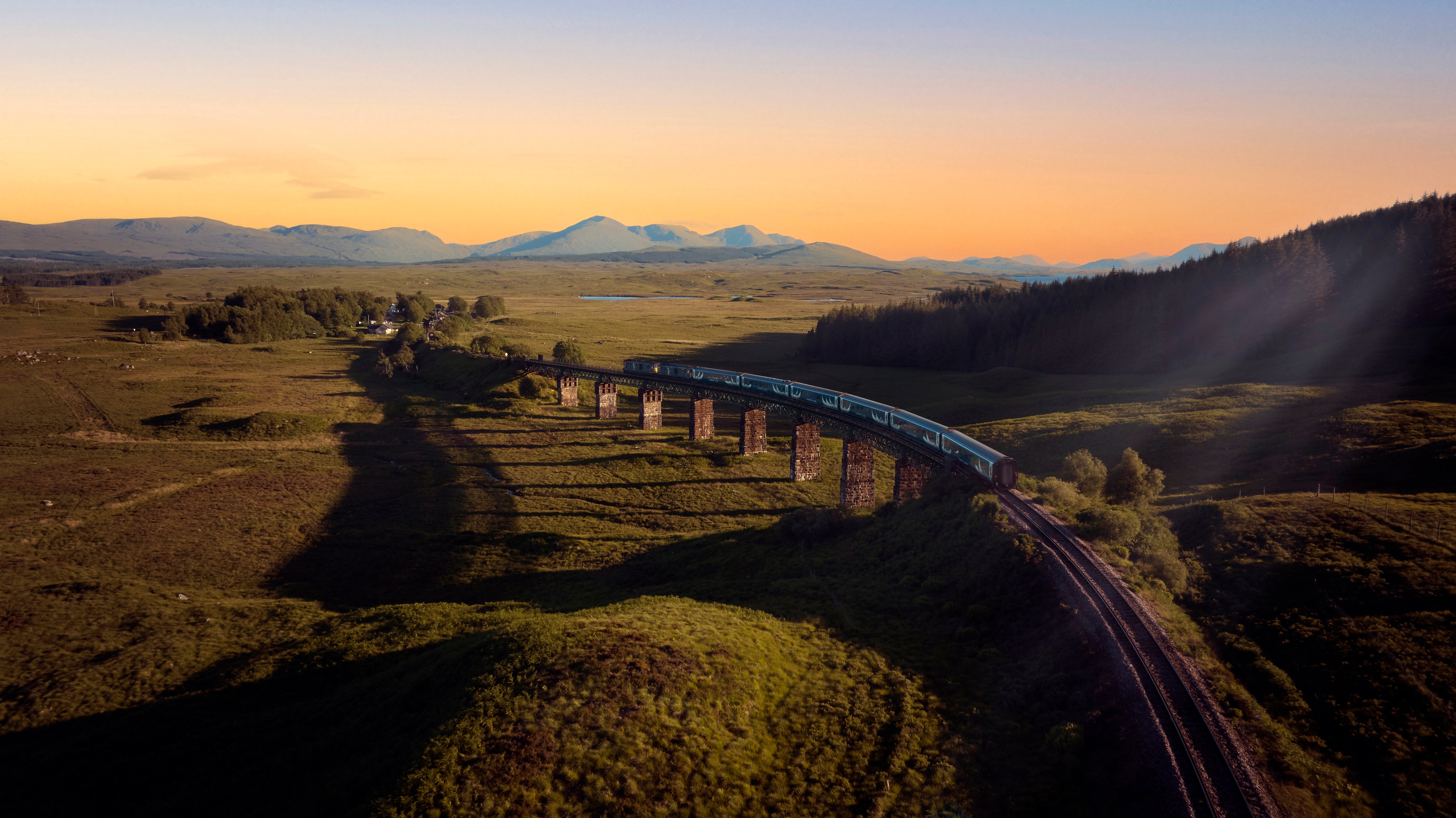
Despite the terminal’s gloomy, brutalist feel, my eight-year-old daughter and I are giddy with excitement at the prospect of spending the night on a hotel-on-wheels which will take us 418 miles north through the Lake District and the Highlands to the foot of Ben Nevis, Britain's loftiest peak, also known as the “Outdoor Capital of the UK”.
Later on after a platform check-in with one of the hosts for the Fort William portion of the train it will split in three in Edinburgh, with one section going to Aberdeen and another to Inverness.
My daughter and I investigate our Classic Room, more luxurious than the seat-only option but the lowest ranking sleeper compartment, below the Club En-suite and Double En-suite. These have showers and loos, though there are shared toilets at each end of the carriage.


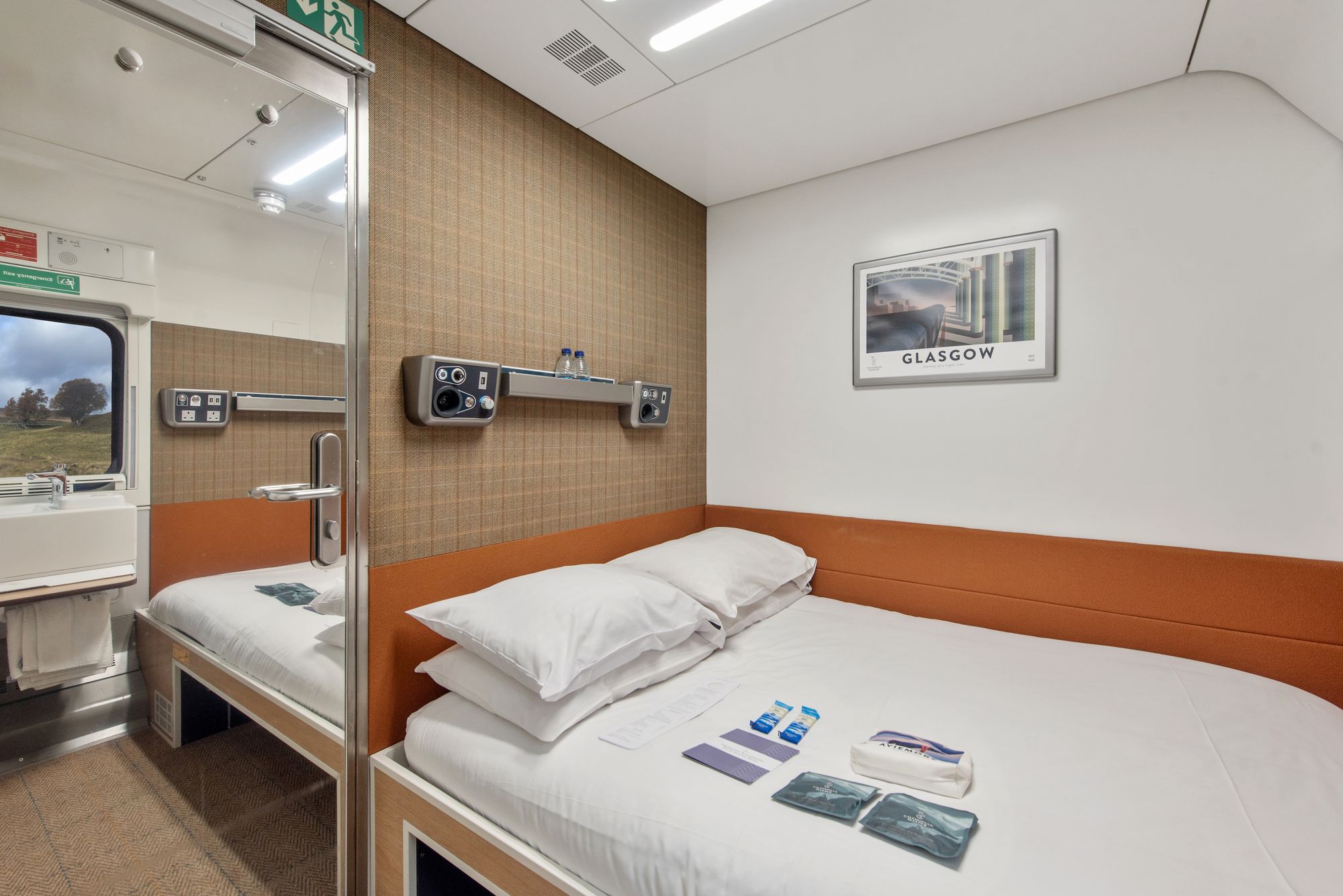
Our spotless set-up comprises a bunk bed, a mirrored door that makes the room seem bigger, a sink with a mirror above it, a bar of posh lime, rosewood and sandalwood soap, and two coat hangers. At one end of the lower bunk is a temperature control dial, a dimmer dial for the main light, a reading light, and a USB port. Opposite is a panel with two plug sockets, two USB ports, a host call button and a button that illuminates a light that runs around the window.
There are also nifty holders for phones, purses or wallets at either end. The person on the top bunk gets just one of these holders, plus a charging port, and two light switches, one for the main light and one spotlight.
There are extras, too — sleep kits containing an eye mask and earplugs, and complimentary bottles of spring water. I also notice that the lower bunk cleverly doubles as a sofa thanks to a wall-mounted cushion.
Read more: New sleeper train set to launch between popular European cities in 2026
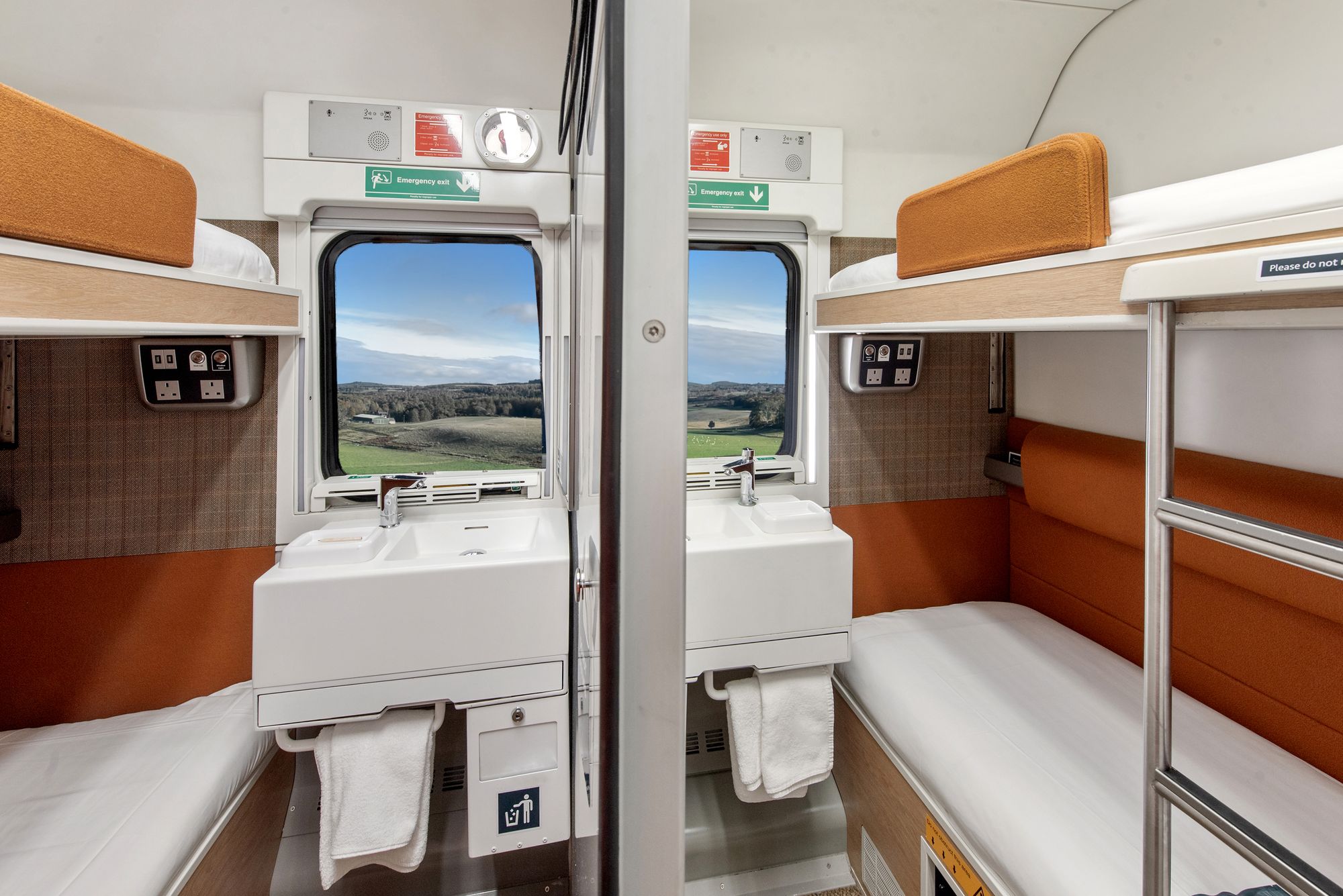
Design-wise functionality triumphs over fanciness — the ambience is slightly sterile, though panels upholstered with Harris Tweed lend a touch of warmth, and a nod to the destination.
Read more: The best spa hotels in Glasgow for rest, relaxation and pampering
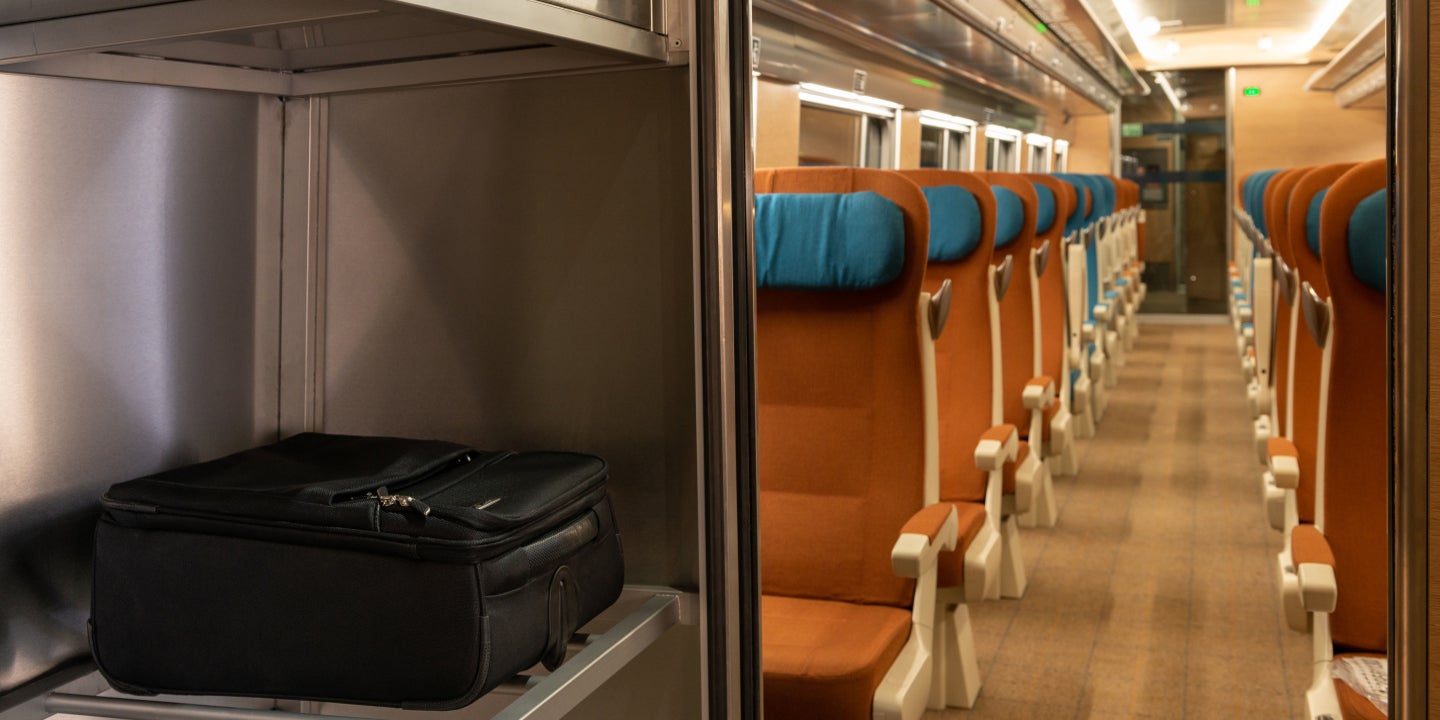
Size-wise, it’s a squeeze — there’s only room for one person to change at a time, and the space underneath the lower bunk is only large enough for small or medium bags. I had brought one bulky rucksack that spends the journey propped against the sink. Consider packing light.
.jpeg)
After playing with the light switches and wrestling bags under the bed, we address our hunger pangs. There is an onboard restaurant — the Club Car — but the Caledonian Sleeper runs a dining class system: places are guaranteed only for guests in en-suite rooms. If your sleeping compartment doesn’t have a toilet you have ‘space-available’ status, forced to plead for a spot despite paying hundreds for a ticket.
Read more: The Fife Arms, Scotland hotel review
Fortunately, the tempting dinner menu is available via room service. Mains include venison stew (£14), lentil ragu (£12), haggis with whisky sauce (£14), and Lammermuir smoked cheddar mac ‘n’ cheese (£14). Dessert choices are lemon curd tart (£10), black currant mousse cake (£10) or a Scottish cheese plate (£14).
We plump for the mac 'n’ cheese — delicious, with a rich and earthy cheddar coating, and delivered promptly. Afterwards, sleep comes easily.
The beds are extremely comfortable, with supportive mattresses and good quality bedding, and the cabin feels snug and cosy once you’re tucked in.
Read more: A booming wild sauna culture is transforming how people explore the Scottish outdoors
I wake up in Edinburgh as the train-splitting ballet is being performed — there’s a bit of thudding and bumping as a diesel locomotive takes over from the electric one that hauled the train from Euston — but other than that, I bank a solid night’s sleep. So does my daughter, but that's no indicator of cabin comfort as she'd sleep soundly strapped to the outside of the carriage.
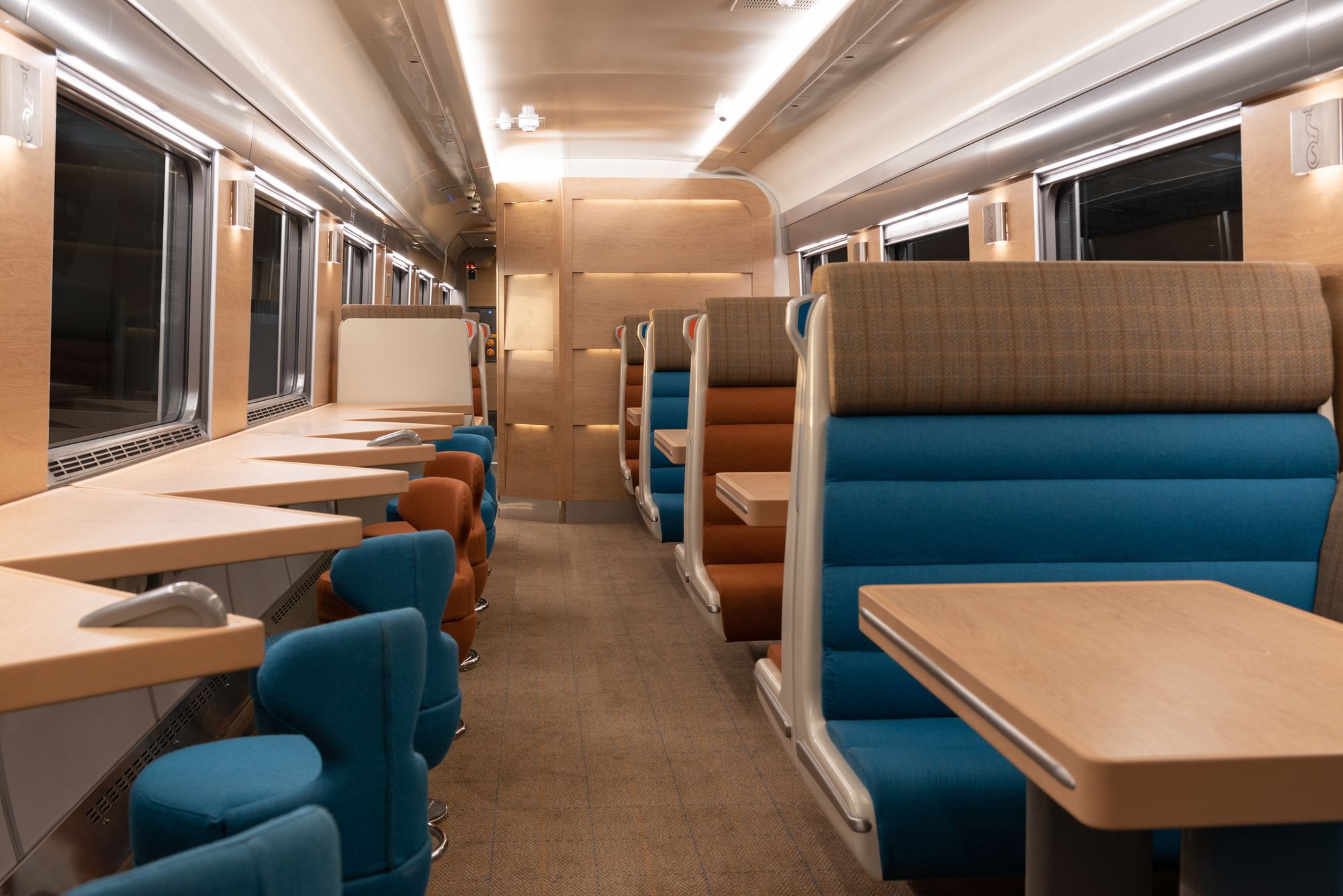
For breakfast (pre-ordered via a tick-box menu hung on the door) we manage to snag a couple of seats in the sacred Club Car. The experience is divine. Amid more Harris Tweed fabric and seated in booths and on stools, diners enjoy glorious views. The scenery is so magical I daren’t look down at my fruit, yoghurt and pancake (£10) for fear of missing even a single yard of it.
The show begins in earnest after the train leaves Glasgow Queen Street station and heads into valleys carved by Ice Age glaciers, across remote moors dotted with lochs and past imposing ancient volcanoes.
At around 7am, the train skirts the magnificent Loch Lomond, with the 3,000-foot-plus peaks (called Munros in Scotland) of the Loch Lomond and the Trossachs National Park forming a guard of honour.


Read more: 9 best hotels in Perth for escapes to the historic Scottish city
Just north of the park’s border, breakfast is forgotten as I’m transfixed by the line curving around the glen beneath pyramidal Beinn Dorain (3,524ft) and crossing the Allt Kinglass Viaduct. Since Loch Lomond, the line has been running parallel to the A82, but after a stop at the Bridge of Orchy, with Beinn Dorain behind us, the line heads away from the road network and into the primordial peat-bog wilderness of Rannoch Moor.
Expansive, jaw-dropping views are readily available from both sides of the carriage, but look to the left (westward) and you’ll spy Buachaille Etive Mòr (3,352ft) and Bidean nam Bian (3,773ft), remnants of the collapsed Glencoe supervolcano that erupted 420 million years ago.
Midway across the moor, the train makes a stop at Corrour, famed for being Britain’s highest railway station — it's 1,347 feet above sea level, and has no public road access — and a pilgrimage destination for Trainspotting fans. It was here that Ewan McGregor's character, Mark Renton, famously said that it's “s**** being Scottish”.
There are wildlife delights, too. We spot dozens of roaming stags, which share this treasured landscape with red squirrels, Highland cattle, golden eagles, peregrine falcons and ospreys.
Read more: I stayed in this Traitors-esque Scottish hotel – here’s why you should too
As the train nears Fort William, it runs alongside otherworldly Loch Treig, which sits beneath a pair of mighty mountains, Stob Coire Easain (3,658ft) and Stob a’ Choire Mheadhoin (3,625ft).
Just before the train pulls into (dull-as-dishwater) Fort William station, Ben Nevis (4,413ft) — the remnant of a vast 350-million-year-old volcano — forms one last scenic hurrah. It’s often cloud-capped (and like us, you may be too busy desperately sorting out your belongings to look out of the window), but you can see it from the left-hand side as the line curves into town.
.jpeg)
While the journey begins and ends at two of Britain's least remarkable stations, and while the service is so-so — even one of the more expensive rooms with a toilet, I notice, doesn't guarantee a warm welcome — the journey is still a shoo-in for any self-respecting train trip bucket list.
Ted paid £325 for a one-way Classic Room, while advance prices start from around £195. Seat-only fares start from around £84 one-way. Find out more on the Caledonian Sleeper website.
Read more: The best Isle of Skye hotels for outstanding Hebridean views and coastal walks
Join our commenting forum
Join thought-provoking conversations, follow other Independent readers and see their replies
Comments
Bookmark popover
Removed from bookmarks