Where’s the best place to go for an autumn Mediterranean getaway?
Simon Calder answers your questions on going solo in the Med, a European city that’s good for long walks, and what to do on a city break in Palma de Mallorca


Q I am turning 50 in late October and would like to take myself off for a solo trip somewhere lovely in the Mediterranean for a week or so, flying from Manchester. Where do you recommend?
Elizabeth C
A Late October in the Mediterranean is a joy – but logistically complicated, because of two factors. The first is the late autumn half-term. For most English schools it begins on Saturday 24 October; the easyJet flight that day from Manchester to Malaga is currently priced at £494, one way. If you can delay your outbound journey by a few days, the half-term effect will disappear. By the Wednesday of that week, the fare falls to just £34. (Yes, a 93 per cent reduction.)
But I am not seeing particularly good value on Spain’s Costa del Sol. So I suggest Greece. However, you will quickly run into the other complexity: the aviation summer season ends in late October, and many airlines will be winding up their holiday routes. From Rhodes to Manchester, for example, the last easyJet flight of the year is on 3 November and is selling for £260 one way.
My recommendation is to book an easyJet flight from Manchester to Athens: currently £144 return, with good timings out on 28 October and back on 4 November. You may wish to spend a day or two in the Greek capital – largely tourist-free at that time of the year. Then take the 75-minute hydrofoil from Piraeus, the port for Athens, to the lovely island of Poros. You will find all the usual joys of a Greek island: a colourful and relaxed waterfront with too many tavernas to count; a maze of steps and alleys clambering up through whitewashed cottages to a church perched on a hill; and some excellent beaches.
There are plenty of family-run places to stay: I chose the Christine Studios on my last visit, a hop and a skip from Askeli beach and a 20-minute walk from the main town. The flight timings on the return leg mean you can take a civilised morning ferry across to Piraeus, then either the direct bus or train to the airport for your 1.35pm flight home.

Q I went to Berlin for a short break last autumn with my son-in-law and we had an excellent time (apart from missing out on the Reichstag, which was unexpectedly closed even though we had a booking). Which city should we choose for a rematch next autumn, ideally flying from our local airport, Luton? I should point out that he is a postman and therefore likes a long walk.
Terry B
A Berlin has a distinctive essence. The German capital has world-class cultural attractions (though the wonderful Pergamon Museum is currently closed for renovation). More appealingly for many visitors, its recent history – in particular the Cold War legacy of a divided city – provides a unique and intriguing dimension. Those who enjoy a long walk can follow some excellent urban trails: decaying landmarks, strange communist-era architecture, and some superb 21st-century buildings. And as a capital with 4 million inhabitants, Berlin has a fabulous repertoire of places to eat, drink and stay.
Nowhere can match the German capital’s portfolio, but other middle-European cities share some of the metropolitan DNA. Conveniently, the Wizz Air network from Luton means they are all reasonably accessible. Budapest, Prague and Warsaw are good candidates, but my top choice is not a capital. It’s Gdansk, the fascinating Polish port city.
The opening shots of the Second World War were fired here, and a museum about the conflict occupies a spectacular modern structure to the northeast of the city centre. On the site of the Lenin shipyard – where the Solidarity movement began the liberation struggle in 1980 – is the European Solidarity Centre. In my view, it is one of the greatest modern cultural sites in eastern Europe, telling the story of how humanity prevailed over brute force.
Your son-in-law can walk for hours along medieval streets and quays while you soak up the atmosphere in a cafe or bar, availing of comfortably low prices.
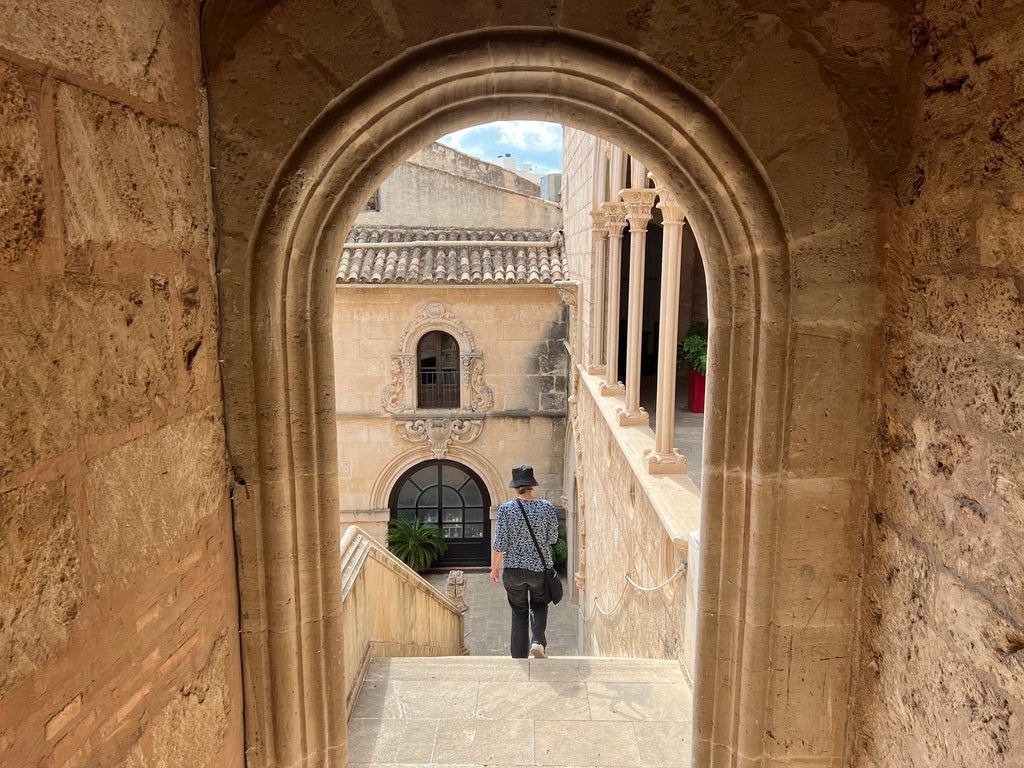
Q My wife and I have booked our first trip to Palma de Mallorca next month. It’s a three-day city break. What do you recommend?
John R
A February is ideal for your first experience of the capital of the largest Balearic island.
Palma is full of cafes, shops and culture. On day one, explore the centre. The main point of reference is the towering Gothic cathedral, and this is a good place to begin your exploration. The interior is notable for the slender columns that support one of the biggest Gothic structures in Europe, and for its vast stained-glass rose windows.
Then thread your way through the lanes of the old Moorish quarter, calling in at the 10th-century Banys Arabs (Arab Baths), and meander through the relatively quiet eastern half of the city to to Placa Major, the handsome main square.
To the northwest, La Rambla is a lively boulevard. From the far end, head south towards the sea. You will find yourself in the Placa de la Drassana, just next to the superb old Llotja, an old guild house that has been transformed into an art space. Book a table at the Marina Bay – a few minutes’ walk away on the quayside, and an excellent place to watch the sun go down shortly after 6pm in February. The high point for Mallorquin cuisine is the tasting menu at Marc Fosh, tucked away in the 17th-century Hotel Convent de la Missio.
On day two, make the most of culture – especially modern art. The 16th and 21st centuries converge at Es Baluard Museu d’Art Contemporani de Palma. The Spanish surrealist Juan Miro spent the latter part of his life in Mallorca, and the dramatic Miro Foundation clings to a hillside in the suburb of Cala Major, 5km southwest of the city centre. Between the two, I rather like the quirky Poble Espanyol – built in the 1960s as a compendium of Spanish architecture.
For your final day, take advantage of the excellent (and ridiculously cheap) bus network to explore more of the island. You can tap in and tap out; take bus 203 to two lovely inland towns, Valldemossa and then Deia. Take a third short hop to Soller, and you can catch the train back over the mountains: a splendid way to end your stay.
Email your question to s@hols.tv or tweet @SimonCalder
Join our commenting forum
Join thought-provoking conversations, follow other Independent readers and see their replies
Comments
Bookmark popover
Removed from bookmarks