Why Berlin is still Europe’s chaotic capital of liberty
As a new annual citywide festival begins in November celebrating the city’s liberal character, James March explores how Berlin’s complicated past informs its unbridled present
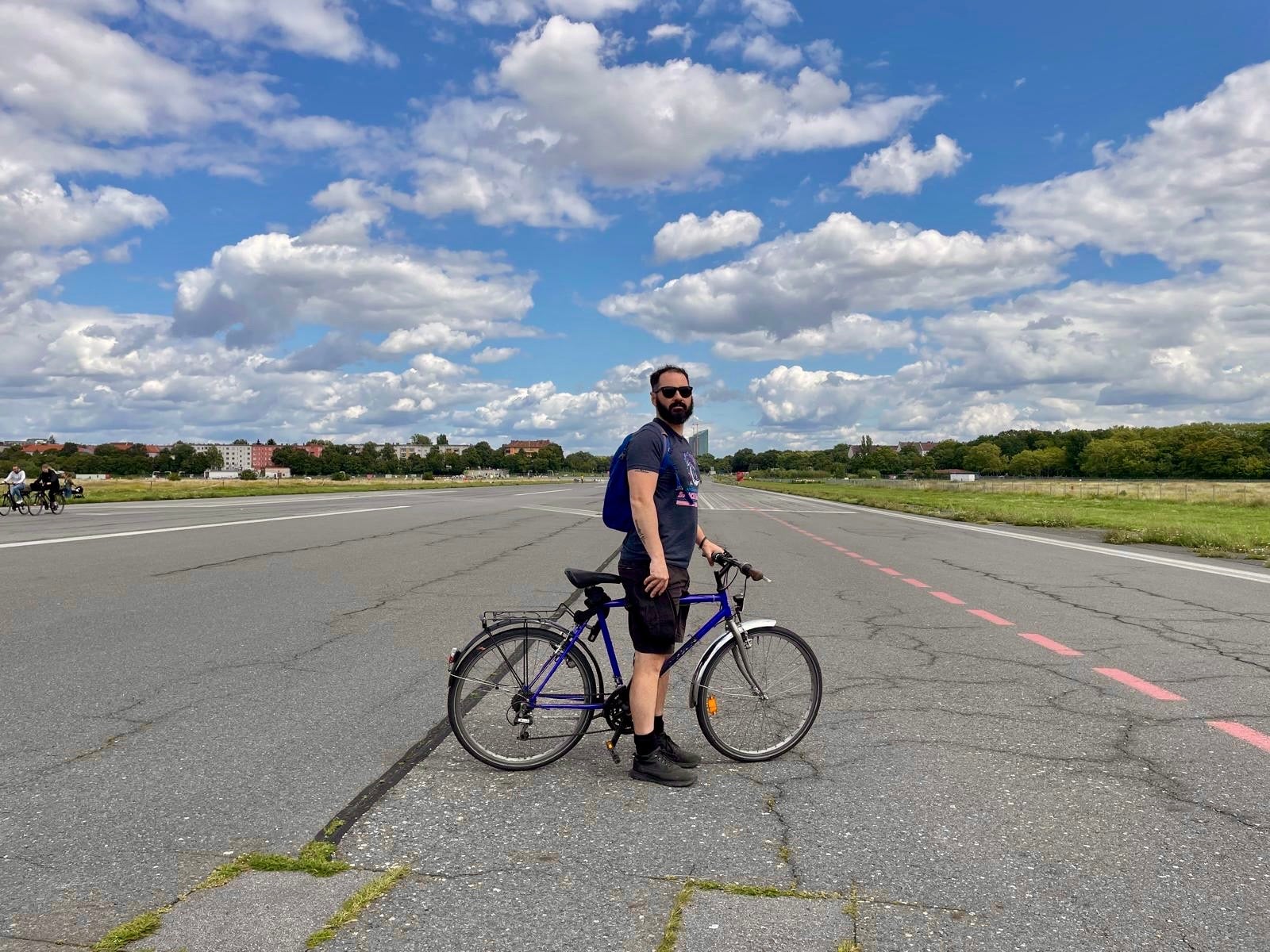
Trundling along Tempelhofer Airfield’s cartoonishly massive runway on my wobbly rented bicycle during a balmy August morning, I find it hard to visualise the remarkable events that took place here from 26 June 1948 to 30 September 1949. Trapped by a road blockade through East Germany, American and British air forces flew in and out of West Berlin over 250,000 times to supply necessities like fuel and food.
But the howl of the Douglas C-54’s engines subsided a long time ago and in 2010 Berlin repurposed Tempelhofer into a genteel urban savannah of fluttering kites, rolling bikes and greenfingered allotments. Watching this languid and liberal scene unfold on such a scarred canvas is strange, but it’s quintessentially Berlin and just another reason why I find the place so intriguing.
Home to both ministers and misfits, bureaucrats and bohemians, the German capital is a rather chaotic but always compelling corner of Europe, and it’s somewhere I’ve constantly returned for almost 20 years. And from 8-15 November, Berlin will host the first-ever Berlin Freedom Week, with every district of the city pulsing with dialogue, music, art and movement – all focused on one theme: freedom. Some 36 years after the fall of the Berlin Wall, the diverse programme of exhibitions, workshops, guided tours, concerts and film screenings will become an annual event, though I never need to look far here for examples of the city’s laissez-faire character.
It’s well-trodden ground, but it’s worth noting that modern Berlin isn’t really like the rest of Germany. The fragmented sections of the Wall form arguably Europe’s most macabre outdoor museum, while neighbourhoods like Neukölln and Kreuzberg are a graffiti-splashed bouillabaisse of breezy cafes, low-lit bars, enticing kebab joints and small urban parks. Yes, the city has the conventional attractions that will always draw in visitors, including the elegant Brandenburg Gate, the glassy dome of the Reichstag and the big hitters of Museum Island (celebrating its 200th anniversary this year) like Egyptian Queen Nefertiti’s bust at the Neues Museum or Caspar David Friedrich's ethereal landscape scenes at the Alte Nationalgalerie.
Read more: Techno, punk and opera – a weekend exploring Berlin’s music scene
But it’s Berlin’s wild 20th century that I find most fascinating. The colourful East Side Gallery is still the city’s most visceral symbol of liberty, turning the hateful wall into the world’s largest permanent open-air art gallery in 1990, with its murals a mix of thunderous political satire and surreal psychedelia. I’d walked this almost mile-long stretch several times before, so I chose to visit the Berlin Wall Memorial on Bernauer Straße instead.
More sombre than the East Side Gallery, it houses foundations of the former watchtowers, and the lush grass where the “dead zone” (todesstreifen) once ran is pretty and poignant. There are also memorials and stories of the 136 who died while trying to escape to the bright lights of West Berlin, like that of Ernst Mundt who wanted to see his mother in the West and was shot in the head while crossing the Sophien parish cemetery on Bernauer Straße on 4 September 1962.
Berlin’s liberal sensibilities were prevalent, however, long before the twin forces of Nazism and Communism choked the city for almost 60 years.
“I truly believe that the world would feel very different about queerness, gender and especially around trans and non-binary people if the Nazis hadn’t destroyed everything,” says Jeff Mannes, who’s guiding me around the LGBT-friendly district of Schöneberg, where Berlin’s non-conformist outlook was thriving 100 years ago.
Read more: As an LGBT+ person, visiting the same places isn’t boring – it’s vital
“Because it was all here in the 1920s. A lot of people think that non-binary is so new and such a trend, but it was all here already. They just had different words for it.”
Mannes moved to Berlin from Luxembourg 10 years ago, and our stroll from the rainbow benches of Nollendorfplatz through Schöneberg’s leafy streets and imposing townhouses is an eye-opening window into Berlin’s long tradition of carefree live-and-let-live attitudes. Just north is Karl Heinrich Ulrichs Straße, a street once named after Imperial German army commander Karl von Einem and now renamed in honour of Ulrichs, arguably the father of the modern queer liberation movement. We soon pass where the Institute for Sexual Science once stood, opened in 1919 by Magnus Hirschfeld and which facilitated the world's first modern gender-affirming surgeries for transgender people during the 1920s.
A rather ordinary-looking organic supermarket was where the Eldorado stood, a gregarious cabaret and nightclub that once hosted early forms of what we’d today call drag shows and was the inspiration for novelist Christopher Isherwood’s Cabaret.
Mannes’ tour touches on Berlin’s underground club culture too, where the Chez Romy Haag club was a pioneer in 1970s West Berlin and its raucous parties attracted the likes of Grace Jones, Freddie Mercury, Mick Jagger and, most famously, local resident David Bowie.
.jpeg)
Read more: The Cape Cod town that’s a beacon for progress
“After the first night, it became so successful and people queued there like people queue today for clubs like Berghain,” says Mannes. “It was absolutely a nightclub revolution and was the beginning of Berlin’s modern club culture.”
Berghain is the iconic techno club that’s open all weekend, though to enter you’ll need to get past some ultra-scrupulous bouncers (Elon Musk famously had issues trying to enter). Beyond its diverse population, nightclubs like about.blank, Golden Gate and Kater might be the ultimate expression of the city’s freewheeling character.
“What’s nice is that what a lot of Berliners do is that you wake up on a Sunday morning, have breakfast and then you go clubbing,” says Mannes. “I went to New York for the first time and I thought it was so much worse, as it supposedly ‘never sleeps’. Then I was there and everything was closed at three in the morning!”
My mornings in Berlin are a little more timid, sadly. I take a quick spin through the new Deutschlandmuseum at Potsdamer Platz, which tells the story of Germany in a creative and immersive fashion (including a room on the Enlightenment which gradually gets lighter), before taking the S-Bahn over to Urban Spree in Friedrichshain. It’s an industrial artistic space for exhibitions, books, prints and tattoos, with a beer garden and currywurst stand. I remember walking past this place on a visit 10 years ago one Sunday lunchtime, and hearing thumping beats while a crowd of young people in sunglasses slowly swayed and nodded to the music.
I was confused, thinking it was a one-off. But no. This was pure, distilled Berlin.
“Sometimes you’ll see open-air raves in the middle of the city in a park,” says Mannes, smiling when I tell him about my naive encounter. “And I love that about Berlin. It makes the city.”
Berlin Freedom Week runs from November 8 to 15.
James was travelling as a guest of Visit Berlin.
How to get there
Airlines including British Airways, easyJet and Ryanair offer direct flights to Berlin from London. Birmingham, Manchester, Liverpool, Edinburgh and Glasgow also fly direct. The average flight time is around two hours.
It’s possible to travel by train from London to Berlin, but it involves several connections and a full day’s travel.
Where to stay
INNSiDE by Meliá Berlin Mitte situated near Berlin Central Station (Berlin Hauptbanhof), is ideally located to explore the city. Prices from €130 (£113) per night.
Read more: 15 emerging LGBT+ travel hotspots to visit in 2026
Join our commenting forum
Join thought-provoking conversations, follow other Independent readers and see their replies
Comments
Bookmark popover
Removed from bookmarks