The Independent's journalism is supported by our readers. When you purchase through links on our site, we may earn commission. Why trust us?
I spent a week with Sony’s new WF-1000XM6 wireless earbuds, and nothing else sounds this good
I’ve had Sony’s latest flagship wireless earbuds plugged into my lugholes for the past week
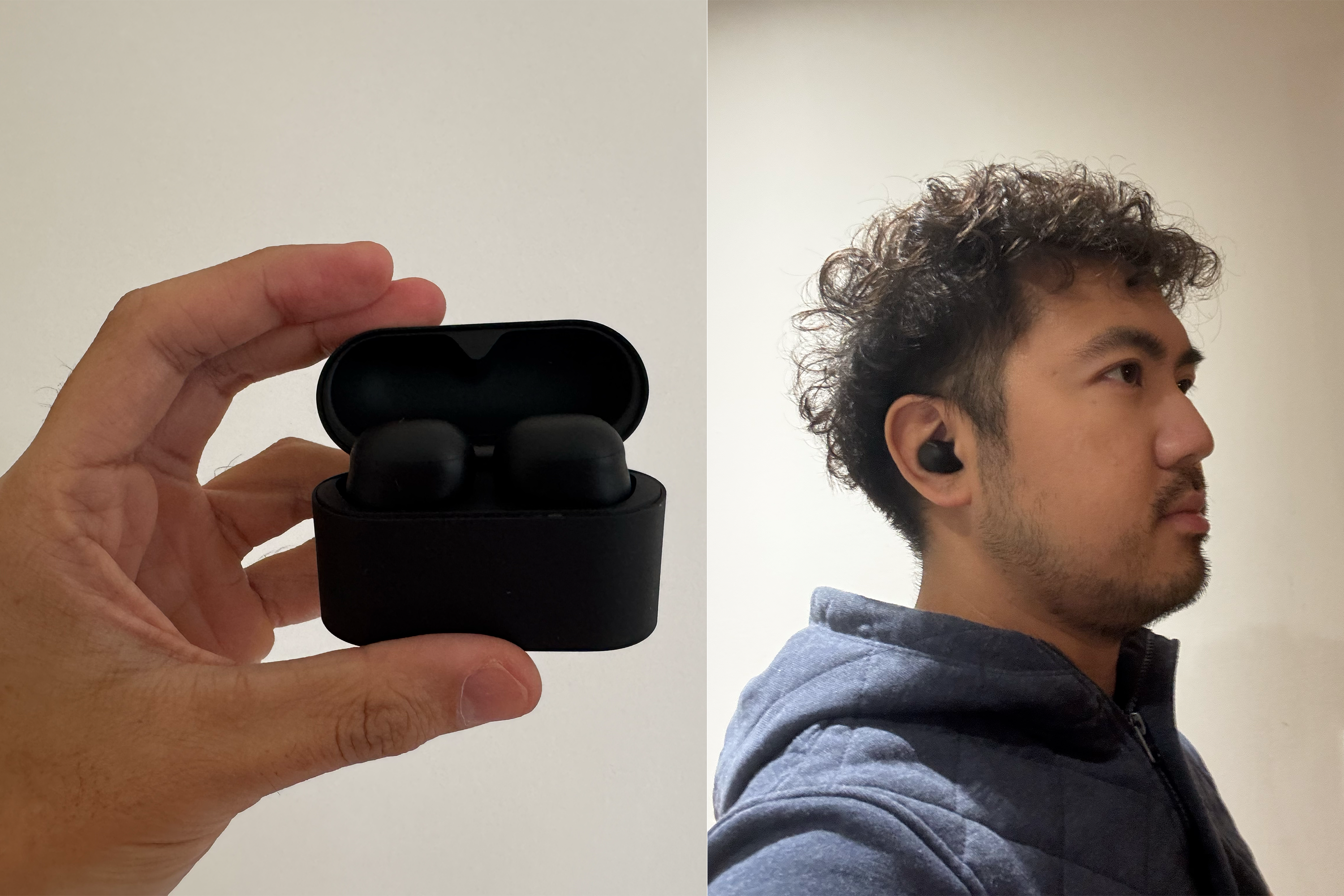
After a three-year wait, Sony’s next flagship wireless earbuds have finally arrived, and they have some big boots to fill. Launching today, the Sony WF-1000XM6 have the difficult challenge of following in the footsteps of the already excellent WF-1000XM5 (£199, Amazon.co.uk), which were some of the best wireless earbuds I’ve tested when it comes to noise-cancellation and sound quality.
While the WF-1000XM5s were brilliant, competitors have since matched, and in some cases, superseded them. Bose’s QuietComfort Ultra 2 (£399.95, Amazon.co.uk) deliver uncanny levels of silence that better the XM5s, for instance, and some earbuds have better fit and comfort.
The all-new Sony WF-1000XM6 have introduced some significant improvements that could help it win back the crown, from a slimmer design and a new QN3e processor for stronger noise cancellation to better sound, could these be the best wireless earbuds yet?
Over the past week, I’ve had the WF-1000XM6 glued to my lugholes. I’ve put them through their paces on busy train platforms, on calls and during long listening sessions, with podcasts, music, audiobooks and films. Costing the same as the previous model, can they live up to the hype?
Read more: We’ve reviewed the best wireless earbuds
How I tested

I’ve been using the Sony WF-1000XM6 for the past week as my everyday earbuds, including on the train, working from home, on long walks and at the gym. I deliberately wore them in noisy environments, including packed tube carriages, cafes and traffic-heavy streets to see how well the upgraded adaptive noise cancellation coped.
I’ve also tested call quality in both quiet rooms and windy outdoor settings to see if the microphones and AI voice isolation make a difference, as well as spent hours listening to a range of music genres, podcasts and audiobooks on Spotify, Apple Music and Tidal, playing around with the various features and new 10-band EQ in the Sony Sound Connect app.
While I haven’t yet drained them from zero to 100 per cent repeatedly to fully verify long-term battery performance, I’ve looked at their comfort and how secure they feel in the ear, especially during movement. After a week of use, here’s what I think.
Sony WF-1000XM6
- Type Wireless earbuds
- IP rating IPX4 (sweat/water resistance)
- Codecs supported SBC, AAC, LDAC
- Connectivity Bluetooth 5.3, Bluetooth LE Audio, multipoint
- Battery life, earbuds 8 hours with ANC on
- Battery life, charging case 24 hours
- Why we love it
- Fantastic active noise cancellation
- Bass response has been improved
- Much more comfortable design
- Take note
- Call clarity still needs work
- Adaptive sound control needs work
Sony WF-1000XM6 design and comfort
The jump from the XM4 to the XM5 was absolutely enormous. It was a massive redesign, with Sony making both the earbuds and the case much more compact. But for the WF-1000XM6, it looks like Sony’s gone back the other way. Everything feels a lot bigger again, but maybe not to its detriment.
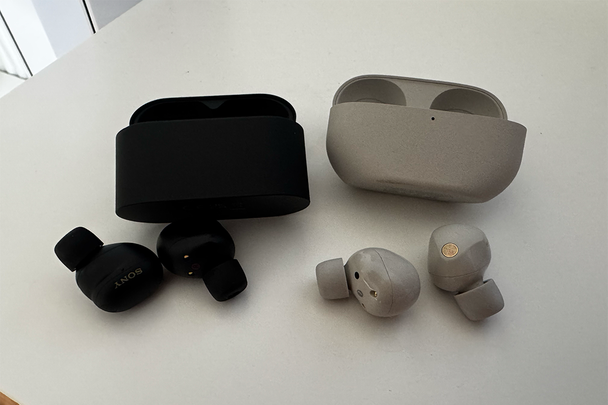
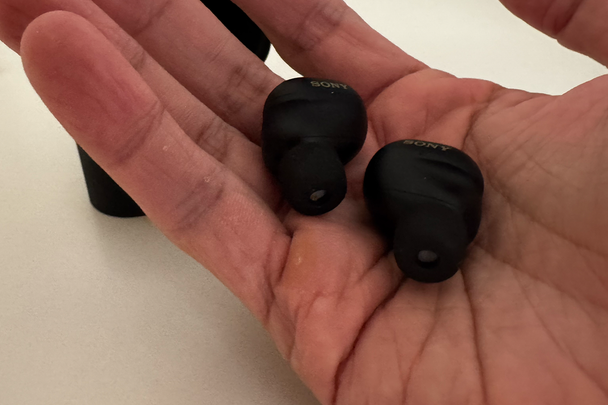
The XM5 were around 25 per cent smaller than the XM4, but they still had a slightly bulbous feel in the ear. That rounded construction often made them feel like they were sitting on the ear rather than nestled inside it. If you eyeball the XM6, they look bigger than the previous model. In surface area, I think they are, but Sony says they’re actually 11 per cent slimmer than the XM5. Does that make a difference? Surprisingly yes.
They’re slightly more bean-shaped, rather than ball-shaped, and look like they should feel fuller in the ear, but they actually don’t. While the XM5s became slightly tiring to wear after some time, the narrow and slightly more protruding shape of the XM6s help comfort enormously.
That seems to be because they have a more contoured design, following the natural curvature of the inner ear more closely. The seal just feels tighter, but without the ear strain I sometimes got with the XM5. It feels bizarre given the more elongated shape, but the fit really has improved.
Sony’s also stuck with polyurethane foam tips. Once you get the seal right, you can forget you’re wearing them. I’ve literally worn them for hours upon hours without any pressurised feeling, and the new ventilation structure that Sony’s engineered into the buds does seem to reduce that slightly blocked, occluded sensation you sometimes get when chewing or walking. You get three ear tip sizes in the box – small, large and extra-large.
They also stay put better. One of my small frustrations with the XM5 was that they sometimes shifted in place when walking, or when readjusting them. The XM6 feel way more stable. I’ve barely needed to readjust them at all – they just stay planted in place without wobbling.
And if you ever felt your XM5s slipping out of your hands when you went to pluck them out of your ears or the charging case, you’ll find that less of a bother. Gone is the slick glossy surface. The XM6s have a more matte-like finish that’s easier to grip. It’s only small, but it does really help anyone with horrible butter fingers.
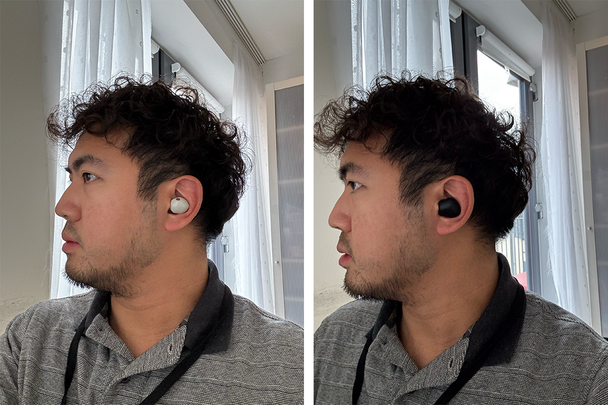
Like the XM5s, there’s a nice tactile dot on the left earbud to help those with reduced vision distinguish the left bud from the right. There are touch controls on the outer surface of each bud again too. They’re responsive and the tap surface is pretty large. You can customise what each side does in the Sony Sound Connect app. The volume control requires repeated taps, which can get a little fiddly. I do prefer how some brands have implemented a capacitive slider to control volume, rather than taps – it feels less like you’re knocking your ear several times, but it’s not dreadful.
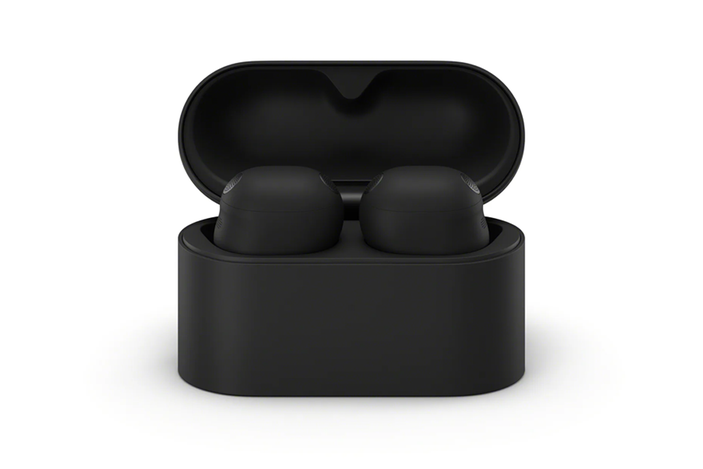
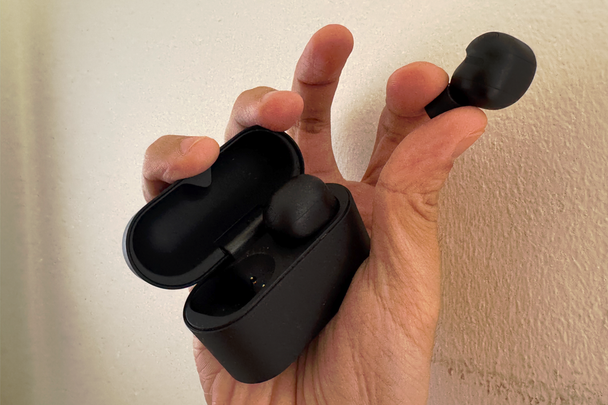
The only thing I haven’t quite got on board with is the redesign of the charging case. It’s slightly bulkier, a little heavier (though I don’t have exact specs yet) and I much prefer the XM5’s more compact case with its rounded corners, which felt modern and pebble-like. The XM6 case has gone back to a slightly chunkier shape. It’s taller, a bit beefier and has sharper edges. It’s still pocket-friendly, but side by side, the XM5 case looks so much nicer.
The magnetic hinge also doesn’t feel quite as firm as the XM5’s, though it’s not a major issue. I’ve both purposely (and accidentally) dropped the case, and the lid hasn’t flipped open with the buds tumbling out, something that has happened to me with the AirPods Pro, for instance. It’s sturdy enough, just not quite as satisfyingly secure as before.
Similar to the WF-1000XM5, you can get the WF-1000XM6 in either black or platinum silver colourways. I’ve been testing the black colourway and they look nice and minimalist.
Sony WF-1000XM6 features
Sony’s WF-1000XM6 feature set is largely familiar if you’ve used the XM5, but there are a few new features up their sleeve. You still get multipoint for pairing with two devices at once, LDAC for hi-res wireless audio on compatible Android phones, and DSEE Extreme to help upscale compressed streams. You also get things like speak-to-chat, which lowers your music when you start talking (thankfully still off by default), as well as quick attention mode, which turns on ambient mode when you cup your ear. If I’m honest, the app can feel slightly overwhelming at first because there are so many toggles and sliders to play with.
One of the biggest upgrades is the new 10-band EQ. The XM5’s five-band EQ did the job, but I think it’s always good to have a decent amount of customisation when it comes to tuning your sound. You can be way more precise now, and Sony’s included a bigger range of presets to start from too. If you can’t be bothered with sliders, I absolutely adore the Find Your Equaliser feature. It plays you short audio samples and you can pick which one you prefer, tuning your sound based on how you choose.
There’s also a new dedicated gaming preset designed to enhance directional cues like footsteps, which is useful if you play mobile shooters. Like the WH-1000XM6 headphones, you now get the background music mode, which pushes the sound away from you, mimicking soft music in a café so it feels like it’s coming from outside your head. It’s a bit gimmicky, but I admit, I still love it to this day.
Sony has also increased the antenna size by roughly 1.5 times compared to the XM5, which Sony says should mean a more stable connection. I haven’t faced any cutouts while travelling through the underground or at the local shopping centre, but I’ve yet to try them at a football stadium, which is the biggest test of endurance.
The WF-1000XM6 earbuds are also more future-proofed than their predecessor. They support Bluetooth LE Audio, the newer, lower-energy version of Bluetooth, which is designed to improve efficiency and stability while using less power. Essentially, it’ll have better sound at lower bitrates.
They do miss out on a few tricks, however. The all-new AirPods Pro 3 (£204, Amazon.co.uk) have an in-built heart rate sensor, so you can track workouts. It’s probably the only thing the XM6 are missing. There are still way more features on these than the AirPods Pro.
Sony WF-1000XM6 noise cancellation and call quality
Sony’s noise cancelling has always been some of the best in the business, but over the past couple of years, the biscuit’s been taken by the Bose QuietComfort Ultra 2, which really delivered that eerie, vacuum-like silence. The noise cancellation on the WF-1000XM6, however, has improved significantly.
In the promo video, you see a man tap his XM6s in a bustling, traffic-ridden city, and the sound just melts away. And that’s literally how I feel when I turn on active noise cancellation with the XM6. External sound washes away. High-frequency clatter like sirens, chatter and screeching train tracks fade away far more than they did on the XM5, which makes sense given Sony says it’s improved performance in the mid-to-high frequency range this time around.
Sony’s always been successful with lower-frequency sounds, and the company still shows off its prowess here. The traffic and the Underground feels almost invisible. There’s more of a vacuum-seal sensation now, closer to the Bose QuietComfort Ultra 2, though not quite as aggressively pressurised.
A lot of that improvement comes down to the hefty upgrades on the inside. There’s a new QN3e HD noise cancelling processor on the inside, which pairs with the V2 integrated processor, and the buds now use eight microphones instead of six – two internally and two externally on each side. Sony says it means it can react more quickly to environmental changes in sound, adding that noise reduction is 25 per cent better than the XM5.
The adaptive NC optimiser has also been updated. It now analyses your wearing conditions and external noise in real time, adjusting for changes in your surroundings, as well as the seal. This worked brilliantly – I didn’t notice when the strength of the ANC ratcheted up when I was in quieter or noisier environments. Loud sounds just continued to be minimised.
But while I’ve been impressed by Sony’s ANC, I’m really, really impressed with Sony’s ambient sound. It’s exceptional. I’ve long considered Apple’s AirPods Pro the benchmark for its transparency, but the Sony WF-1000XM6 are ecen better.
There is absolutely zero background hiss from the microphones, and it really feels like you’re not wearing earbuds at all. Voices sound lifelike and clear. I could have full conversations without feeling like everyone’s voices were being re-processed through a microphone. One little feature I really liked in the Sound Connect app was the ability to keep horrible external sounds to a minimum and voices in-tact. A nice halfway house of the best bits of ambient mode and ANC.
I’m still not a huge fan of adaptive sound control being on by default. I probably use ambient mode more than I do ANC in general life, and what was really clunky was that it would switch to ANC automatically, even if I was just sitting at home with the TV on, or walking through a quiet street. Was it too aggressive? I’m not sure, but I turned it off quite quickly. I think I much prefer controlling my ANC and ambient modes manually, rather than having it dictated to me.
Sadly for me, call quality is where things start to fall apart. Sony says it’s improved voice pickup with the new mic array, AI processing and a new bone conduction sensor, but in my experience, this is the weakest part of the XM6. I was constantly told by friends and family that I sounded muffled or like I was in a bubble. I recorded a few calls and heard exactly what they meant – I didn’t sound clear, like I was underwater.
They also behaved a little strangely with background noise. When I was washing up, for example, the sound of running water became audible to the person on the other end while I was speaking, but all sound disappeared when I stopped talking. The same happens when I have the TV on in the background. It feels a bit like the system is dynamically opening up the microphones to prioritise my voice, but in doing so is letting surrounding noise flood in. It’s strange – call clarity on rivals like the AirPods Pro 3 are crystal clear. I would say that the wind reduction structure works very well, however. In the typical British winter, my voice could still be heard when gusts blew.
Sony WF-1000XM6 sound
While the Sony WF-1000XM5 sounded clean and detailed, they weren’t exactly, well, fun. Unless you adjusted the EQ, the bass was a little lacking. Sony seems to have worked hard on that for the WF-1000XM6, and it shows almost immediately.
There’s an updated 8.4mm dynamic driver. Sony says the internal structure has been refined and paired with its new QN3e processor, which now handles 32-bit audio processing compared with 24-bit on the previous model. Sony’s also worked on sound tuning, saying the XM6 have been fine-tuned in collaboration with Grammy-winning and Grammy-nominated mastering engineers. It’s a noticeable improvement in terms of separation, clarity, musicality and bass.
The improvement in bass can be seen on pop tracks like Olivia Rodrigo’s “Bad Idea Right?”, which maintains its control. It’s even more prominent on tracks like “The Hills” by The Weekend, where the sub-bass really bounces and you can feel the reverb. Beneath the mix, the low-end swells without it swallowing the vocals. It’s heavier and sounds fantastic.
The mid-range is just as good. On “I Can’t Believe I Did This Without You” by jasmine.4.t, the vocals feel textured, and almost fragile in places. There’s a bit more warmth, and there’s some nice separation with the guitars. It all feels more musical, especially when listening to airier tracks from artists like Lowell.
While they’re excellent for music, they’re also exceedingly good when it comes to podcasts and audiobooks. Narrators and podcast hosts come across crystal clear and natural. The same for dialogue in films and TV shows. When you pair that with 360 reality audio on supported content, there’s a nice sense of width and height.
If you’re coming from the XM5, you’ll feel a sense of refinement. There’s been work on the low-end to make the XM6 sound more fun and lively, and they’re just more interesting to listen to, whatever the genre, and instrumental separation is excellent. Plus, you can always tune them the way you like with the updated 10-band EQ.
Battery life is unchanged from the previous generation. You’ll get up to eight hours from the buds themselves with ANC switched on, and up to 24 hours in total with the charging case. That’s decent, but not class-leading. Some buds can now deliver up to 10 hours on a single charge. Still, it’s enough to get me through a work day.
Should you buy the Sony WF-1000XM6?
The Sony WF-1000XM6 have been upgraded in all the places where it matters. They’re more comfortable and secure, the noise cancellation is the best you can buy right now, and the ambient mode might be the most natural I’ve tested on any earbuds. Sound quality has had the injection of fun the XM5 slightly lacked, with deeper bass and better overall musicality. Call quality is the one weak spot, and the bulkier case won’t be to everyone’s taste. But overall, they definitely earn their flagship status. They cost the same as the Bose QuietComfort Ultra 2 earbuds, and are now on par in terms of noise cancellation and sound quality.
Why you can trust IndyBest reviews
IndyBest is The Independent’s reviews section, where experts examine products to see if they actually live up to their marketing claims.
Alex Lee is a senior tech critic at The Independent. He’s been reviewing gadgets since 2017 with a particular interest in audio and headphone tech. Alex is on top of new launches and knows what tech you should spend your money on. Always curious about what’s next in headphone technology, he understands which features actually matter, and his recommendations are based on hands-on testing, detailed research and comparisons of the biggest brands.
Looking for more recommendations? Here are the best noise-cancelling headphones, tried and tested
Bookmark popover
Removed from bookmarks