Zohran Mamdani’s victory has left his party with a Trump-sized headache
Following the 34-year-old leftist’s stunning win to become New York’s mayor, the jubilant Democrats must now guard against picking the wrong candidate when the time comes to mount a challenge for the White House, says Mary Dejevsky


Zohran Mamdani is guaranteed his place in the history books. At 34, he is the youngest person to become mayor of New York City in more than a century. He is the first Muslim mayor in a city that suffered the most destructive act of Islamist terrorism anywhere on September 11, 2001, and he is a Democrat who describes himself as a democratic socialist and espouses a left-wing agenda – left-wing by US, rather than European standards, perhaps – in the city that has long stood as the centre of global finance.
His election set other records, too. At more than 2 million, the turnout was more than double that of the mayoral election four years ago; Mamdani won more than a million votes – the only candidate to reach that total since 1969 – and he took more than 50 per cent of the vote, with former state governor Andrew Cuomo, standing as an independent, taking 41 per cent; the Republican, Curtis Sliwa, trailed with 7 per cent. No one can complain that Mamdani does not have a democratic mandate.
As he declared in his victory speech, what is more, the stage could now be set for an epic duel – not just between two master communicators and instinctively populist politicians, Mamdani and the US president himself, but between the political and financial capitals of the United States. Mamdani clearly set up such a contest in his victory speech, when he said he had no doubt Donald Trump was listening and told him to “turn the volume up”.
Taken together, all the elements of Mamdani’s success – plus, it might be added, the arrogance and insolence to assume he has a direct line to the president – cannot but offer US Democrats a potentially tempting recipe for renewal in advance of the midterm elections this time next year, and the presidential election in three years’ time. Such a recipe has to be particularly attractive at the end of a year in which the Democrats have seemed to languish, devoid of the will and the ideas to mount a serious challenge to Trump in his second term.
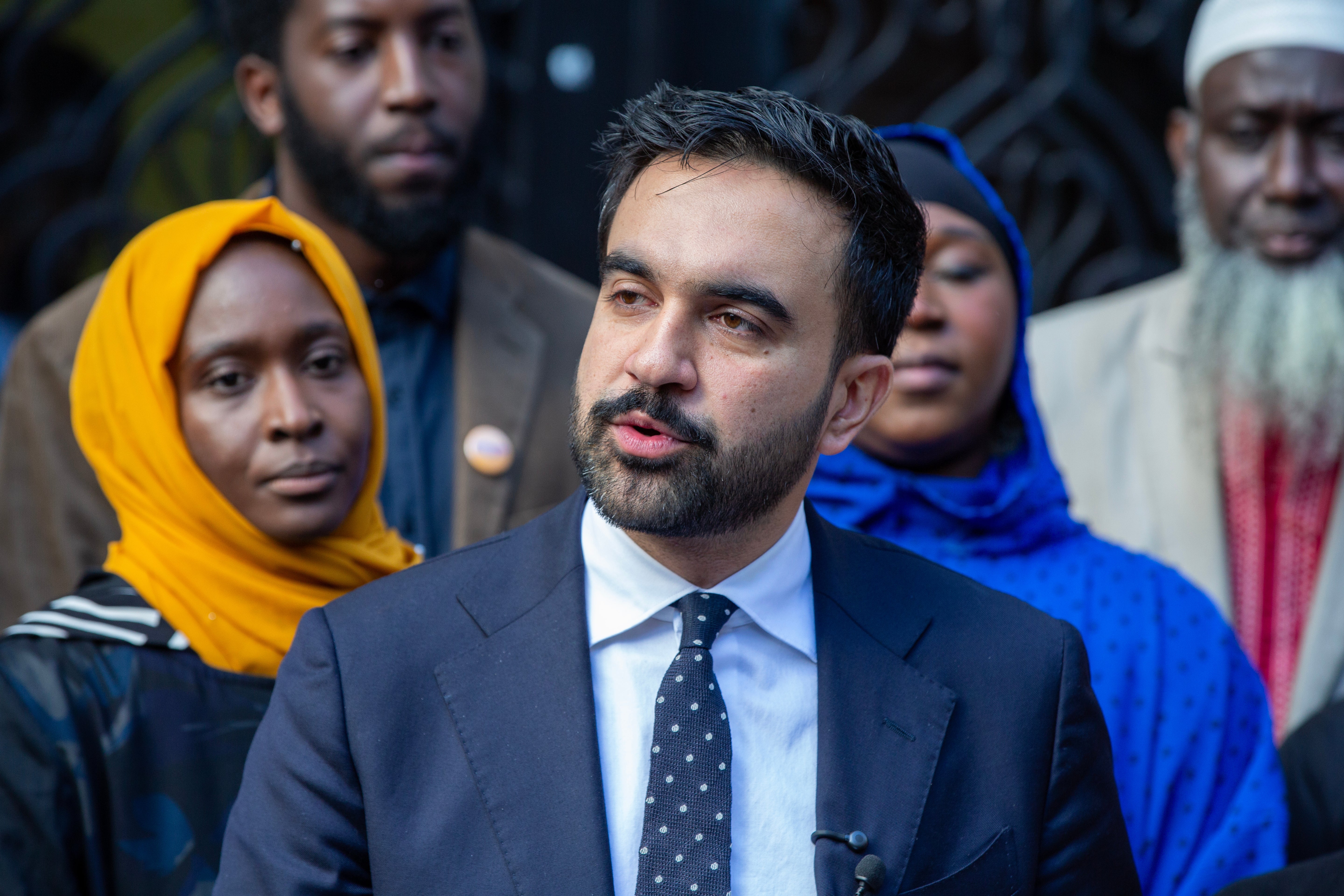
While there are undoubtedly points for the Democratic Party mainstream to note, however, there have to be questions about how far Mamdani’s victory could or should translate into a comprehensive template for the Democrats.
New York City is unique in so many ways. In its ethnic and religious composition, in the sources of its wealth and the affluence and poverty that live side by side, it is a cosmopolis that may have more in common with other megacities, such as London, than with anywhere else in the United States. Such cities have a habit of bucking prevailing political trends, drawing big characters to represent, if not always successfully to manage them. Would Mamdani have been electable in, say, Chicago?
His multifarious ethnic background, but especially his Muslim faith, made for an at-times dirty campaign that included smears of antisemitism, which he fiercely rebutted. But they could also be seen as assets in New York City in a way they might not have been elsewhere.
There were also special aspects of this year’s New York mayoral election that favoured an outsider. The Democrat insiders – the outgoing mayor, Eric Adams, who decided against running, and Cuomo, the initial favourite – were both tainted; Adams by corruption allegations, and Cuomo by sexual harassment claims; all claims strenuously denied by their targets, but damaging nonetheless.
Mamdani’s age may also have been more of a plus than a minus for New York City voters, who are somewhat younger on average than voters elsewhere in the US, and at a stage in their lives – more than a quarter of the city’s population are in their late twenties and thirties, between 25 and 39 – where affordability, the theme of Mamdani’s campaign, which includes free childcare, free bus travel and a freeze on controlled rents, would have particular resonance.
While trying to trade on experience, both Cuomo (67) and Sliwa (71) could not help but come across as “yesterday’s men”, given Mamdani’s energy, physical presence on the campaign trail, and facility with social media. Nor could Mamdani be dismissed as a novice, having sat in the New York State assembly since 2021.
The message for the Democratic Party might be less to court youth for its own sake than to avoid looking backwards, avoid looking fossilised, and seek out new ideas. Those suggesting that Mamdani’s decidedly left-wing platform points the way for the party to go have also to take into consideration the generally strong performance of the Democrats in Tuesday’s other elections.
Their victory in two governors’ races could reflect the start of a turning political tide in the US, with voters looking for a way to counter Trump and Trumpism as he moves into the second year of his term. The task for the Democrats, however, may be more complicated than simply rediscovering the confidence to oppose Trumpism.
From surveys of voters in New York City, it would appear that not a few voted for Trump in 2024 and then for Mamdani in 2025, not out of any change of heart, but because of what they saw as the similarities. Trump may have endorsed Cuomo in the last days of the campaign, describing him as “capable” and Mamdani as a “communist”.
But for some voters at least, it was what they saw as Mamdani’s authenticity and consistency as a politician, his understanding of “ordinary people” and their concerns, and his ability to communicate with the man, woman and young person in the street, that convinced them to choose him. The Democrats, it might follow from this, need some charismatic characters and a lot more persuasive campaigners – and they need them fast.
Mamdani faces a crucial test, too. Much that he has promised is not in his gift alone, not even as mayor of New York City. He will need the resources and the cooperation of the state and other institutions. What is more, Trump was surely not joking when he threatened to send the very minimum of federal funding to New York in the event of “the communist” Mamdani’s election. To succeed, not just as mayor of New York City, but as a model for the future of the Democratic Party, Mamdani has to show quickly, at the very least, that his policies are feasible. Various academics have scoffed at a keystone of Zohranomics, the proposal to reduce the cost of living by opening state-run grocery stores, as ignoring basic economics.
If he cannot see through key parts of his agenda, for whatever reason, then he will only vindicate those many mainstream Democrats who regard his programme as a leftward swerve far too far and send the party back to more familiar terrain.
Radicals have to deliver or they are erased. For all the hopes raised by his victory, failure would spell the end not only of Mamdani as a politician, but also for those hailing his ideas as a model for the next generation of Democrats.
Join our commenting forum
Join thought-provoking conversations, follow other Independent readers and see their replies
Comments
Bookmark popover
Removed from bookmarks