The new Teflon Don: How Trump 2.0 has made reality optional
In the first year of Trump’s second presidency, events that once would have halted politics entirely now pass with barely a pause, writes Holly Baxter. After 12 months of non-stop provocation and unreality, the most unsettling feature of Trump’s second presidency is not what has happened, but how quickly Americans have learned to absorb it — and move on


One full year into Donald Trump’s second presidency, the defining feature of American politics is not any single decision, scandal or abuse of power, but how little any of it seems to matter.
The outrage economy that once sustained Trump’s critics has collapsed under its own weight. There is simply too much to be outraged by, arriving too quickly, layered so thickly that even events that would once have dominated public life now pass with barely a ripple.
“Teflon Don” — a moniker once applied to a NYC Mafia boss — is now a governing strategy.
In the same way that we now look back on once-reviled George W Bush with a rose-tinted nostalgia (what’s “lying a lot” as compared to “treating the Constitution as if it’s optional,” after all?!), The Donald’s first go at the presidency feels comparatively quaint. The Access Hollywood tape and its inability to sink his candidacy, the false claims about crowd sizes and the shouting about “fake news” were all unpresidential, sure. They were, however, miles away from opening a criminal investigation against the chief of the Fed, cutting the pension of a veteran for criticizing the president, or referring to a mother shot by a federal agent as a “domestic terrorist” within hours of her death.
Trump fully internalized the lessons of his first term and the years that followed it: accountability can be neutralized not by persuasion or restraint, but by saturation. In other words: Flood the zone. Overwhelm the system. Make the cost of paying attention higher than the cost of letting go.
In 2026, Truth Social functions as a command center. Statements appear there before they are filtered through advisers, lawyers or basic plausibility. Claims contradict one another openly. Corrections are unnecessary. The sheer volume does the work. By the time a falsehood is examined, two new ones have arrived, each demanding its own rebuttal, each diluting the last.
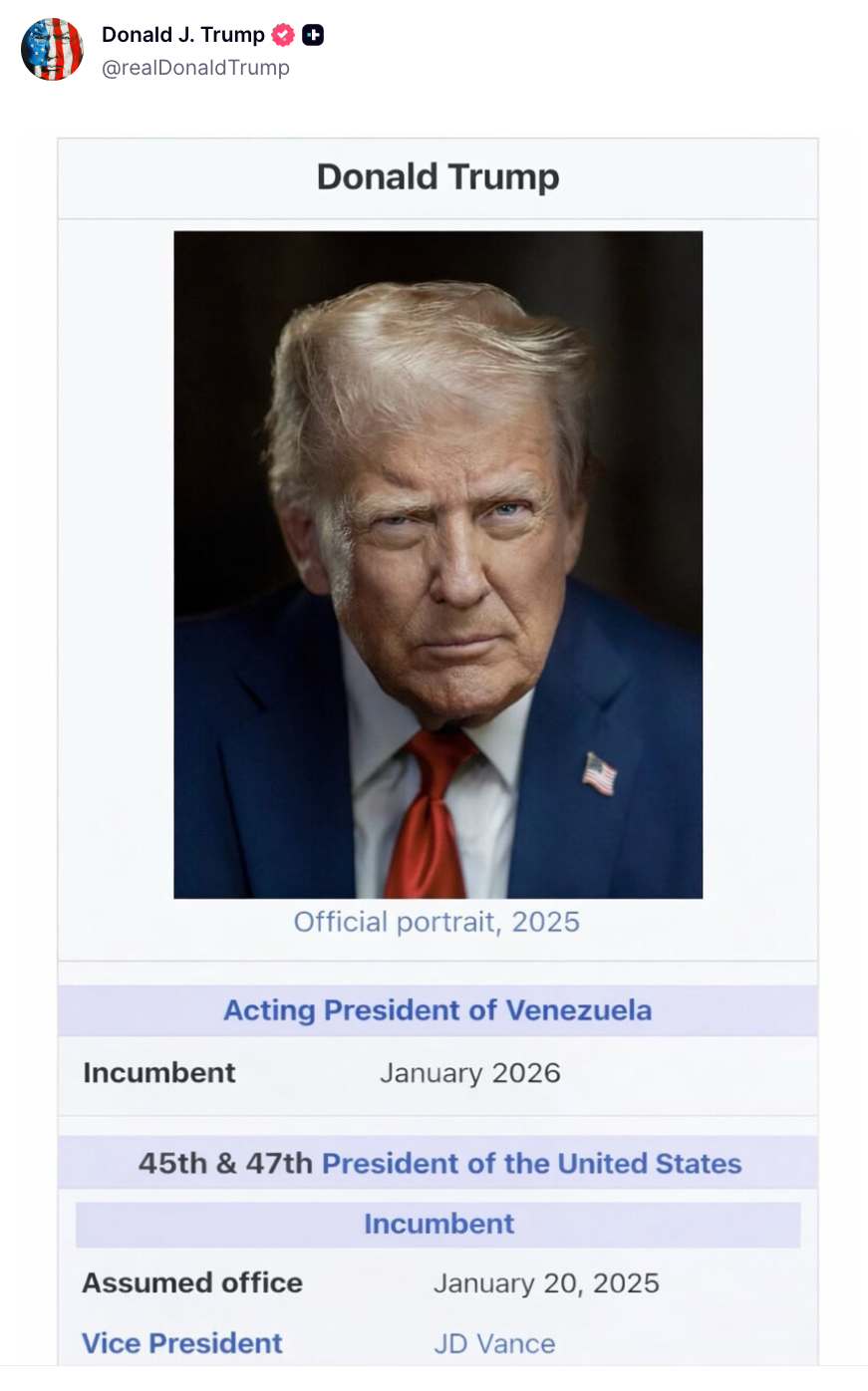
The availability of AI image generators turned what was an occasional grenade into a full-scale bombardment: a fake Wikipedia page declaring Trump the acting president of Venezuela; a video of the president, dressed as a king and flying a plane emblazoned with the words “KING TRUMP”, dropping bombs of excrement on protesters; a bizarre vision of Gaza as a Trump-owned golden beach resort. The result is viewer fatigue.
The right’s delight in “trolling” makes any critical response difficult: if you took it seriously, that’s your problem. Time and time again, when called upon to explain Trump’s use of his personal Truth Social account or even the official White House Twitter account, his supporters in Congress have simply replied with the equivalent of: “It’s just a joke!”, the universal defense of people who very much want their barbed asides to be taken seriously.
When everything and nothing is a joke, it’s hard to tell whether you’re really going to invade Greenland and destroy NATO or nuke Denmark or bomb Iran or go to war with Russia or just post about all that stuff at 3a.m. and see what happens. Will the midterms be conducted fairly? Are those “Trump 2028” hats a serious threat to democracy, or simply a tasteless in-joke with (whatever’s left of) the base? Will the president really invoke the Insurrection Act and deploy the military against Minnesotans? In an environment where up is down and down is up, it becomes genuinely difficult to address these questions. Instead, there’s an overwhelming urge to simply shrug.
The same dynamic played out around the Epstein files, an issue Trump himself repeatedly raised on the campaign trail, promising transparency and accountability. In late 2025, the Justice Department released tens of thousands of pages of Epstein-related documents under pressure from Congress and the courts. Coverage briefly flared, particularly around references to Trump’s past social proximity to Epstein. For a brief moment, it seemed like this would be the issue that stuck — then the fog descended again.
The administration dismissed further scrutiny as partisan obsession. Trump waved the matter away as a “hoax” and a “witch hunt,” sometimes within the same week, he accused others of hiding information. He chose Christmas Day, no less — a day traditionally reserved for goodwill, cheer and governmental accusations of international sex trafficking cover-ups — to post a long rant claiming it was actually the Democrats who had close ties with Epstein and who would be presently held accountable for them, in a message that started with “sleazebags” and ended with “enjoy what may be your last Merry Christmas!”
Needless to say, as far as Epstein is concerned, the documents exist. They are public. They are also, in practical terms, inert. The act of disclosure was absorbed into the noise, stripped of consequence by denial so casual it barely rose to the level of defense.
From ending ‘forever wars’ to kidnapping autocrats
Abroad, Trump has wielded American power with the same indifference to precedent. In early 2026, the United States launched a unilateral operation in Venezuela that resulted in the capture of Nicolas Maduro and his wife, and their transport to New York on narcoterrorism charges. It was an extraordinary escalation that bypassed multilateral diplomacy and triggered immediate questions about international law. Once, such an action would have produced congressional hearings or emergency summits. Instead, it landed, detonated briefly, and vanished into the churn.
Iran has been handled in a similar register. A week ago, Trump imposed a punitive tariff penalty on any country trading with Tehran, effectively daring allies to choose. He openly entertained further military action as unrest spread inside the country, brushing aside questions about congressional authorization or long-term strategy. Polling shows that a large majority of Americans oppose military action against Iran and think that Trump has gone too far abroad, but the administration has shown little interest in restraint. One wonders what the Trump supporters who cast their votes because of a promise to end “forever wars” are thinking right now.

At home, federal authority has been deployed with comparable disregard for convention. It’s barely been a few months since the president declared a crime emergency in Washington D.C. and filled the city with federal troops, but memory has faded fast. Now protesters across the country are subject to the same language that justified action in D.C.: chaos, lawlessness, restoration of order. Federal force has become an instrument rather than a last resort. Combined with the big military parade Trump demanded for his birthday — at a cost of around $30 billion to America’s taxpayers — this looks like what everyone with a passing knowledge of history says it looks like: fascism.
What is striking is not just the scope of the actions taken by the second Trump administration over the past year, but the absence of sustained resistance. Universities threatened with the dissolution of funds have disciplined or suspended pro-Palestine protesters. Lawsuits have been filed but almost instantly forgotten by the public, as the president continues to write on social media that he wants to throw Democrats in jail or punish them “by DEATH” for telling troops they can refuse to carry out illegal orders. Although strong words have been said by Democratic leadership in Minneapolis, they were almost immediately tempered with public pleading for protesters not to be violent or to “take the bait”.
“We cannot counter chaos with chaos,” Mayor Jacob Frey said earlier this month, a statement that leaves everybody wondering exactly what chaos can be countered with instead.
Are we divided, or are we just seriously confused?
Despite the fact that he is hemorrhaging key voters he likely needs — Latinos and independents chief among them — the president has clearly decided he does not need consensus or even loyalty. Instead, he needs momentum. Scandals have become fuel for the fire, rather than something to wait out. Critics exhaust themselves assembling timelines and fact-checks that feel instantly outdated. The sheer effort required to maintain moral clarity becomes its own deterrent.
After Trump 1.0, the country was polarized. A year into Trump 2.0, it’s probably more accurate to say the country is disoriented. What was once an isolationist, flag-hugging, populist presidency has descended into flipping factory workers off during a meet-and-greet in the morning and destabilizing foreign regimes over dinner.
Meanwhile, grocery prices are high. Gas is expensive. Every now and again, someone remembers that oh yeah, Trump was shot once, and oh yeah, there was that double-tap bombing where the Pentagon targeted and killed some people on a boat in the Caribbean, and oh yeah, the Charlie Kirk murder and the strange and sudden, glittery rise to power of his wife Erika, and oh yeah, the Trump-packed Supreme Court ended the federal right to abortion and oh yeah, that time when the president said he’d end birthright citizenship entirely.
The true legacy of Trump’s second term — so far — is not a single policy or a standout moment but the normalization of unreality as a governing condition. In such an environment, anything can happen. And even worse, people forget what authenticity even looks like, and forget to expect it.
In other words: How are we supposed to know how to vote when we can’t even trust that the president’s Wikipedia screenshot actually came from Wikipedia?
Join our commenting forum
Join thought-provoking conversations, follow other Independent readers and see their replies
Comments
Bookmark popover
Removed from bookmarks