Could this private jet become the successor to Concorde?
Plane Talk: The Bombardier Global 8000 provides ‘the one thing that is always in short supply: time’
“Concorde was all first class, so you were treated in a great way,” says Larry Mueller – former boss of IBM Europe and now chief executive of the ultra-high-end travel company Cuvee.
“But for me, it was really about the convenience of leaving Paris and getting to New York in three and a half hours – and picking up two hours of time.”
The Anglo-French supersonic jet, which first flew paying passengers 50 years ago this month, was seemingly able to transcend the rules of the cosmos. The evening westbound flight outpaced the spinning of the globe, so the sun appeared to rise in the west.
Mr Mueller could take off from Paris and touch down at JFK airport two hours before he had left, local time. From London, the saving was “only” an hour. But Concorde was a time machine.
As I have been reporting this month, a Denver-based company named Boom Supersonic hopes its commercial passenger jet, named Overture, will be breaking the sound barrier with passengers on board by the end of the decade.
In contrast, the former chief Concorde pilot for British Airways, Captain Jock Lowe, reckons it will be 2050 before anyone can buy a ticket for a supersonic plane. Yet a business jet that has just been certified by the European Union Aviation Safety Agency claims to be the natural successor to Concorde.
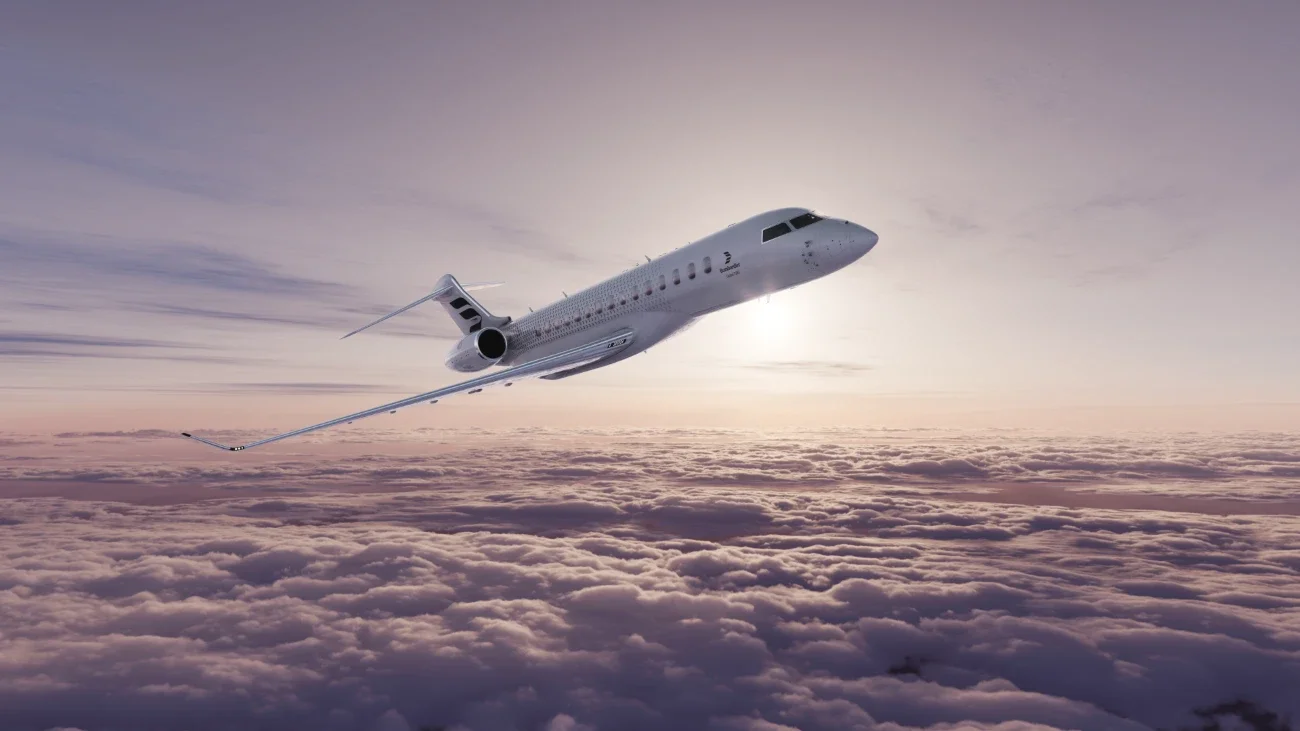
Bombardier, the Canadian company that makes the Global 8000 aircraft, calls it “the fastest business jet ever conceived” and “the fastest civil aircraft since the Concorde”.
Longhaul passenger aircraft typically cruise at around 550mph. But the Global 8000 can comfortably fly while in “ultra high-speed cruise” mode at 605mph: 10 per cent speedier. (Concorde was 138 per cent quicker.)
Bombardier says: “You can now fly faster, providing you with more of the one thing that is always in short supply, time.”
What does that mean on specific journeys? Some comparisons for you, with the length of journey and time saving:
- London-New York: The journey comes down to six hours, saving 40 minutes on a fast crossing aboard a commercial jet
- Manchester-Cape Town: Were there a direct flight (which there isn’t), a commercial jet would take an hour longer than the Global 8000’s expected journey of just over 10 hours
- London-Perth: Qantas regularly makes the trip in under 16 hours, with a little help from the jet stream. The Bombardier plane would be 90 minutes quicker
Does that degree of timesaving compare to Concorde? No. On the London-New York link, the supersonic jetset would be on their second martini in the Top of the Rock in Manhattan while the Bombardier slowcoaches were still unfastening their seatbelts at the end of the flight.
Flying close to the speed of sound is not a new concept. In the early 21st century, Boeing announced a new “Sonic Cruiser”. The jet, whose delta shape bore more than a passing resemblance to Concorde, was supposed to carry upwards of 200 people.
Sir Richard Branson, founder of Virgin Atlantic, was tempted. But the innovation never got beyond the drawing board. Most airlines were unenthusiastic, and the team that had been working on it were redeployed to the design what would become the Boeing 787 – which has since become an industry workhorse.
Now, the business-jet industry has delivered what the passenger-planemakers could not. The Bombardier plane has the added bonuses of flying to the edge of heaven, with a maximum altitude of 51,000ft, and a “smooth flex wing” described as an in-air shock absorber, engineered to help dampen turbulence for the industry’s smoothest ride.
Yet a traveller would need to apply an astronomical value to their time to make the Global 8000 worthwhile. Let us park the $78m (£57m) cost of the plane itself. On the London-Perth run, the cost of saving 90 minutes compared with the Qantas scheduled flight would run to hundreds of thousands of pounds in fuel burnt to take eight passengers Down Under. (Liz Truss, while foreign secretary, ran up a bill of £500,000 when she treated herself to a government private jet to Australia and back.)
The real value of private jets is flexibility: in terms of route options, and timing. That Perth flight goes only once a day. The 11.50am departure arrives in the Western Australia capital in good time for lunch the following day. If you miss it, the one-stop scheduled options will not get you there until dinner. Handy to have a Global 8000 waiting. But it is no Concorde.
The future of fast flying is to be found in new city-pairs that cut out time-devouring connections. That is why the proposed London-Sydney non-stop link is predicted to be an instant success when it starts next year.
More mundanely, Wizz Air will save travellers time by deploying the long-range version of the Airbus A321 on new routes such as the one between the Armenian capital, Yerevan, and Luton, the private jet hub for London.
Read more: All you need to know about the proposed Qantas flight from London to Sydney
Join our commenting forum
Join thought-provoking conversations, follow other Independent readers and see their replies
Comments
Bookmark popover
Removed from bookmarks