Affordable London to New York flights in under four hours: Boom Supersonic outlines Concorde-esque ambitions
Exclusive: Blake Scholl, founder and CEO of the aircraft maker, says Concorde successor Overture could fly by end of decade
“We’re aiming to pick up where Concorde left off,” says Blake Scholl.
Fifty years after the Anglo-French jet first carried paying passengers faster than the speed of sound, the Denver-based entrepreneur is set on bringing back supersonic passenger flight. But he vows to do so “in a way that’s far more mainstream and accessible than Concorde ever was”.
The maiden passenger flight of a British Airways Concorde took off on 21 January 1976 from London Heathrow to Bahrain. Initially the US would not allow the supersonic jet to operate. On the same day, Air France departed from Paris CDG, destination Rio via Dakar in Senegal. The flights took place seven years after the first supersonic test flight.
Both airlines grounded their fleets in 2003, bringing an end to the brief 27-year supersonic era.
Mr Scholl is founder and CEO of Boom Supersonic. At the company’s HQ, he tells The Independent: “It’s insane, isn’t it? From the Wright brothers in 1903 to Concorde’s first flight in 1969, we were literally accelerating — and then we did something bizarre: we went backwards. To my knowledge, that’s only happened in aerospace.
“Think about it — 1969, Concorde flies supersonic; within months, we land on the Moon. Now it’s 2025. If you’d asked anyone in 1969 what travel would be like in 2025, no one would have said, ‘We won’t be able to go to the moon, and we won’t be able to fly supersonic.’ And yet, that’s the world we live in.”
A year ago a testbed, XB-1, broke the sound barrier for the first time.
By the end of the decade, the aim is for an aircraft seating up to 80 passengers to fly at Mach 1.7 across the ocean, at a height of 60,000 feet.
The speed is one-sixth slower than Concorde. “We optimised for 1.7 because of noise — specifically, takeoff and landing noise,” Mr Scholl says. “The faster you fly, the smaller and louder the engines must be. To make Overture quiet enough for airport communities, we brought the top speed down.
“We’ve committed that Overture will be no louder than subsonic aircraft during takeoff and landing. That small speed tradeoff makes it vastly more practical and community-friendly.”
For Concorde, flying at supersonic speeds over land was not generally feasible because of the sonic boom created by breaking the sound barrier. The maiden British Airways flight to Bahrain spent the first 90 minutes at subsonic speeds as far as Venice, passing through Mach 1 – the speed of sound – only once over the Adriatic.
But the Boom Supersonic boss believes people on the ground can be protected against the shockwave.
“The truth is, sonic boom is a solvable problem,” says Mr Scholl. “We’ve proved it. We take in real-time weather data, run it through advanced algorithms, and they tell us how to fly — what altitude and speed. If you do that, the boom bends upward in the atmosphere, making a giant U-turn so no one on the ground hears it.”
There is, though, a time penalty, he says: “You can’t go full-speed ‘boomless’. At lower supersonic speeds, the energy projects forward instead of down. Combine that with the right weather data, and you can calculate how much bending you get — and decide how fast to fly. On a great day, Mach 1.3; on a bad day, Mach 1.05. Even then, you’re still 50 per cent faster than a 737 or A320.”
The Overture range is expected to be around 5,000 miles (8,000km) – substantially more than the first-generation supersonic passenger jet. Mr Scholl claims “there are over 600 viable routes”, including transatlantic, transpacific and US coast-to-coast journeys. But he confirms: “New York–London is the obvious one.”
The journey time: “About three-and-a-half hours.”
“Most importantly, it’s affordable. Concorde tickets cost £20,000: a luxury for royalty and rock stars. Overture’s fares will be comparable to today’s business class around $5,000 round trip across the Atlantic, under £4,000. Airlines will actually make money at that price thanks to modern technology.”
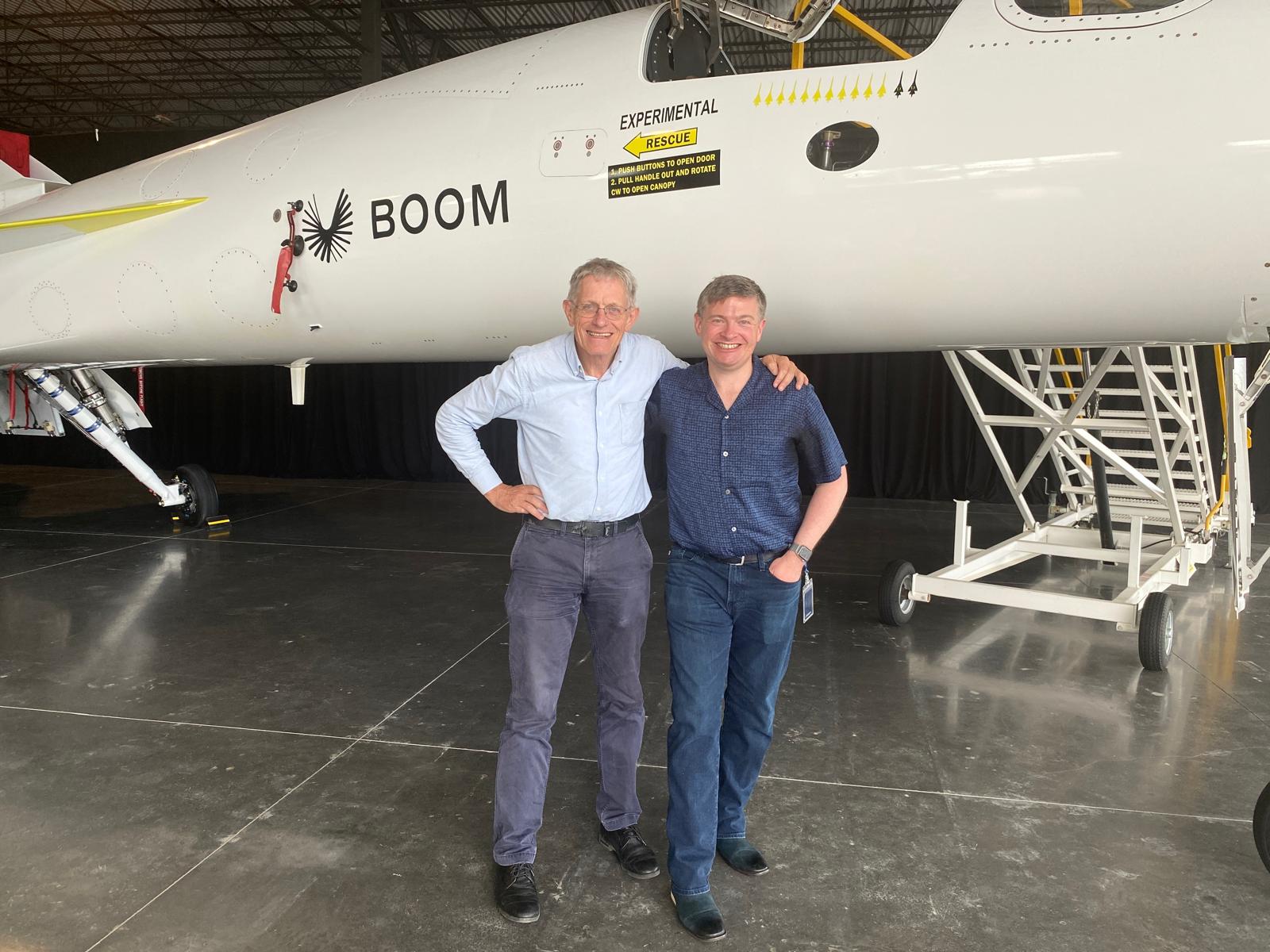
One concern with Concorde was the narrow, cramped cabin. The Boom Supersonic pioneer says his design will address that.
“Overture is the proper successor to Concorde, made of carbon fibre composites, powered by our Symphony engines, quiet and efficient. The cabin is roomier: taller doors, wider seats, a beautiful interior. The one thing we don’t have is an ashtray.”
He dismisses the absence of flat beds, now a fixture in almost all long-haul business class cabins: “What we’re really doing is trading flying beds for much better beds – the ones at home before we leave.”
Boom Supersonic has attracted 130 orders, “pre-orders” and options from American Airlines, United and Japan Airlines.
Leading environmentalists deplore the impact of supersonic aircraft. Anna Hughes, director of Flight Free UK, told The Independent’s daily travel podcast: “Flying is extremely energy-intensive, but supersonic flight even more so. Fundamentally, what we need to do is fly less.”
Others have questioned the viability of supersonic aircraft in a world in which technologies such as Zoom enable online meetings.
But Blake Scholl remains optimistic: “Flight should be the most inspiring human experience – we soar above the Earth, seeing its beauty and our creations below. Yet somehow we’ve turned that miracle into an experience most people dread.
“Don’t accept that. Demand better – faster, more comfortable, more human travel.”
Listen to Blake Scholl on The Independent’s daily travel podcast
Join our commenting forum
Join thought-provoking conversations, follow other Independent readers and see their replies
Comments
Bookmark popover
Removed from bookmarks