The resilience of long-suffering Ukrainians is about to face its most serious test of the war so far
Surviving the cold season is simply not possible without light and heat, and as Putin launches a massive drone attack after rejecting the terms of another peace deal, Owen Matthews reports on Putin’s plan to deliver his fatal blow on Ukraine


Cold and darkness are the cruel weapons of Russia’s energy terror campaign aimed at crushing Ukraine this winter. The Kremlin has been attempting to systematically destroy Ukraine’s electricity, heating and transport systems for three years now – so far, without success. But as Russia launches a new drone attack just hours after rejecting a proposed peace peace deal, this winter could be the one when Ukraine’s air defences are finally overwhelmed.
Russia’s attack strategies have been honed to a peak of destructiveness, with a raft of devastating new tactics aimed at making whole cities and regions uninhabitable. First, and most spectacularly, Russian forces are becoming increasingly adept at evading air defences by sending ballistic and cruise missiles and drones in unprecedentedly large swarms. In mid-November, for instance, Kyiv was kept under unrelenting bombardment for over five hours, with 430 drones and nearly 20 missiles hitting electrical grids, railway sidings and gas-fired power stations, as well as smashing into apartment buildings. At least eight civilians were killed.
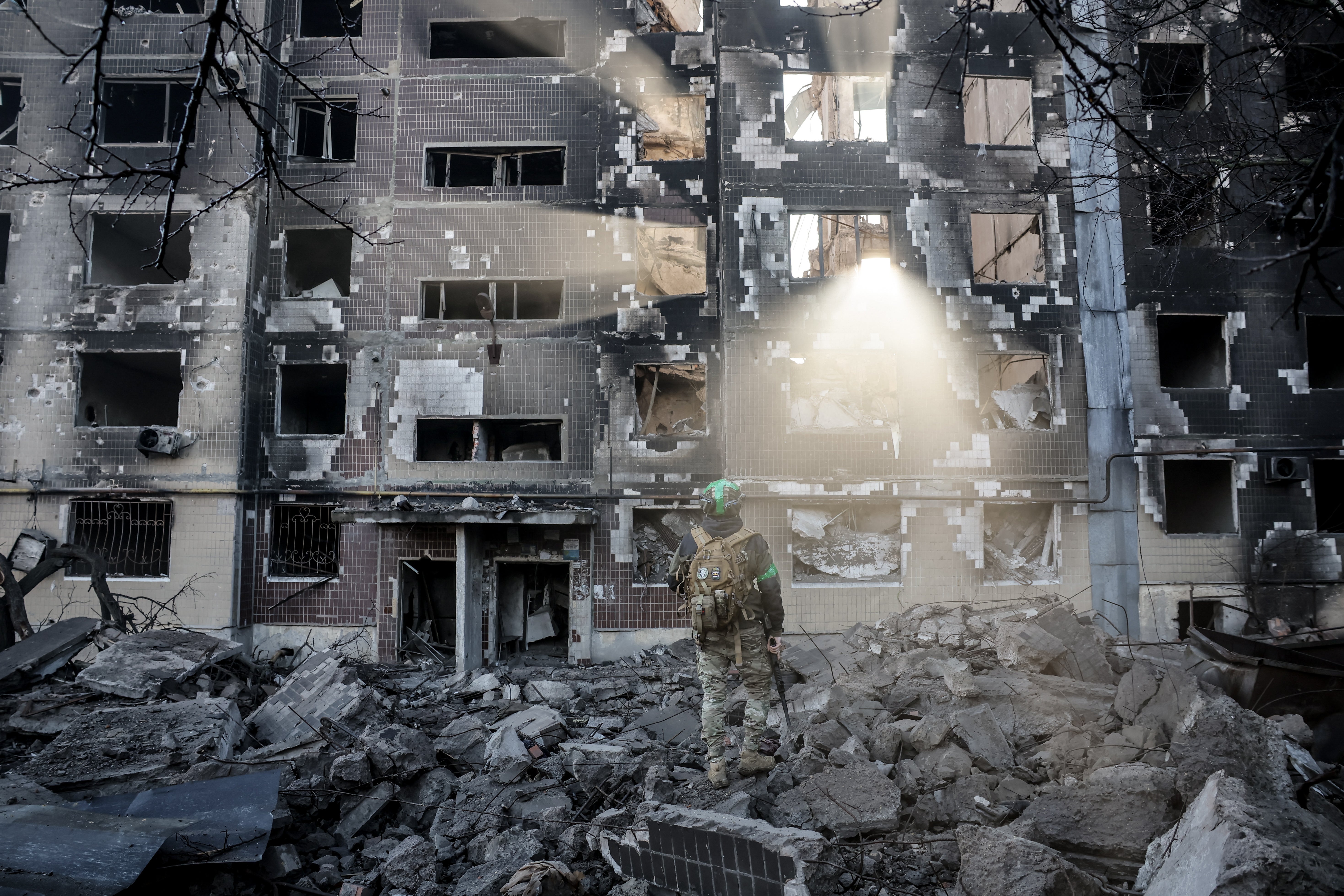
Another raid cut off power to half of the capital for the best part of a day. In response escalating attacks, large parts of Ukraine’s electricity grid had to be switched off for up to 16 hours, as large-scale repairs were undertaken. As temperatures drop, the Kremlin’s attacks will become relentless.
What’s fiendishly effective about the Russian attack strategy is that the basic habitability of a town works on a tipping-point principle. Three hours a day without electricity, for example, is liveable. Eight hours is not. In many Ukrainian towns, the heating system is centralised, with whole districts relying on a shared supply. If these systems are hit in midwinter, pipes freeze and then burst, making evacuation inevitable.
“We have developed blackout routines – we charge up power banks, fill tubs with fresh water, the kids are used to doing their homework by torchlight,” says Anna Khomenko, a translator and curator from Kyiv. “But when the power is out, we have to walk up seven storeys. The streets are dark and icy. Maybe it’s time to leave at last.” Khomenko says many of her friends and colleagues are also considering fleeing the country.


“It is very evident and clear that Putin aims to make winter as unbearable as possible for Ukraine, to destroy morale and break the resistance of the Ukrainian people,” said Germany’s defence minister Boris Pistorius said recently. “He is not succeeding in this.” Not succeeding just yet, perhaps, but according to a German official, Berlin is bracing for a fresh influx of Ukrainian refugees this winter. They will flee not because their spirit is broken, but because life in a Ukrainian winter is simply not possible without light and heat.
The Russians have evidently built a formidable spy and surveillance system, because the precision of their attacks – along with their effectiveness – has also grown. Most sinister of all, there seems to be a deliberate plan by the Kremlin not to target any of Ukraine’s large 750kV electricity substations, which connect regions to one another and form the basis of the national energy grid.
Most of the 750kV stations have been left pretty much unscathed so far. There can only be one reason for that – and it’s not humanitarian forbearance. Rather, Vladimir Putin is likely waiting for the coldest part of the winter to deliver a fatal blow by blacking out whole provinces, and cutting them off from their neighbours so that they are unable to share power.

Even the presidential administration building on Kyiv’s Bankova Street is not immune. A few weeks ago, as Volodymyr Zelensky was sitting down for an interview with a Western journalist, the building was plunged into darkness. The blackout was symbolic, as Zelensky’s own reputation has suffered in the wake of a major corruption scandal that has seen some of his closest political allies and business partners accused of raking off around $100m (£76m) from funds earmarked to build defences for Ukraine’s power stations.
Since the start of the war, Ukrenergo, the country’s national electricity utility, has secured €1.5bn (£1.32bn) in Western aid to build grid defences, and constructed 60 concrete shelters to defend critical transformers. But according to Ukraine’s National Anti-Corruption Bureau, a major kickback scheme involving Timur Mindich – the co-founder, alongside Zelensky, of television production company Kvartal 95 – together with justice minister Herman Halushchenko and at least seven others, profited from defensive fortification contracts. The combination of severe blackouts and charges of war profiteering at the most senior level in Ukraine’s government is building into a serious political crisis.
At the same time, Ukraine had started to score some important counterstrikes of its own, with a campaign of long-range attacks on oil refineries and terminals deep inside Russia. New technology has given Ukraine the capacity to hit more than half of western Russia’s refineries, with a significant impact on domestic oil refining and the availability of fuel. Thus far, though, Russian air defences have been able to defeat up to 95 per cent of Ukrainian drones, and – given the small payload of the Ukrainian munitions – only around half of the drones that have reached their target have actually done meaningful damage.
However, according to a recent report by Dr Jack Watling of the Royal United Services Institute in London, “there is good reason to believe that Ukraine can improve the efficacy of its strikes in 2026, [but] the question is the extent to which the combination of sanctions and strikes will create a cashflow problem for the Kremlin”.
In other words, both sides have upped their air-offensive game in what is increasingly becoming a war of attrition. On the ground, Russia’s troops continue a slow and bloody advance through the Donbas. “Despite the official bravado, the situation is more than complicated and less than controlled,” former deputy defence minister Vitaliy Deynega, the founder of Come Back Alive – a Ukrainian foundation supporting the military – wrote on Facebook. Ukrainian forces “need to get out of these [besieged] cities while it is possible”, he added.
Putin still believes that he can bring Kyiv to its knees – which is why he has rejected even the generous peace terms offered by Donald Trump in Alaska and hours after rejecting the latest peace plan, launched a massive drone attack on the eastern Dnipro region.
The war is going to be won or lost not on the slowly moving battlefront, but in the skies above Ukraine’s cities, where the Russians believe they can land a truly killer blow against the country’s critical infrastructure. The resilience of ordinary long-suffering Ukrainians is about to face its most serious test of the war so far.
Join our commenting forum
Join thought-provoking conversations, follow other Independent readers and see their replies
Comments
Bookmark popover
Removed from bookmarks