Trump-Iran latest: Tehran says it is ready for negotiations with US but not under ‘shadow of threats’
US military assets are gathering in the Middle East ahead of a possible strike
Iran is prepared for talks with the United States, but negotiations should be "fair and equitable" and not take place “under the shadow of threats”, the country’s foreign minister has said.
In a post on X, Abbas Araghchi said Tehran had “no problem with negotiations” following repeated threats of US military intervention by Donald Trump.
“They must certainly set aside their threats and change their approach toward a fair and equitable negotiation, as Mr Trump himself said in his post," Araghchi said.
Trump warned Iran it must do “two things” to avoid US military action, as US forces continue to build in the Middle East ahead of a possible strike.
"Number one, no nuclear. And number two, stop killing protesters," the US president said.
Iran earlier warned it will retaliate to any US attack “instantly” and that its response would not be limited. A response would likely see it attack the US military bases stationed in Gulf countries.


US approves arms sales worth over $15bn to Middle East allies
The Trump administration has approved a massive new series of arms sales to Israel totalling $6.67 billion and to Saudi Arabia worth $9 billion.
The State Department announced the sales to America's allies in the Middle East late Friday as tensions rise in the region over the possibility of US military strikes on Iran.
They were made public after the department notified Congress of its approval of the sales earlier Friday.
The sales also come as president Donald Trump pushes ahead with his ceasefire plan for Gaza that is intended to end the Israel-Hamas conflict and reconstruct the Palestinian territory after two years of war left it devastated, with tens of thousands dead.
While the ceasefire has largely held, big challenges await in its next phases, including the deployment of an international security force to supervise the deal and the difficult process of disarming Hamas.
How powerful are Iran's Revolutionary Guards?
As we reported earlier, the EU has agreed to designate Iran’s Revolutionary Guards (IRGC) as a terrorist organisation, which she said will put the regime "on the same footing" with al-Qaida, Hamas and the Islamic State group.
The group is often touted as one of the most powerful forces in the Middle East - but how powerful are they really?
Unlike the ordinary military, which comes under the Defence Ministry in the elected government, the IRGC answers directly to the supreme leader, Ayatollah Ali Khamenei.
Formed soon after the revolution, the IRGC's role defending the Islamic system greatly expanded during the 1980-88 war with Iraq and it is now the strongest and best-equipped section of Iran's armed forces.
Over the decades, the Guards have extended their influence through the worlds of politics and business, gaining in power at home and abroad.
Members of Iran's Islamic Revolutionary Guard Corps (IRGC) giving a military salute during a military parade in Tehran
The Quds Force, an elite Guards unit, has spearheaded Iran's regional strategy of supporting affiliated Shi'ite groups across the Middle East, most notably in Lebanon and Iraq. That strategy was hard-hit by the U.S. assassination of Quds Force commander Qassem Soleimani in a 2020 air strike in Iraq, and by Israel's pummelling of Lebanon's Hezbollah in a 2024 war.
The Basij militia, a part-time paramilitary force under Guards control, is often used to quell protests inside Iran.
Since the early 2000s, the Guards' economic power has grown as its contracting company Khatam al-Anbiya won projects worth billions of dollars in Iran's oil and gas sector.
Omid Djalili: Iranians will fight to the end against this brutal regime
Iran would try to avoid all out war - but risks miscalculation, says analyst
Our senior foreign reporter James Reynolds reports:
Andreas Krieg, associate Professor in security studies at King's College London, tells The Independent that Iran would likely want to avoid an “all-out” exchange if the US attacks.
The main risk would be miscalculation, he says.
“If the US attacks, Iran’s most likely retaliation is asymmetric and calibrated rather than an immediate all-out exchange,” he said.
“It can target US interests and partners through deniable channels, pressure shipping and energy routes, and use cyber operations.
“It will try to avoid an escalatory cycle that forces Israel into a sustained campaign, because that risks widening the conflict beyond Tehran’s control.”
“The central danger is miscalculation. Coercive signalling can quickly become a war neither side claims to want.”
Turkey ready to mediate between Iran and the US, says presidency
Turkish president Tayyip Erdogan told his Iranian counterpart Masoud Pezeshkian in a call on Friday that Turkey was ready to play a facilitator role between Iran and the United States to ease the tensions between the two sides.
"President Erdogan emphasised that Turkey was ready to take up a facilitator role between Iran and the United States to ease tensions and resolve issues," the presidency said in a statement on X.
It added that Erdogan would also receive Iran's foreign minister, who is visiting Turkey for talks with his Turkish counterpart.
Starmer: ‘We need to deal with Iran’
The Independent’s political correspondent Athena Stavrou reports:
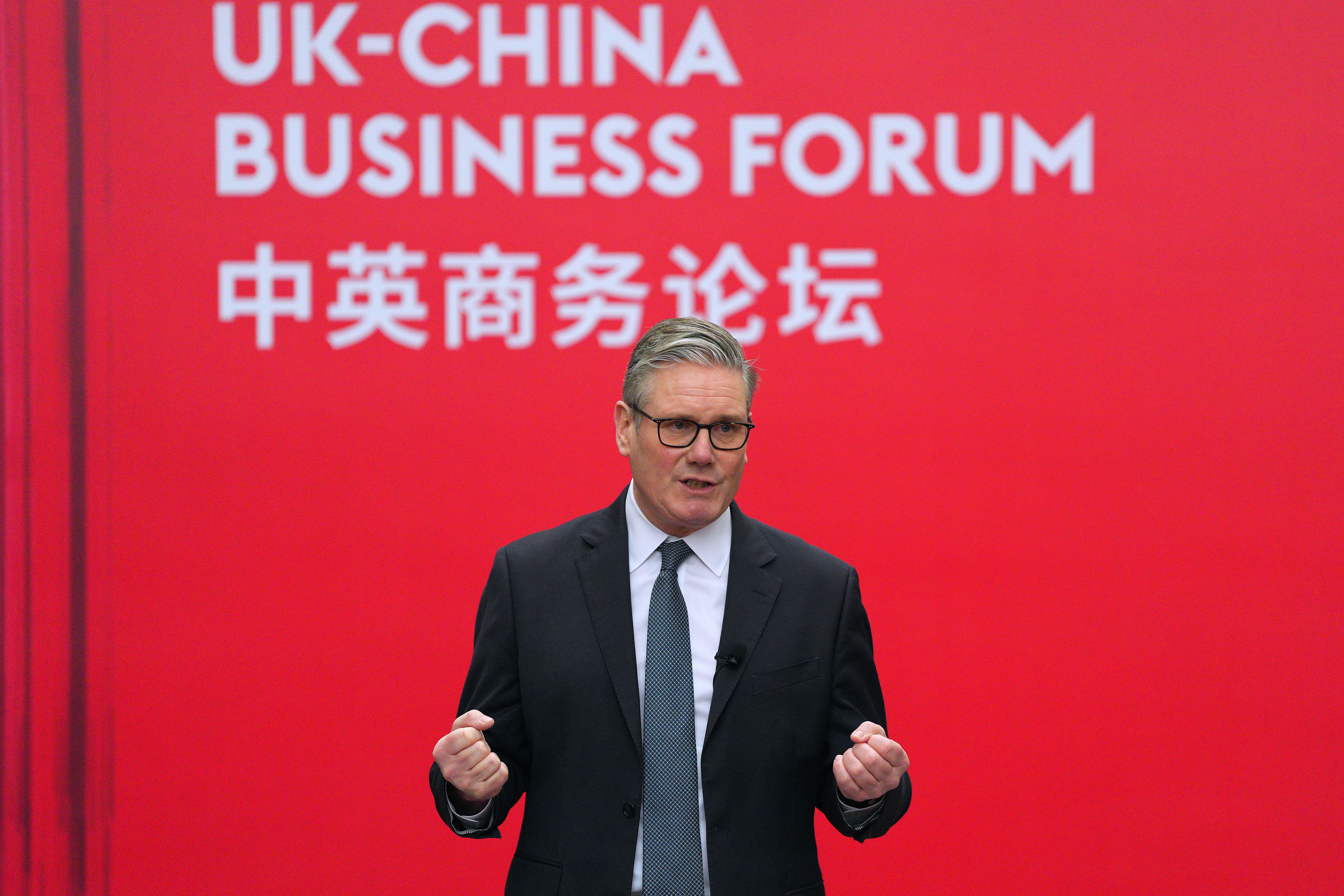
Sir Keir Starmer has said the UK and its allies need to “deal with” Iran amid its ongoing deadly crackdown on protesters.
On his visit to China, Sir Keir said the repression of demonstrators was “grotesque” and “that is where our focus is”.
US President Donald Trump has ramped up pressure on the country in recent days, warning that time is running out to agree a deal on its nuclear programme and called for an end to the “senseless killing”.
The UK prime minister also said the UK supports “the goal” of preventing Iran from developing a nuclear weapon, but stopped short of explicitly backing US military action in the region.
“The goal or the aim here is that Iran shouldn’t be able to develop nuclear weapons and that is hugely important and, of course, we need to deal with the fact they are repressing protesters, killing protesters,” he told the BBC.
“It is grotesque what is happening so that is where our focus is and we are working with allies to that end.”
Pressed on whether Britain would support another US strike on the country, he said: “I am saying we support the goal and we are talking to allies about how we get to that goal.”
Iran open for talks with US but they must be 'fair and equitable', says foreign minister
Earlier, we heard from Iranian foreign minister Abbas Araghchi and his Turkish counterpart, Hakan Fidan, in a joint press conference.
Iran is prepared for the resumption of talks with the United States, but negotiations should be "fair and equitable", Mr Araghchi said.
Araghchi, who described his talks with Hakan Fidan in Istanbul as "good and useful", also said that Tehran was ready to engage with regional countries to promote stability and peace.
Mr Fidan, meanwhile, said he had spoken with US special envoy Steve Witkoff on Thursday and that he will continue speaking to US officials on Iran.
He said he hoped a solution could be found to avoid conflict and the isolation of Iran.
'I told them two things': Trump reveals what he told Iran
Oil slips, but set for biggest monthly gain in years
Oil prices slipped more than 1 per cent this morning from multi-month highs, though they are set for their most substantial gains in years, as the risk premium surged due to a potential US attack on Iran that could disrupt supplies.
Brent crude futures fell 91 cents to $69.80 a barrel after rising 3.4 per cent to close at its highest point since 31 July yesterday.
The March contract expires later today. The more active April contract slid $1.07 to $68.52.
US West Texas Intermediate crude dropped $1.06 to $64.36 a barrel after gaining 3.4 per cent to settle at its highest level since 26 September in the previous session.
US imposes further sanctions on Iranian figures
The US on Friday imposed sanctions on Iranian interior minister Eskandar Momeni and a businessman it said helped launder money for Tehran, as Donald Trump's administration ramps up pressure on the Islamic Republic.
The Department of the Treasury said Momeni was responsible for a brutal security crackdown in Iran this month as he oversees law enforcement forces it said were responsible for the deaths of thousands of peaceful protesters.
The financial sanctions on Friday also targeted five other Iranian security officials involved in "violently repressing the Iranian people", the Treasury said in a statement.
Sanctions were also issued against investor Babak Zanjani and two digital asset exchanges registered in Britain that the Treasury said had processed funds linked to Iran's Islamic Revolutionary Guard Corps.
Treasury secretary Scott Bessent said: "Like rats on a sinking ship, the regime is frantically wiring funds stolen from Iranian families to banks and financial institutions around the world. Rest assured, Treasury will act.”
Join our commenting forum
Join thought-provoking conversations, follow other Independent readers and see their replies
Comments
Bookmark popover
Removed from bookmarks