Spain train crash latest: Broken rail track identified as possible cause of collision which killed 40
Madrid-bound train derailed on a straight stretch of track, before being hit head-on by another locomotive travelling 200kmph in the opposite direction
Technicians investigating the cause of the deadly Spanish train disaster have identified a faulty joint on the rails, a source briefed on the preliminary probe said.
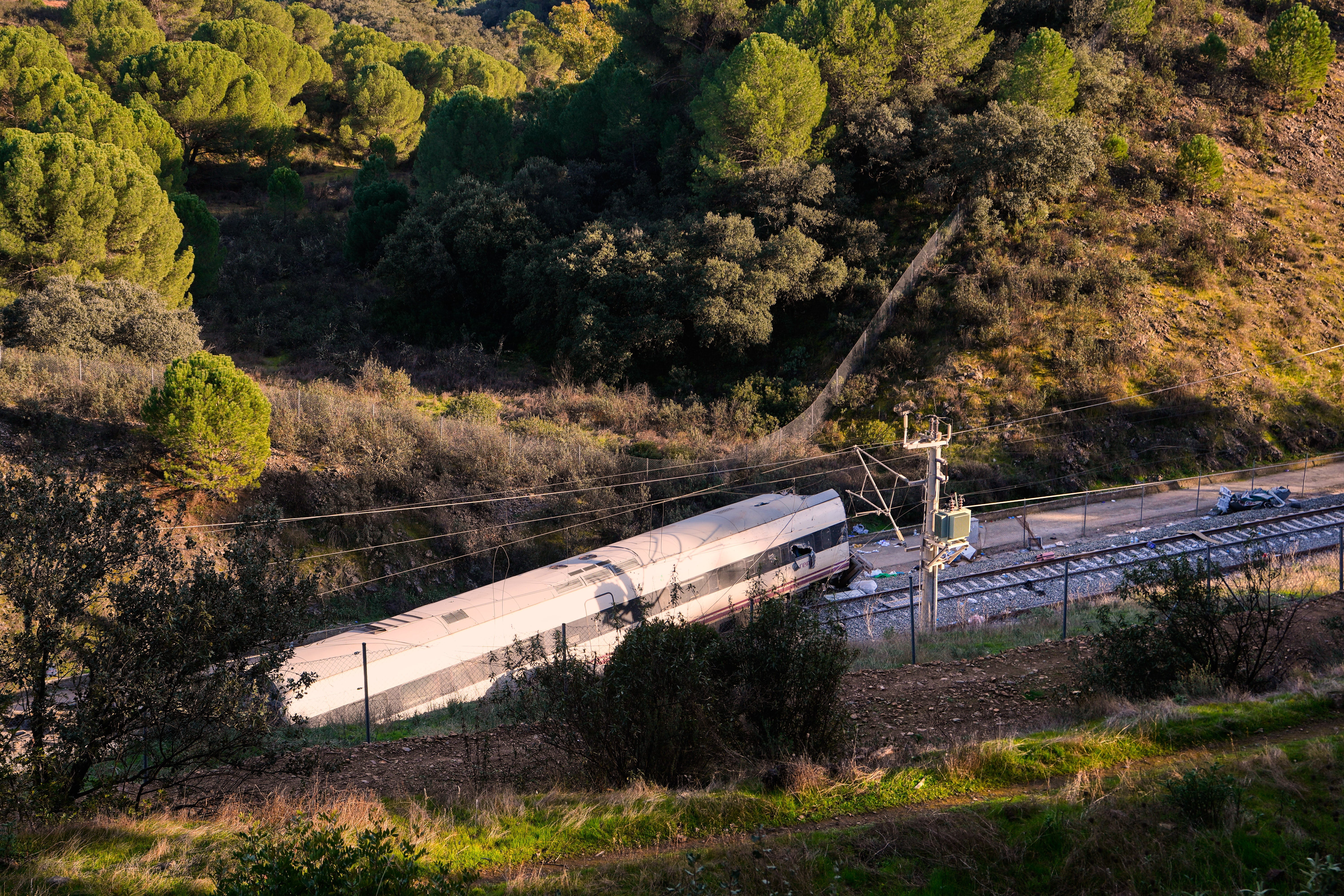
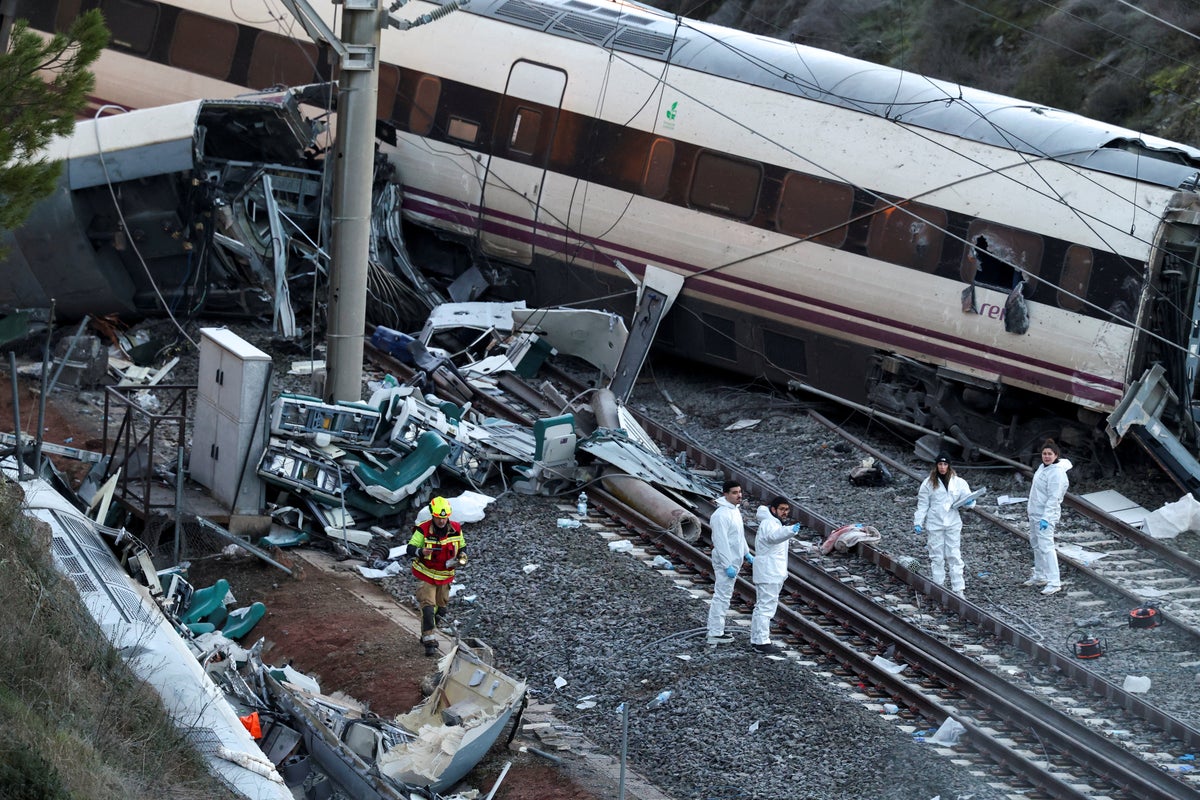
At least 40 people were killed on Sunday evening after a high-speed train derailed and crashed into an oncoming train, pushing it off the tracks near Cordoba.
Experts on site identified wear on the joint between sections of the rail, known as a fishplate, which they said showed the fault had been there for some time, the source told Reuters.
They found that the faulty joint created a gap between the rail sections that widened as trains continued to travel on the track.
The source, who declined to be identified due to the sensitivity of the issue, said the technicians believe the faulty joint is key to identifying the precise cause of the accident.
It emerged today that train drivers’ union SEMAF had written to rail operator ADIF in August to warn about “severe wear and tear” on high-speed rail tracks, claiming their concerns had been overlooked.
The union had cautioned ADIF about potholes, bumps and imbalances in overhead power lines that it said were causing frequent breakdowns and damaging trains.


Accident took place on straight section of track renovated in May, says Andalusian president
Andalusia’s president, Juan Manuel Moreno, described the incident as "extremely strange” during a visit to the scene in Puente on Sunday, according to El Pais.
Speaking before initial investigations showed a broken joint on the rails caused the crash, Mr Moreno said that the accident was unusual given that it occurred on a straight section of track that had been renovated in May.
He expressed confidence that an investigation would clarify the causes.
Crash caused by broken rail track, initial investigations show
Experts studying the crash site found a broken joint on the rails, which created a gap between the rail sections that widened as trains continued to travel on the track, according to a source briefed on initial investigations.
That faulty joint could prove important in identifying the cause of the accident, the source said.
Ignacio Barron, head of Spain's Commission of Investigation of Rail Accidents (CIAF), said on RTVE: "What always plays a part in a derailment is the interaction between the track and the vehicle, and that is what the commission is currently (looking into)."
The Iryo train was travelling at 110 kph from Malaga to Madrid when it derailed, Renfe President Álvaro Fernandez Heredia said on radio station Cadena Ser.
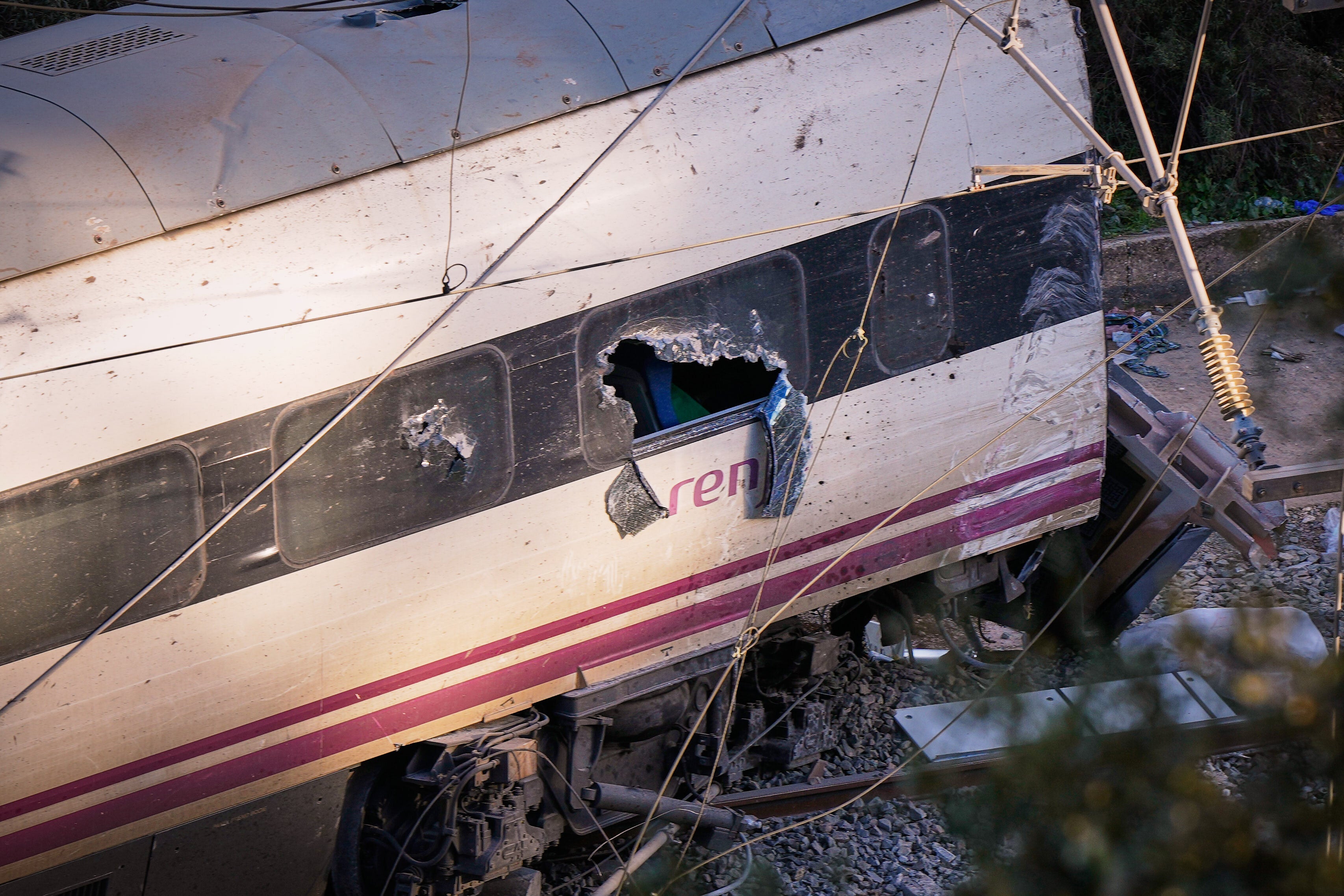
Twenty seconds later, the second train, heading to Huelva at 200 kph, either collided with the final two carriages of the Iryo train or with debris on the line, he said. The Iryo train lost a wheel that has not yet been located.
Death toll rises to 40 as rescuers struggle to retrieve bodies from wreckage
The death toll following a high-speed collision between two trains has been increased to 40, marking one of the worst railway accidents Europe has seen in 80 years.
Twelve were in intensive care after the accident near Adamuz in the province of Cordoba, about 360 km (223 miles) south of Madrid, according to emergency services.
A total of 43 reports of missing persons have been filed so far at police headquarters in Huelva, Madrid, Málaga, Córdoba and Seville, officials said.
The Andalusia region's president Juan Manuel Moreno said emergency crews faced difficulties bringing in the heavy equipment needed to lift the wreckage and reach those still lying beneath it.
Experts say a faulty rail joint might be key to determining the cause of the crash.
Inspection of Iryo train last week found no anomalies, source says
A source told Reuters today that an inspection last week of the Iryo train that derailed found no anomalies.
A source also said that technicians are investigating damage to a joint on the track, which they believe is key to understanding the cause of the accident.
The joint damage had likely been around for some time, the source indicated, citing the technical inspection.
Read the latest:
Spanish rail operator was warned of ‘severe wear and tear’ before crash killed 39
Survivors of Spanish train crash describe horrific wait for help
Survivors of the deadly train crash in southern Spain have described their horrific wait for help on Sunday after the trains derailed.
Ana Garcia Aranda, 26, who was travelling to Madrid from Malaga with her sister and their dog, said: “The train tipped to one side ... then everything went dark, and all I heard was screams.”
"There were people who were fine and others who were very, very badly injured. You had them right in front of you, and you knew they were going to die, and you couldn't do anything," she said.
Salvador Jiménez, a journalist with public broadcaster RTVE who was on board the train from Málaga to Madrid, said the impact felt “like an earthquake”.
“I was in the first carriage. There was a moment when it felt like an earthquake and the train had indeed derailed,” he said.
Rocio, a survivor currently in hospital in Cordoba, was travelling on the route from Madrid to Huelva when they struck the derailed train.
"It was total chaos. I am under observation because of the blows to my head and the vomiting. My ribs are not broken, just dislodged," she told El País.
"I am covered in bruises and cuts. It was terrible. We were thrown through the air. Thank God I am okay but there are people who are far worse off than me."
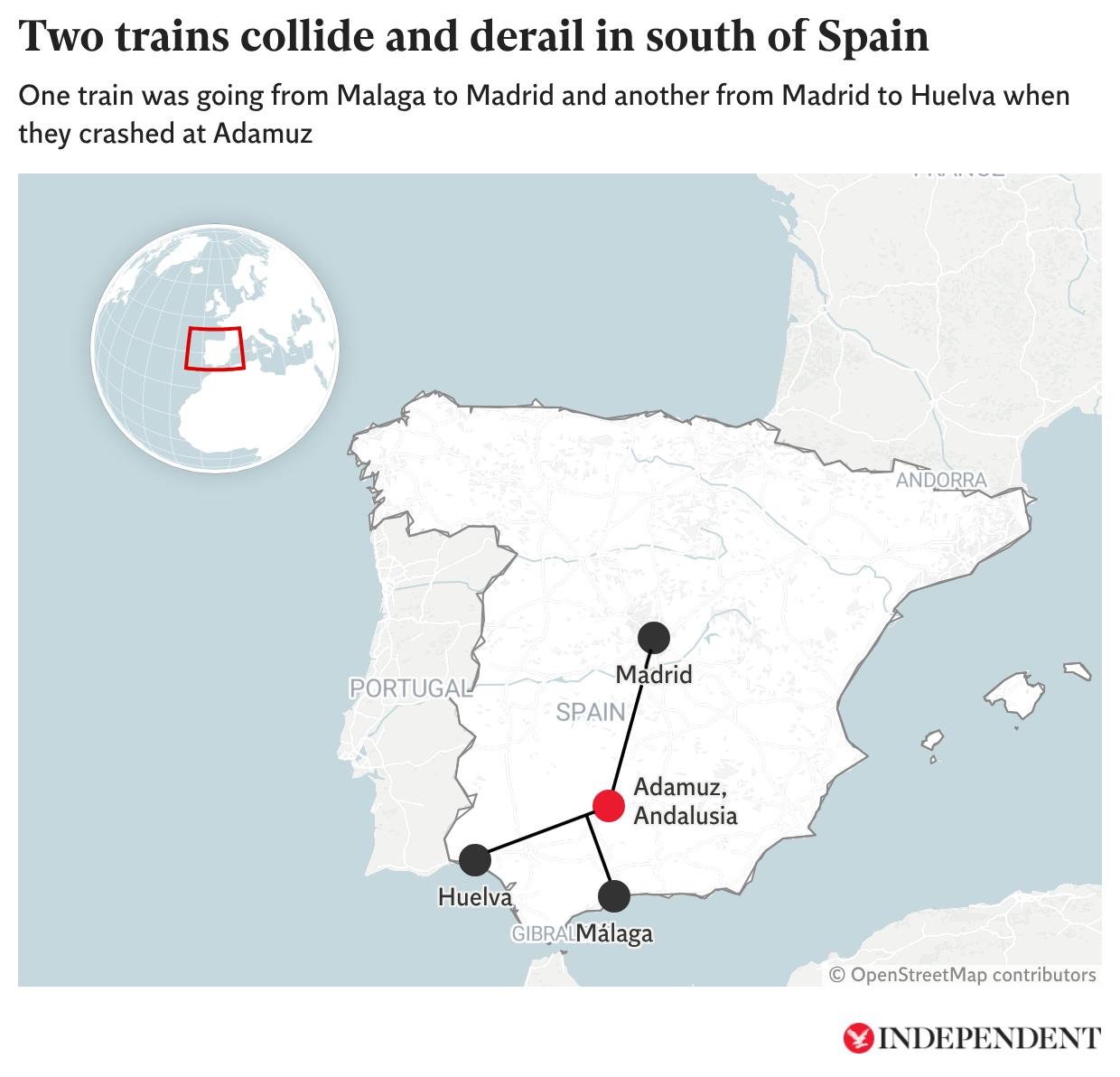
Mapped: Where did the crash take place?
At least 39 people died in southern Spain after a high-speed train derailed and collided with an oncoming one on Sunday night in one of the worst railway accidents in Europe in the past 80 years.
Twelve were in intensive care after the accident near Adamuz in the province of Cordoba, about 360 km (223 miles) south of Madrid, according to emergency services. Experts studying the crash site say a faulty rail joint may be key to determining the cause of the crash.
The collision occurred in a hilly, olive-growing region which could only be accessed by a single-track road, making it difficult for ambulances to enter and exit, Iñigo Vila, national emergency director at the Spanish Red Cross, told Reuters.
Europe’s deadliest train accidents in recent years as dozens killed in Spanish crash
A high-speed train derailment in southern Spain has claimed at least 39 lives and left more than 150 people injured, authorities have confirmed.
Rail travel is a common, affordable, and convenient mode of transport for many across Europe.
Despite a reported decrease in major railway accidents since 2010, according to the European Union, this catastrophe serves as a grim reminder of how deadly they can be, echoing past incidents across the continent.
Here is a look at some of the most deadly train, tram and subway crashes in Europe in recent years.

Europe’s deadliest train accidents in recent years as dozens killed in Spanish crash
Macron says 'France stands by your side'
French president Emmanuel Macron has shared his condolences with those affected by the Spanish train crash.
“A railway tragedy strikes Andalusia. Thoughts for the victims, their families, and all the Spanish people. France is by your side,” he wrote in a post on X/Twitter.

Trains collided at over 120mph, say sources
Two high-speed trains at the centre of the collision in Spain that killed 39 people, were travelling at over 120mph, sources from the Spanish transport ministry told Sky News.
The Iryo train derailed first and was travelling at around 130mph while the second train was moving at approximately 127mph.
The incident took place in less than 30 seconds.
Full story: Spanish rail operator was warned of ‘severe wear and tear’ on tracks before horror crash killed at least 39
Spanish rail operator ADIF was warned about “severe wear and tear” on high-speed rail tracks last year, before a horrific collision killed at least 39 people on Sunday.
The SEMAF train drivers’ union wrote to the state-owned infrastructure manager in August to caution the operator about potholes, bumps and imbalances in overhead power lines that it said were causing frequent breakdowns and damaging trains.
The letter warned about damage on one of the tracks where two trains collided yesterday evening near Cordoba. It added that drivers had told the operator of their concerns “daily” but that no action had been taken.
Drivers had urged the operator to implement a maximum speed of 250kph (155mph) on damaged lines until the state of the network rail was improved.
A source briefed on the initial investigations into the disaster said today that experts had found a broken joint on the rails. Technicians on site identified wear on the joint between sections of the rail, known as a fishplate, which they said showed the fault had been there for some time, the source said.
James C Reynolds reports:
Spanish rail operator was warned of ‘severe wear and tear’ before crash killed 39
Join our commenting forum
Join thought-provoking conversations, follow other Independent readers and see their replies
Comments
Bookmark popover
Removed from bookmarks