Renewed calls for Trump to be removed under the 25th Amendment after threats to Greenland. But can he be?
President Donald Trump’s recent behaviour provokes calls from Democrats for him to be relieved of his duties
President Donald Trump’s administration is facing another round of calls to invoke the 25th Amendment to remove the president from office in the wake of his calls to make Greenland a U.S. territory.
Trump’s cabinet and then-vice president Mike Pence previously faced similar demands in the aftermath of the attack on the U.S. Capitol on January 6, 2021, when a mob of the president’s supporters stormed the halls of Congress to derail the certification of an election he lost.
It is not the first time Trump has faced calls to step down since he returned to the White House in January last year. Liberal commentators and critics on social media demanded his cabinet invoke the Amendment in early October after he delivered a rambling address to the nation’s top military leaders in Quantico, Virginia.
It is extremely unlikely that the president’s allies and a Republican-dominated Congress would vote to oust him. The president has the ironclad allegiance of his cabinet and Vice President JD Vance, who would effectively have to agree with their political opponents that the president can no longer serve.
But prominent Democrats claim the president is unfit for office, that his cognitive health is in decline, and that his behaviour on the world stage is becoming increasingly erratic.

What are Trump’s critics saying now?
A number of Democrats, including Massachusetts Sen. Ed Markey, Arizona Rep. Yassamin Ansari, and California Reps. Eric Swalwell and Sydney Kamlager-Dove have called for the Amendment to be invoked to remove Trump from office over the text he sent to Norwegian Prime Minister Jonas Gahr Store on Sunday.
In the message, the president complained about Store’s country not giving him the Nobel Peace Prize last year and said that, in light of that disappointment, “I no longer feel an obligation to think purely of peace, although it will always be predominant, but can now think about what is good and proper for the United States of America.
“Denmark cannot protect that land from Russia or China, and why do they have a ‘right of ownership’ anyway? There are no written documents, it’s only that a boat landed there hundreds of years ago, but we had boats landing there, also.”
Responding Monday after Store released the message, Ansari wrote on social media: “The president of the United States is extremely mentally ill and it’s putting all of our lives at risk. The 25th Amendment exists for a reason – we need to invoke it immediately.”

A more surprising critic of the text was Dr Jonathan Reiner, longtime cardiologist to late vice president Dick Cheney, who posted: “This letter, and the fact that the president directed that it be distributed to other European countries, should trigger a bipartisan congressional inquiry into presidential fitness.”
Another cause for concern arose Tuesday when Trump posted 33 times on Truth Social in just 45 minutes, claiming he “has done more for NATO” than anyone else, sharing conspiracies about voting machines, and reposting an Islamophobic message alleging that Islam, not China or Russia, is America’s true enemy.
“Are we watching a real-time mental health crisis with Trump?” former Republican congressman Adam Kinzinger asked on BlueSky, shortly after the president’s posting spree concluded. “Seriously.”
Has it been used before?
Congressional Democrats publicly urged then-Vice President Pence to invoke the 25th Amendment in January 2021 to remove Trump after he failed to stop hundreds of his supporters from breaking into the Capitol in a violent attempt to block the certification of the 2020 presidential election results.
House lawmakers voted 223-205 on January 12, 2021, to adopt a resolution that would compel Pence to invoke the 25th Amendment. Pence rejected the effort in a letter to then-House Speaker Nancy Pelosi. Trump was later impeached by the House for inciting an insurrection.

Republican officials and Trump allies also routinely called on former President Joe Biden’s cabinet to invoke the Amendment against him, including most notably after his decision to end his re-election campaign in July 2024.
Trump himself had claimed that Democratic leaders told Biden to end his campaign or be removed from office. During the campaign, Vance also called on Biden’s cabinet to invoke the Amendment to remove him.
“You don’t get to do this in the most politically beneficial way for Democrats,” he said on Fox News at the time. “If it’s an actual problem, they should take care of it the appropriate way.”
GOP lawmakers also called on officials to invoke the Amendment against Biden after a report from special counsel Robert Hur suggested that then-President Biden’s mental fitness was “significantly limited.”
The 25th Amendment, however, has been invoked several times as a practical matter to temporarily transfer power from a president to their vice president during medical procedures.
Ronald Reagan briefly transferred power to then-Vice President George HW Bush when Reagan underwent colon cancer surgery in 1985. George W Bush similarly transferred authority to Cheney twice, in 2002 and 2007, during his colonoscopies. Biden also transferred authority to Kamala Harris for a colonoscopy in 2021.
How does it work?
Prior to the ratification of the 25th Amendment in 1965, the rules of succession were constitutionally vague and did not specify how, exactly, the vice president would become acting president if the president died, resigned or was removed from office.
First, the amendment explicitly makes clear that the vice president becomes president “in case of the removal of the president from office or of his death or resignation.”
But removing the president would require the vice president and a majority of the 16-member presidential cabinet to jointly agree that “the president is unable to discharge the powers and duties of his office.”
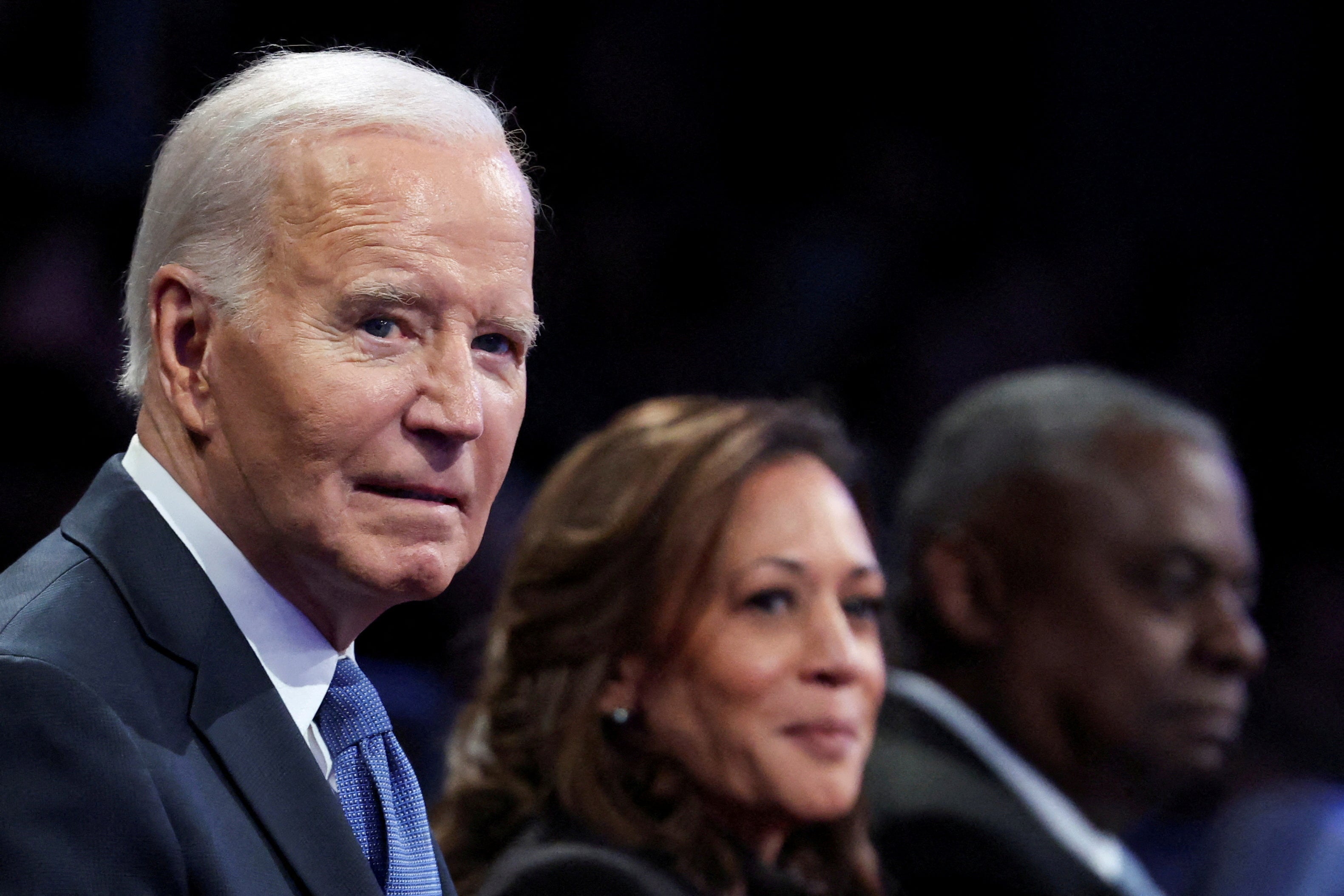
Another option would require the creation of a disability review panel, which would need approval by Congress and the president's signature, or, if vetoed, the support of at least two-thirds of the House and Senate.
Once the vice president and either the cabinet or a disability review panel agree that the president must be removed, the vice president would then immediately be able to “assume the powers and duties of the office as acting president.”
The president can tell Congress that “no inability exists” and will “resume the powers and duties of his office,” which the cabinet or disability panel can then challenge.
Congress then has 21 days to settle whether the president is fit to serve. A two-thirds vote from both the House and Senate must agree to let the vice president step in.
Join our commenting forum
Join thought-provoking conversations, follow other Independent readers and see their replies
Comments
Bookmark popover
Removed from bookmarks