OceanGate CEO ‘completely ignored’ flawed Titan sub before deadly Titanic trip, Coast Guard report finds
The Titan submersible’s implosion was “preventable,” according to a new Coast Guard report.
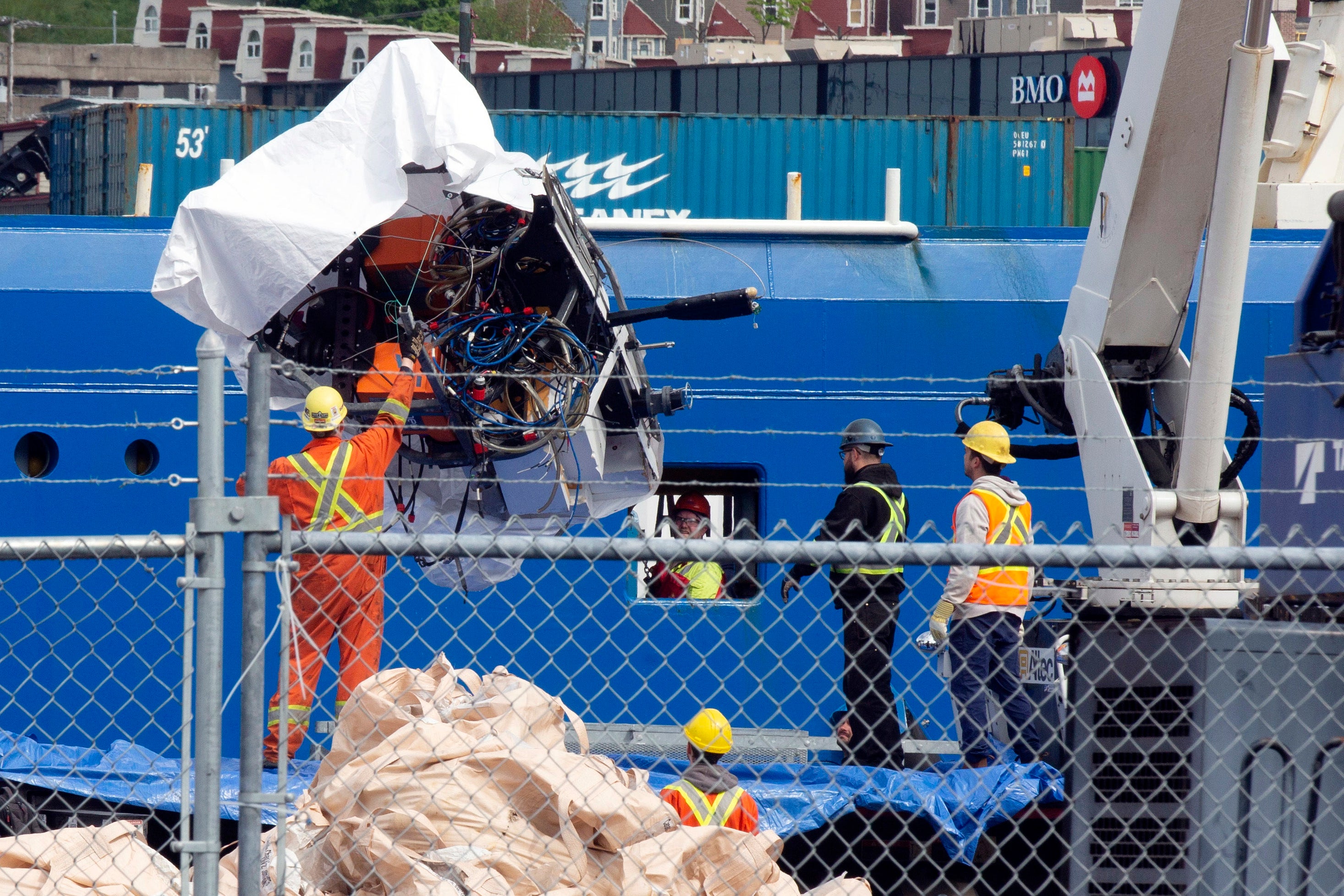
OceanGate CEO Stockton Rush, who died on the deep-sea submersible alongside four others, ignored critical data leading up to the vessel’s implosion in June 2023, according to a new report from the U.S. Coast Guard.
The 335-page report released Tuesday revealed that OceanGate had “critically flawed” safety practices and a toxic workplace culture — and that Rush’s “negligence” contributed to the deaths of those on board.
It also found that the Titan’s disappearance — and eventual implosion — was “preventable.”
“This marine casualty and the loss of five lives was preventable,” said Jason Neubauer, the Titan Marine Board of Investigation Chair, while calling for greater oversight. “The two-year investigation has identified multiple contributing factors that led to this tragedy, providing valuable lessons learned to prevent a future occurrence.”
Rush, 61, and four other passengers were trekking out to see the wreckage of the Titanic in June 2023 when their Titan sub imploded. The other four passengers killed in the implosion were Pakistani businessman Shahzada Dawood, 48; his son, Suleman Dawood, 19; British businessman Hamish Harding, 58; and French explorer and Titanic expert Paul-Henri Nargeolet, 77. The search for them after losing contact with the surface became a worldwide phenomenon.
Rush, who acted as the Titan sub’s pilot, was singled out as the driving force that led to the catastrophe.
The OceanGate boss “exhibited negligence that contributed to the deaths of four individuals,” the report found. It also “identified evidence of a potential criminal offense.” Had Rush survived, the Coast Guard would have recommended that the Department of Justice consider pursuing a separate criminal investigation.

 Titan sub heard ‘popping’ on previous dive before fatal implosion in eerie audio
 Titan viewers left unsettled by OceanGate CEO’s chilling comment in Netflix documentary
- ‘Close enough’: OceanGate CEO Stockton Rush’s reckless behavior before Titan implosion revealed in new documentary
 Titan submersible victim honoured with plaque at Titanic wreck site
How the company was run allowed Rush to “completely ignore” critical data and other safety measures ahead of the doomed expedition to the Titanic’s ruins.
“The lack of both third-party oversight and experienced OceanGate employees on staff during their 2023 Titan operations allowed OceanGate’s Chief Executive Officer to completely ignore vital inspections, data analyses and preventative maintenance procedures, culminating in a catastrophic event," the report stated.
The report detailed eight primary causal factors that led to the sub’s implosion:
OceanGate’s design and testing processes didn’t address “the fundamental engineering principles” needed for operations in “an inherently hazardous environment.”
- OceanGate did not understand the expected cycle life of the sub’s hull.
- The company relied too heavily on a real-time monitoring system of the sub’s condition, but failed to meaningfully examine the data the system provided.
- OceanGate continued to use the Titan following incidents that “compromised the integrity of the hull and other critical components.”
- The Titan’s carbon fiber construction led to issues that weakened its overall structural integrity.
- The company failed to investigate the sub after “mishaps that negatively impacted its hull and components during dives” before the implosion.
- OceanGate’s “toxic workplace environment,” where employees who raised safety concerns were either fired or threatened with termination.
- The company’s failure to conduct “preventative maintenance” on the sub’s hull or protect it from elements during the off-season ahead of the doomed 2023 expedition.
However, it also confirmed the overarching cause of the implosion was a “loss of structural integrity,” which led to the instantaneous death of all five people.
The report also noted that OceanGate failed to investigate a whistleblower’s complaint in 2018. Had there been an earlier investigation, the report suggests, OceanGate could have either met regulatory requirements or changed its plans for the Titanic expedition, the report found.

In September 2024, the Coast Guard held a two-week -ong hearing into the submersible’s disastrous voyage that shed a light on some of the issues the company was facing ahead of the tragedy.
During the hearing, over two dozen witnesses spoke, including former OceanGate employees, who detailed the “absolutely idiotic” hand-typed Excel spreadsheet the company used to track the Titan.
“There were delays because there was this manual process of first writing down the lat-long coordinates and then typing them in,” Antonella Wilby, a former OceanGate contractor, told the hearing held by the Coast Guard Marine Board of Investigation.
“We tried to do that every five minutes, but it was a lot to do,” she said.
Another former employee, Tony Nissen, told the hearing he raised concerns about the sub’s safety and had refused to take a test dive in the vessel.
The hearing also revealed one of the final messages sent from the Titan, which eerily read “All good here.”
David Lochridge, the former director of marine operations for the company, testified that he had expressed concerns over the Titan’s carbon fiber hull — and slammed the company for cutting corners and only caring about making money.
“I knew the hull would fail,” he said during the hearing. “It’s an absolute mess.”
Mark Butler, CEO of Action Aviation, paid tribute to his friend Hamish Harding, who perished on Titan, as a “kind, wonderful father, and an amazing businessman.” Butler also hit out at Rush in a statement following the report’s damning findings.
"We are obviously appalled by the contents of the investigation report, but not shocked. It was very evident from the early stages of the investigation, now confirmed by the published report, that Mr Rush had been trying to run his company on a shoestring, cutting corners, and paying little attention to basic safety and best practices,” Butler said.
“His negligence and appalling behaviour has caused the death of Hamish Harding and the other passengers on board the Titan submersible. The loss of Hamish has been horrific for both the family and for all of us at Action Aviation. We hope that others will learn from this incident and not repeat the selfish and senseless actions of Mr Rush and his company,” Butler added.
The submersible company suspended all exploration and commercial operations following the doomed expedition. The National Transportation Safety Board is also running its own investigation into the implosion.
Join our commenting forum
Join thought-provoking conversations, follow other Independent readers and see their replies
Comments
Bookmark popover
Removed from bookmarks