The Independent's journalism is supported by our readers. When you purchase through links on our site, we may earn commission. Why trust us?
I tried Dyson’s new robot vacuum – it’s a major upgrade on the old model
Dyson finally gets robovacs right – the new self-emptying hybrid is a suction superstar with clever built-in tech
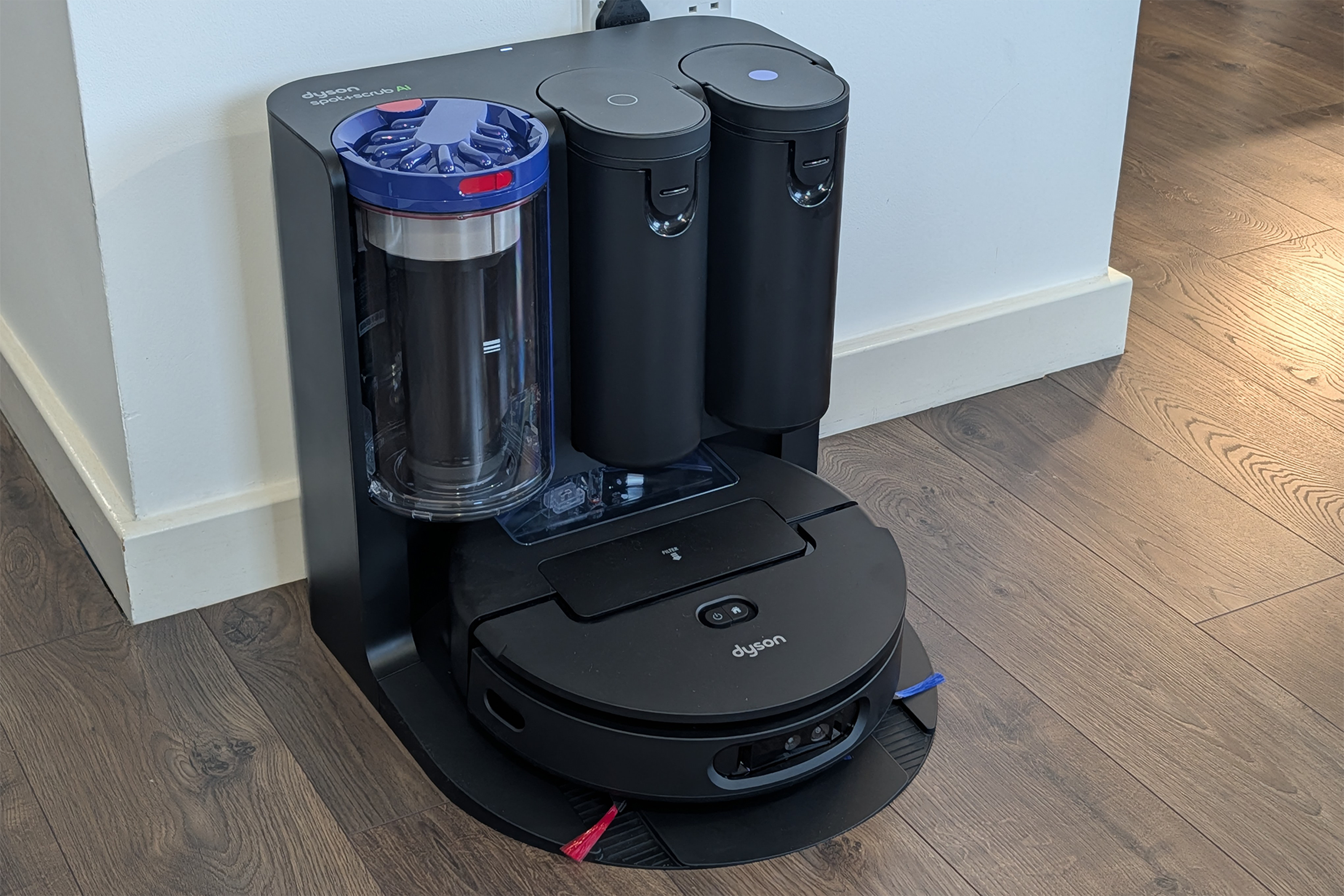
Dyson has taken another swing at designing a robot vacuum cleaner – and this time, you might actually want to use it. I wasn’t a fan of the company’s Dyson 360 vis nav – a noisy, bulky and expensive purple monstrosity that lacked a mopping function, couldn’t empty itself and seemed to actively seek out obstacles to get stuck on.
With the Dyson spot+scrub AI, the British engineering giant has wisely gone back to the drawing board. The design is much more mature, finally taking the vacuum-and-mop hybrid format seriously, delivering a hands-off machine that promises to wash your floors as aggressively as it vacuums them.
The headline feature here isn’t just the Dyson-tier cleaning power, but the dock. Unlike almost every other self-emptying robot on the market, Dyson has stuck to its guns with its trademark bagless cyclone design. This means no ongoing costs for disposable dust bags, which is a small win for your wallet. However, in a move that must have caused heated arguments among Dyson’s design team, it also means your accumulated household filth sits in a clear plastic bin for all to see.
Does the performance justify having a literal window into your home’s hygiene? And can the mop really tackle the kind of kitchen nightmares that usually require human elbow grease? To find out, I’ve been testing the Dyson spot+scrub AI in my own home, pitting it against everything from dried oat milk to stray charging cables.
Read more: Best Dyson vacuums, tried and tested
How I tested
I’ve been using the Dyson spot+scrub AI as my regular robot vacuum cleaner for several weeks, letting it take over the daily cleaning duties. On top of that, I challenged the robovac to a series of rigorous tests, chucking rice around like I was at a wedding and dumping so much cornflour on the floor that my flat began to look like Tony Montana’s mansion.
Dyson spot+scrub AI robot vacuum
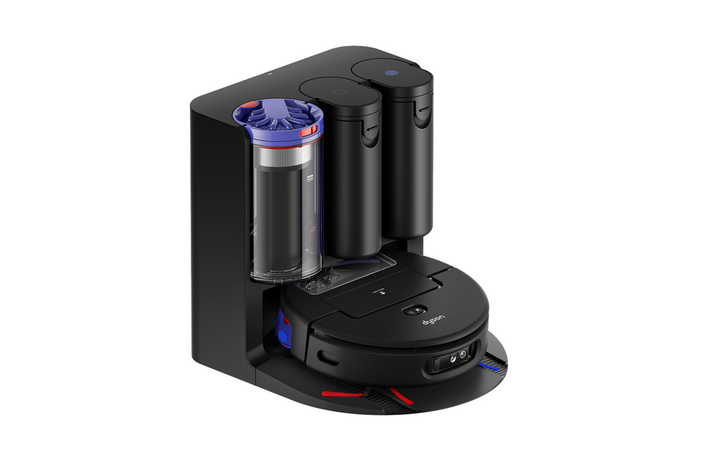
- Why we love it
- Powerful suction
- Impressive mopping capability
- Excellent obstacle avoidance
- Truly hands-free
- Take note
- Large dock
- Transparent bin is unappealing
Design and setup
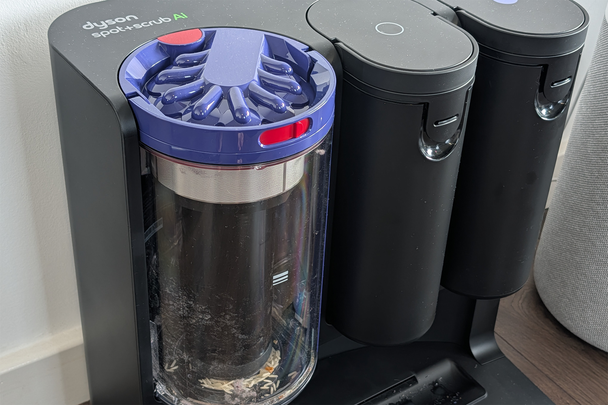
The Dyson spot+scrub AI is not a subtle piece of tech. The docking station is huge compared to my current top pick of robovacs, the Eufy X10, dominating the room in a way that suggests it was designed for sprawling Californian mansions rather than pokey British flats.
It looks the part, though. You get a colourful flash of Dyson purple on top of the cyclone dustbin and on the robot itself. The transparent tank even lets you see your mopping water sloshing around inside as it bops around your kitchen – a detail I find weirdly mesmerising.
My little London flat doesn’t have the luxury of a utility room for the robot to call home, so I prefer the subtler and more compact design of the Eufy docking station, which manages to cram the same dustbin and water tanks into a smaller box. The fact that Dyson has chosen to make the dock’s dustbin see-through means it’s not an object you’ll want to position somewhere your guests can see it, either – unless they’re particularly interested in the content of your carpets.
The robot itself is slightly taller and wider than many rivals I’ve tested, which caused an immediate issue in my bathroom: it can’t fit into the gap between the toilet and the wall, a space that slimmer robots just about squeeze into. If you have a lot of low-slung furniture or tight nooks, this chunky boy might struggle to reach them.
Navigation and obstacle avoidance
Whereas the Dyson 360 vis nav required that you pre-tidy your floors before setting it loose, the Dyson spot+scrub AI confidently gives a wide berth to obstacles it spots in its path. It’s not perfect, but it strikes the right balance between caution and bravery. By not being too timid about bumping into stuff, it’s less likely to miss a patch of floor or fail to navigate its way through a tight spot.
Overall, the navigation is up there with the best robot vacuum cleaners. It successfully scooted around a tactically placed shoe without choking on its laces. While it would sometimes gently nudge stray plugs, it manages to avoid getting tangled in loose cables.
Mapping is quick and does a fair job of recognising the outlines and layouts of rooms, even if it can’t physically reach the walls because of furniture and fittings. In my testing, the robot was confused by a mirror, which it seemed to think was a portal into the next room. This meant I had to manually split the room in the MyDyson app, which is straightforward enough to manage.
The app successfully guessed what each room was, automatically labelling the kitchen, living room, bedrooms and hallways. If you find that a bit creepy, Dyson assures us that anything captured by the robot’s camera never leaves the device – images don’t even show up in the app. That’s a far cry from the less privacy-conscious Dreame X50, which lets you remotely pilot the robot from your phone.
Vacuuming performance
Look, when it comes to sucking things up off the floor, Dyson is obviously in its element. Raw suction power was the Dyson 360 vis nav’s saving grace, and the cleaning performance of the spot+scrub AI remains exceptional. In the rice test – where robots like the Roomba 105 tend to fling dry grains across the hard floor with their fast-spinning side brushes – the Dyson managed to guide and brush almost every single grain into its waiting rollers.
It was equally impressive with fine particles. When faced with a spill of cornflour, the suction did a great job of clearing the mess without spreading it around, and crucially, it didn’t leave any white traces deep between the floorboards. If your primary concern is dust pickup, this machine is a beast.
There’s great dirt clearance on deep and low-pile rugs, and the robot is clever enough to know when to deploy its mopping roller and when to lift it. I’ve tested robot vacuum cleaners that physically remove their mopping pads when they’re not needed, like the Dreame X50, but the Dyson isn’t troubled by carrying a wet roller around during its vacuuming phase.
Mopping
The “scrub” in the robot’s name implies a vigorous, back-and-forth action designed to lift stubborn stains. In practice, I didn't see much of this happening. In any case, you can ask the robot to take extra passes in a room or use extra water, but by default, it’s giving floors more of a wipe than a scrub.
This style of mopping is hardly unique to the Dyson. I’ve found that mopping functions on robot vacuum cleaners really aren’t intended to tackle serious messes; instead, they lift stuck-on dirt and clean up spills that dry vacuuming alone will miss. For light duties, it works just fine.
The robot heats clean water to 60C before mopping, which tends to sort out the most common stains without any trouble. A dried-on spot of oat milk vanished in a single pass, but tougher, oilier stains like dried ketchup remained largely intact after the robot passed over it. It’s great for surface-level freshening, but don’t expect it to replace a manual mop for dealing with proper kitchen grime.
The robot cleans its mop roller as it spins to avoid smearing muck up and down the hallway, and when cleaning along walls and skirting boards, it will physically extend the roller to reach edges. After a run, it returns to the dock to empty its bin, giving the absorbent pad a deeper clean and a blow-dry to prevent bacteria and other grot building up. The drying process takes a little while and makes a quiet whooshing sound, but it’s a great feature that makes upkeep a breeze.
Oddly, Dyson doesn’t include any detergent in the box. My guess is that it’s a logistical headache to ship a concentrated chemical cleaner alongside the robot itself – but I would have appreciated at least a voucher code to grab my first £19.99 bottle.
Is the Dyson spot+scrub AI robot vacuum cleaner worth it?
It took Dyson a few attempts, but it has finally made a robot vacuum cleaner that can be counted among the best. The spot+scrub AI’s suction power and overall cleaning performance are top-tier, handling everything from fine flour to scattered rice with the competence you’d expect from the brand.
The bagless dock is an innovation I’d like to see rivals copying, less so the bizarre decision to add a great big window to the side of the dustbin. Sure, the see-through cyclone tech is unmistakably Dyson, but nobody needs to see their own dirt on display.
With an RRP of more than £1,000, the spot+scrub AI falls into the classic Dyson trap of commanding a premium price tag when cheaper competitors are matching or beating their vacuums on performance. For a lot less money, you can get the excellent Eufy X10 pro omni, which mops and cleans just as well, can fit into tighter spaces and comes with a smaller and more discreet dock. The money you save would keep you in disposable dustbin bags for a long time.
Still, this is a fantastic and stylish robot vacuum cleaner that, considering the rest of Dyson’s product range, comes in at a surprisingly reasonable price. If you’re brand loyal and holding out for truly hands-off automation from Dyson, the spot+scrub AI is the robot vacuum you’ve been waiting for.
How I tested the Dyson spot+scrub AI robot vacuum cleaner
I’ve been passively testing the Dyson spot+scrub AI for weeks to spot the kinds of issues that only pop up with regular daily use. For this review, I subjected the robot vacuum cleaner to a more rigorous set of cleaning challenges to see how it compares to the best robot vacuum cleaners.
- Navigation: I set the robot loose in a space filled with typical hazards, including a tactically deployed shoe, stray plugs and cables, to test its obstacle avoidance. I also checked its physical dimensions against tight squeezes, specifically the gap between my toilet and the wall.
- Vacuuming: To test suction power across different particulate sizes, I dumped white rice on the floor to see if it scattered the grains or collected them. I also used cornflour to test its ability to capture finer material and checked for residue between floorboards.
- Mopping: I tested the scrubbing claims against different stains, ranging from easy-to-clean wet spots and dried oat milk to tougher, oily stains like ketchup.
- Maintenance: I evaluated the self-cleaning dock process, noting the noise levels and the practicality of the bagless dustbin.
Why you can trust IndyBest reviews
As IndyBest’s tech critic, Steve Hogarty has tested dozens of the best robot vacuum cleaners, watching them develop from novelty gadgets into indispensable cleaning companions. By deploying the robots in his own home like some rubbish science-fiction villain, he tracks how they cope when the pristine lab conditions are stripped away, ensuring his recommendations are always based on real-world performance.
Tired of cleaning? Go hands-free with the best robot vacuums to clean dust and pet hair
Bookmark popover
Removed from bookmarks