Japan braces as Takaichi begins new term with huge mandate for low-tax, ultra-conservative agenda
A supermajority in parliament’s lower house allows prime minister’s party to override upper house opposition
Sanae Takaichi is set to be formally reappointed as Japan’s prime minister after winning a landslide election victory for her Liberal Democratic Party.
The reappointment is largely procedural, but it strengthens her mandate to push Japanese policies further to the right, experts say.
Armed with a supermajority in the parliament’s 465-seat lower house, the LDP can override upper house opposition, dominate key committees and pass legislation more easily.
In calling a snap election after only around three months in office, the 64-year-old conservative sought a fresh public mandate for increased spending, tax cuts, and a security strategy aimed at accelerating Japan’s military build-up.
Her economic policies in particular “marked a major shift”, Ms Takaichi told the national broadcaster NHK, and she felt she “could not proceed without first seeking a mandate.”
After becoming Japan’s first female prime minister in October, through a historic parliamentary vote, she said she was putting her leadership to the test to bolster backing for her economic and defence agenda.
Jiji Press reported that Ms Takaichi’s cabinet resigned collectively on Wednesday, a procedural step ahead of her expected reappointment.
The Asahi Shimbun reported that a 150-day special session of the parliament, scheduled to run until 17 July, would begin with Ms Takaichi’s policy address on 20 February. In her speech, she is expected to emphasise economic growth driven by investment and announce a public-private partnership roadmap for advanced technologies and key growth sectors that will be unveiled in March. She’ll tackle questions about her address from representatives in both houses from 24 to 26 February.
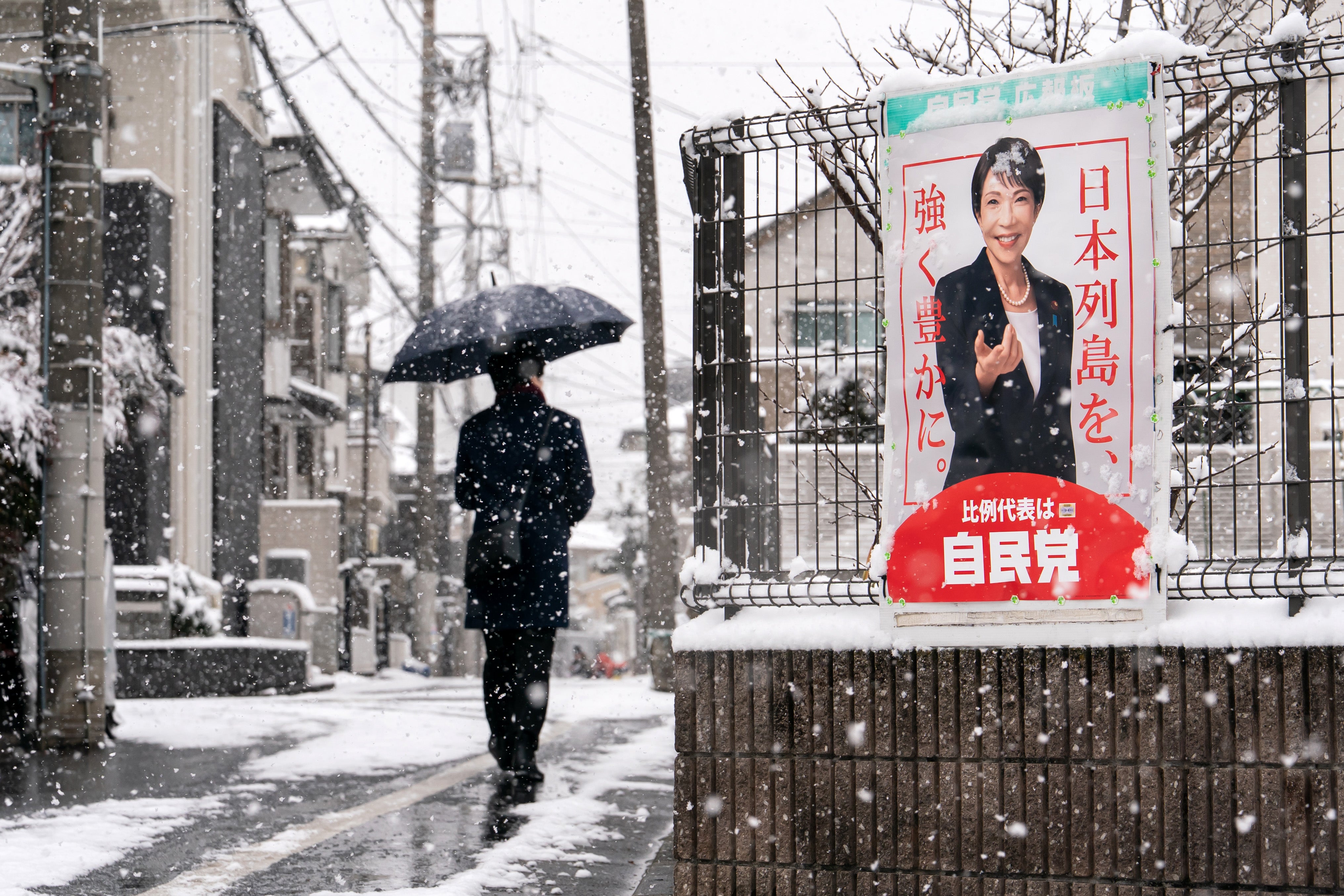
Ms Takaichi previously outlined plans to expand Japan’s defence capabilities and weapons exports, introduce stricter immigration measures, uphold male-only imperial succession, and maintain the long-contested requirement for married couples to share a single surname, a practice that critics said disproportionately affected women.
However, the prime minister’s goal of amending Japan’s US-imposed pacifist constitution may be delayed as her government faces mounting pressure to tackle inflation, demographic decline and growing security concerns.
Ahead of the election on 8 February, Ms Takaichi received an endorsement from Donald Trump, who hailed her as a “strong, powerful and wise leader”. “She will not let the people of Japan down!” the US president added.
Ms Takaichi is planning a two-year sales tax cut on food to ease living costs, though experts warn her expansionary fiscal approach could worsen inflation and Japan’s already large national debt.
On foreign policy, she has sought to ally with Mr Trump. Tokyo, in a bid to escape punitive tariffs, has pledged major investments in US projects under a $550bn package and also indicated willingness, in the face of American pressure, to further increase defence spending.
Ms Takaichi has taken a hawkish stance towards China, suggesting, in remarks that drew diplomatic and economic pushback, that Japan could act if Beijing were to move militarily on Taiwan.
The prime minister is also considering visiting the controversial Yasukuni Shrine, which is seen by neighbouring countries as a symbol of Japanese brutality against their populations during Second World War.
Join our commenting forum
Join thought-provoking conversations, follow other Independent readers and see their replies
Comments
Bookmark popover
Removed from bookmarks