America’s new Iran policy? Keep the ayatollahs guessing
Despite Donald Trump’s promise to the protesting masses in Iran that ‘help is on its way’, the US president may have been persuaded to adopt a more cautious – and potentially more fruitful – wait-and-see approach instead, says Mary Dejevsky


Since the start of the year, it has been rare to wake up without news of a fresh and unheralded demonstration of US power. Yet in recent days, that is what happened – or, rather, did not happen.
Braced for some risky US intervention in Iran, we awoke this morning to find that… well, nothing had happened. The Trump administration might have declared that the US was “locked and loaded and ready to go”, but it didn’t go – or hasn’t yet. So why not?
It is not as though Donald Trump shies away from the use of force, as shown so graphically in recent weeks. From Christmas Day strikes in defence of Christians in northern Nigeria, to the dramatic extraction of the president of Venezuela and his wife in the first days of the new year, to the capture of a Russia-flagged, Venezuela-linked oil tanker in the northeastern Atlantic, and a flurry of reprisal strikes on Islamic State targets in Syria… the US military has been exceptionally busy.
And threading through all this action was Trump’s running commentary on the protests in Iran, which began with a pledge that if Iran “violently kills peaceful protesters … the United States of America will come to their rescue”. There would, Trump said, be “very strong action” if Iran started hanging protestors.
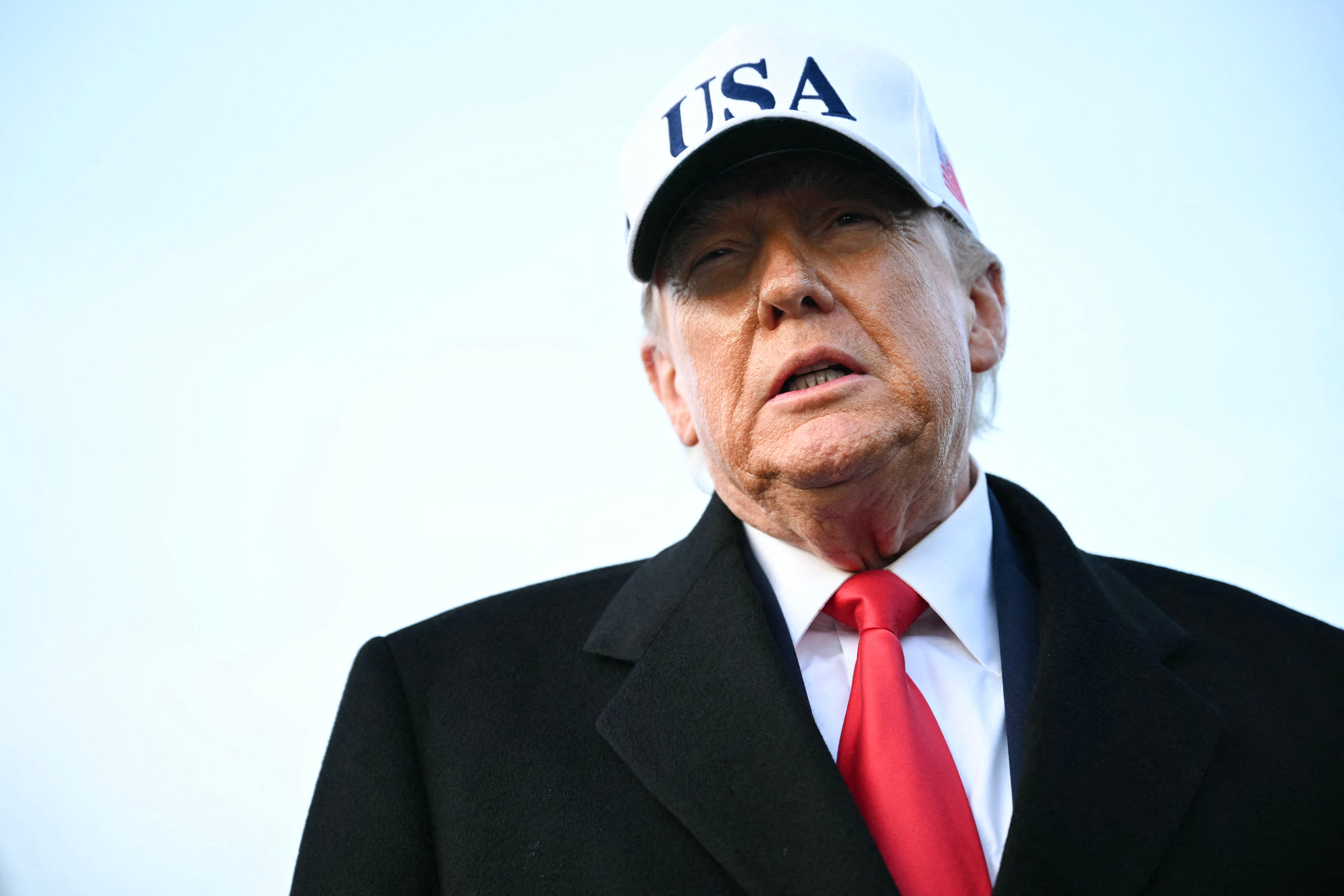
He continued with what seemed open encouragement to “Iranian patriots” to “keep protesting, take over your institutions” and an assurance that “help is on its way”. Although what help that might be was unspecified, the White House press secretary, Karoline Leavitt, helpfully noted that, while diplomacy remained Trump’s first option, “airstrikes would be one of the many, many options that are on the table”.
A day later, Trump said he had been told on good authority that the killings were subsiding, and there were no plans for “large-scale” executions, as though that somehow justified a retreat. That same evening, who should pop up on pro-Trump TV channel Fox News but Iran’s foreign minister, Abbas Araghchi, who said “there is no plan” by Iran “for hanging at all … hanging is out of the question”.
It might be noted at this point that the US has had no diplomatic relations with Iran since the 1979 Islamic Revolution, and launched airstrikes on its nuclear facilities last June, although it is still not known (publicly) to what effect. So, for a US TV channel to host a senior Iranian official with what amounted to a public statement for a US audience was quite an event.
It would now appear that any direct intervention in Iran has been paused, if indeed it was ever planned – which poses the questions: why, and what next?
A preliminary answer has to be one of caution. Military intervention of some kind could still be in the offing. Part of Trump’s purpose could be to keep many options open and everyone, especially the ayatollahs, guessing – and this is, in a way, a policy in itself.
What is more, it could be argued that this policy has not been without results. Were the Iranian authorities constrained by Trump’s threats? Unlikely as it might look from a Western viewpoint, did they scale back their use of force for fear of possible consequences? Has Trump actually saved some of those taken prisoner from execution? It would be hard for Iran now to embark on executions, given the direct public statements on US TV by the foreign minister – that is, without overt evidence of profound divisions in the Iranian leadership.
A bigger reason might be that, when it comes to it, for all his public bravado, Trump is a prime realist. He understood that intervening in what remains essentially a domestic dispute, albeit one bordering on revolution, could have unforeseen and dire consequences in this big and administratively centralised country. Limiting the repressions, in even a marginal way, was the best that could be done at this stage.
Such a view would be compatible with Trump’s stated contempt for US interventions in Iraq, Libya and Afghanistan. The operations he has mounted, both in his first term and now, are quite narrowly drawn: the 2020 assassination of Qasem Soleimani, leader of a branch of Iran’s Revolutionary Guard and the capture of Nicolas Maduro in Venezuela – as well as multiple raids from the air – could be defined by what is judged feasible, and where the benefits are calculated to outweigh the risk.
It might also be observed that, for all his grand talk, Trump has not engaged in direct regime change. In Venezuela, so far, the US has merely decapitated, but not toppled, a government.
In all that he has said about Iran, Trump has also been quite careful not to join calls for the restoration of the monarchy, despite this being a demand from some protestors and the late Shah’s heir, Reza Pahlavi, making his claim from exile. Trump is actually on record as saying that he is unsure about the strength of his support – the same reason he gave for not replacing Maduro with the opposition figure and Nobel prize-winner, Maria Corina Machado.
Considerations of feasibility versus risk may also have led to Trump’s caution about further US military backing for Ukraine.
He might give every appearance of being a risk-taker, but Trump’s own self-description as a deal-maker may remain nearer the mark. This does not mean that the US will not intervene in Iran in the future, but this will depend on how it calculates the odds of success and an orderly transition, and on keeping US boots very far from the ground.
Two other calculations may also be in play: the proximity of the congressional midterm elections, where a successful spectacle (Maduro) could play well, but a messy intervention (in Iran) could be a huge liability; and regional dynamics, as the US attempts to move to the second stage of its Middle East plan.
When it comes to US foreign policy, it may be worth trying to look beyond Donald Trump’s capital-letter shouts to the finer calculations and quieter diplomacy that could lie behind them.
Join our commenting forum
Join thought-provoking conversations, follow other Independent readers and see their replies
Comments
Bookmark popover
Removed from bookmarks