By unveiling his shadow government, Nigel Farage has just lost the next election
Reform’s front-bench team still looks like a one-man band, says John Rentoul – and the more ex-Tories it hoovers up, the less it will convince voters it can offer something new


You could almost hear Robert Jenrick’s ears prick up when Nigel Farage said: “If I was hit by a bus tomorrow…” Jenrick has secured a very good transfer fee for his defection, and today he claimed his prize of being named as chancellor in a possible Reform government, but he gives the impression of always wanting more.
There are certainly people in Reform who think that Jenrick’s calculation in joining the party was with an eye to taking over as leader if anything happened to Farage, but the man at the top was not in the business of naming his successor today. If he were the victim of the proverbial public transport accident, he said, “Reform has its own brand, Reform has its own identity”.
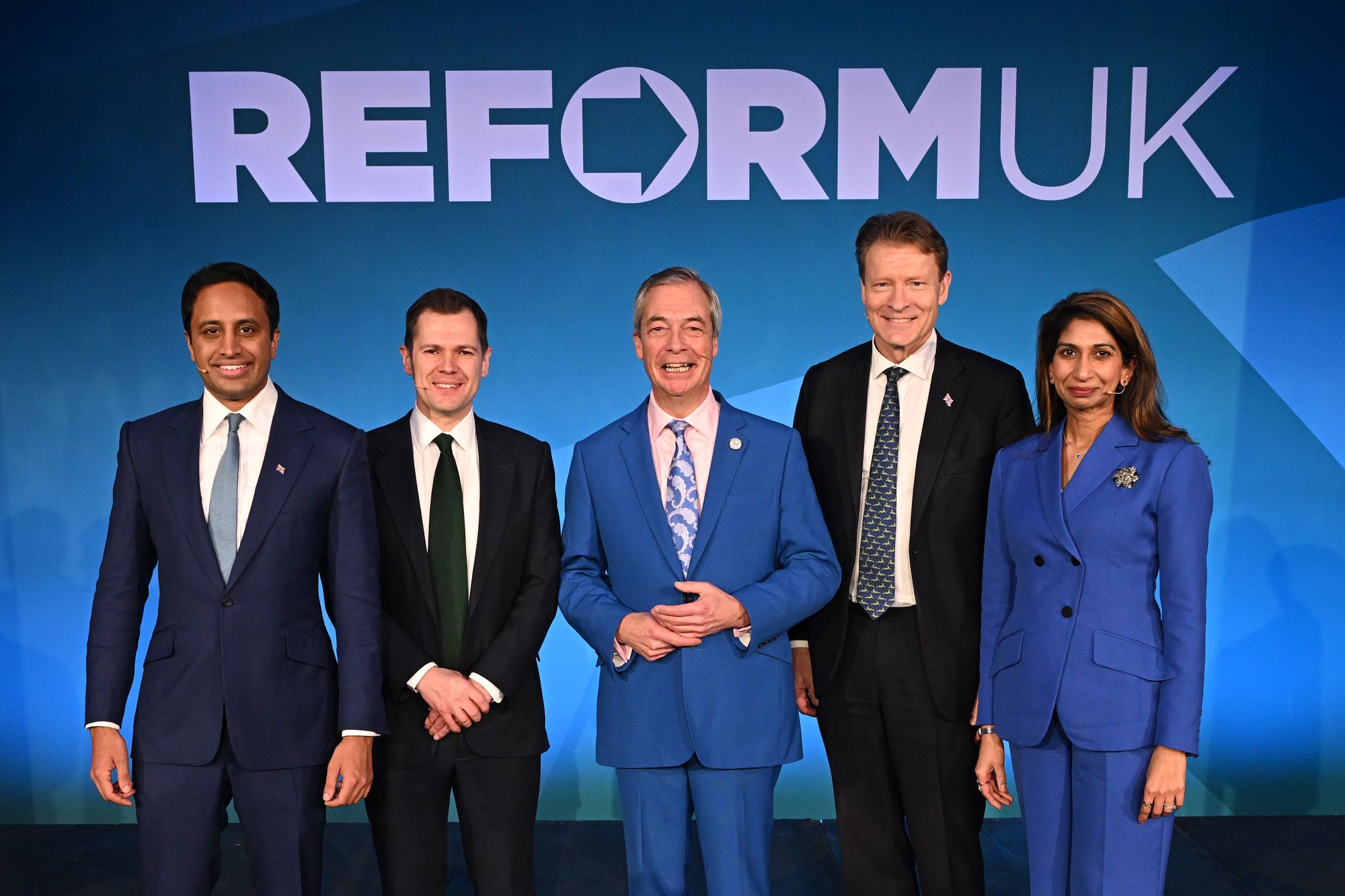
He was trying to say that the party was no longer a one-man band, and that it was now a professional outfit getting ready to assume the responsibilities of government. But almost everything about today’s news conference contradicted that impression.
“I want to speak for Robert here,” said Farage, when a journalist from the Daily Express tried to ask Jenrick a question about the two-child limit on benefits – a policy on which Farage has zigzagged since the last general election campaign.
When another journalist recited a roll call of people with whom Farage had shared similar platforms and with whom he has fallen out over the years, Farage became defensive and said there were people “in this room” who had worked with him for 10 years.
The Reform leader – or “shadow prime minister” as Gary Gibbon of Channel 4 News called him – also seemed to be tiring already of his openness to journalists’ questions. “It’s a long list,” he said as he looked at the names his media handlers expected him to call.
When he spoke for Jenrick, he said that the shadow chancellor would be making a speech tomorrow, “So there’s no point answering that.”
When ITV News asked about Jenrick serving as immigration minister in the Conservative government, responsible for the policies that gave us the Boriswave of immigration, he said Jenrick had resigned over the policy. “What more do you want? We don’t need to answer the question.”
Asked why he no longer believed that MPs switching parties should hold by-elections, he said: “We haven’t got time.”
He was stung by a journalist asking about Kemi Badenoch, who said she was glad to have got rid of “drama queens” from the Tory party. “If people mess about, are disloyal, they won’t be here for long,” he said.
And yet he had already had to negotiate the kind of jostling for position that afflicts established parties. With Jenrick and Richard Tice both pushing for the leading economics brief, he tried to split the difference by adding energy to the business department for Tice and adding the “shadow deputy prime minister” title to try to avoid Jenrick appearing too obviously to outrank him.
Again, there are many people in Reform who think Farage is like a football manager who has spent too much on his star players. “Shadow chancellor” is a generous title for Jenrick, who did not have much bargaining power once Badenoch expelled him from the Tories for plotting to defect. It not only gives Jenrick a great deal of power over policy but sets up possible conflict with Farage, whose instincts are to cut taxes and increase spending.
Suella Braverman, named as shadow education, skills and equalities secretary, has driven an even harder bargain. At least Jenrick has shown himself to be unexpectedly good at making videos. Braverman, a twice-failed home secretary, seems to bring rather less to the party.
Farage seemed surprisingly deferential about Jenrick and Braverman’s ministerial experience. “We’ve got an awful lot to learn,” he said. “These guys will help us.” We will see about that.
Oddly enough, the member of the “shadow cabinet” who was most persuasive was the one who is not an MP. Zia Yusuf, the “shadow home secretary”, presented a wall of statistics, as if he couldn’t choose which one best illustrated his point that the British are “lovely people who have been betrayed by a political class that has failed in its most basic duty – to control immigration”. Reform’s policy for stopping the boats is unconvincing, but he presented it with a conviction and a clarity that his would-be ministerial colleagues lacked.
And the more he and Jenrick referred to the wonderful things that would befall this nation under “Prime Minister Nigel Farage”, the more it felt like a one-man band whose complicated array of instruments is going to fall apart before he reaches the general election.
Join our commenting forum
Join thought-provoking conversations, follow other Independent readers and see their replies
Comments
Bookmark popover
Removed from bookmarks