Stop calling Iranian protesters ‘foreign‑backed’ – they’re not puppets
As Iranians, particularly the women, risk everything for freedom, too many in the West prefer conspiracy theories and scepticism to solidarity – and are repeating the language of the regime they claim to oppose, says Shabnam Nasimi


The first thing Western liberals and self-proclaimed progressives do when people rise up in Iran to protest isn’t to ask what they want. It is to ask who’s “behind” them. Before the names of the dead are even known, before the detained have been counted, the conspiracy theories begin: “Zionist-backed.” “US-backed.” “A CIA operation.”
It is the easiest way to delegitimise a movement before anyone has even listened to it.
I am tired of it – the kind of tiredness that comes from watching people in the region fight for their own dignity, only to have that struggle confiscated by Western progressives who treat our lives like footnotes to their ideological scripts.
Will the regime killing of Erfan Soltani convince progressives in the West to support #freeiran? Will the 2,400 Iranians killed finally bring people to the right side of history?
What makes it even harder to watch is that women are once again at the centre of this courage. Iranian women and girls are standing up to a regime that has built a machinery of control around their bodies, their voices and their choices. It takes a particular kind of bravery to protest when the state’s punishment is not abstract, but intimate, immediate and deadly.
If you are sitting comfortably in the West, with the freedom to protest, publish, assemble and criticise your government without disappearing into a prison, you should be careful about the arrogance of telling Iranians what their movement “really” is. That arrogance is not neutral. It has consequences.
It dismisses people facing a tyrannical state and hands the regime the very language it uses to justify repression: foreign agents, foreign plots, foreign hands.
I recognise this posture because I’ve lived it – as a woman from Afghanistan speaking about the Taliban. The same people who now dismiss Iranians as pawns dismissed Afghans as pawns too. The same people who now mutter “regime-change psy-op” were, not long ago, congratulating themselves for being on the “right side of history” because Nato left Afghanistan, as if the end of Western presence automatically meant the beginning of justice.
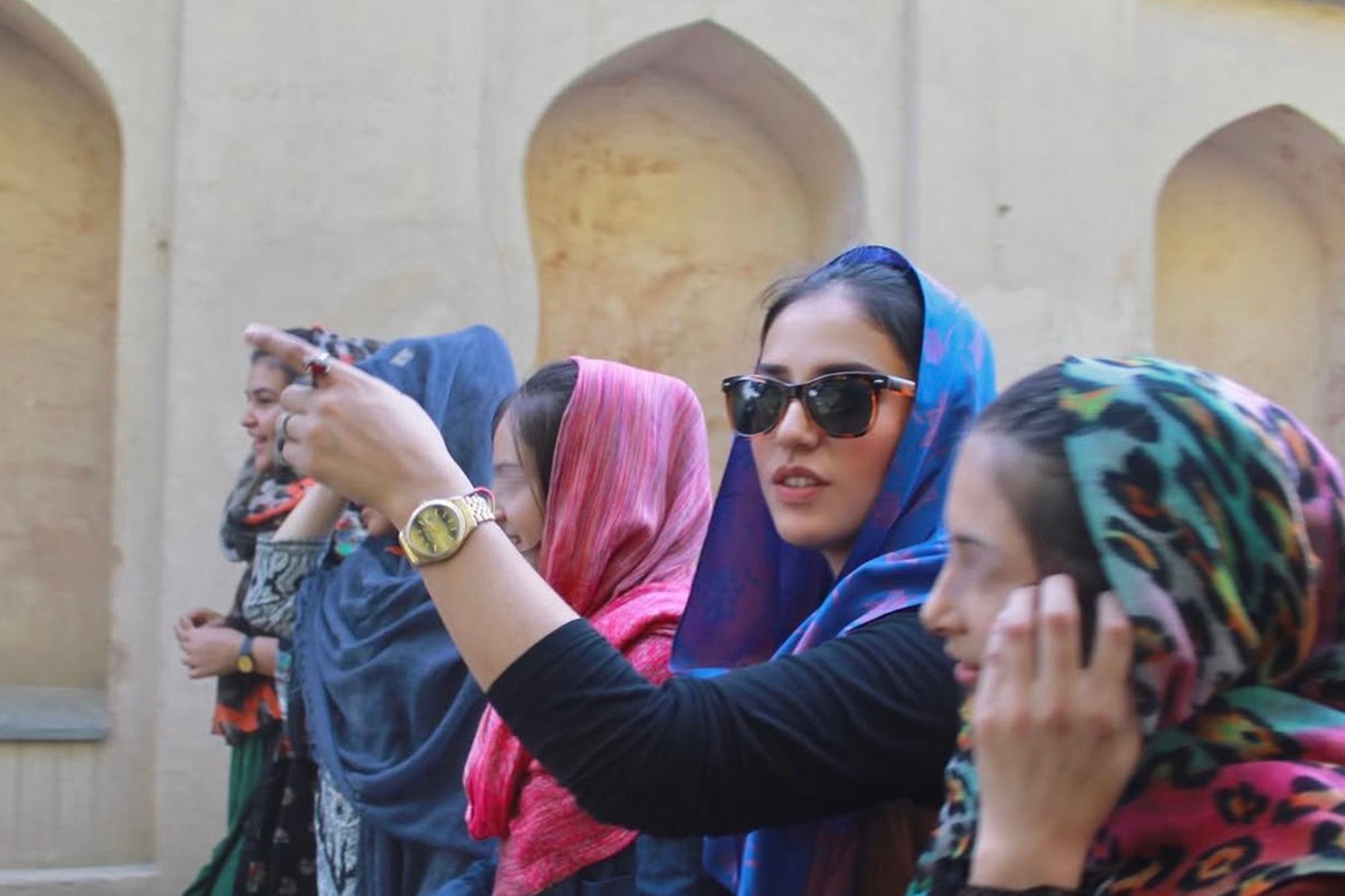
In June 2022, I was invited to speak at the Hay Festival on a panel about whether the West should have left Afghanistan. One of the other panellists, associated with the Stop the War Coalition, interrupted me multiple times while I tried to explain what the Taliban’s return meant in human terms: women erased from public life, girls locked out of classrooms, journalists targeted, civil society dismantled and people living with the constant knowledge that any wrong word can ruin your life.
He kept insisting – over and over – that the Taliban’s return was essentially a good thing because Nato had left. A Western man, speaking over an Afghan woman, telling her what her country “needed”, with the confidence of someone whose sister’s education was never on the line.
At some point, I snapped and told him to shut up. I told him to stop telling Afghans what Afghanistan needs. And I said the part that still matters: it is precisely this kind of commentary that helps tyrants gain legitimacy, because it reframes our catastrophe as your ideological victory.
That is what I’m seeing again with Iran.
Western campism – the habit of sorting the world into neat camps where the only “real” oppressor is the West – cannot cope with the fact that an Islamic regime can also be a tyrant. It becomes emotionally and politically easier to blame Washington than to name the Islamic Republic’s violence against its own people.
So they reach for the smear that does all the work: “foreign-backed.” It’s not analysis; it’s abdication. It’s a way to feel clever without having to feel responsible.
The most insulting part is the accusation that follows any demand for freedom: that you must be pro-US intervention. If Iranians want rights, if Afghans want the Taliban gone, they’re told they’re cheering for bombs, occupation and imperialism – as if there are only two options for us: submit quietly to domestic tyranny, or invite Western armies.
This is a false binary that polices our humanity. It rests on a deeply colonial assumption: that people in the region cannot desire freedom on their own terms. That our political imagination is borrowed. That our revolutions are never ours.
Let me say it plainly. Wanting to live under a state that does not beat you, surveil you, control your body, censor your speech and crush your future is not “pro-America”. It is pro-human.
You can oppose Western militarism and still oppose domestic authoritarianism. In fact, if you can’t do both, what you have is not principle; it’s a team sport.
And yes, there is a hypocrisy here that needs naming. Many Western activists find it easy to speak with moral clarity about Gaza because the oppressor fits the story they already know how to tell: colonialism, occupation and siege. And when Gaza was being bombed, I stood with innocent lives. I spoke up. I shared. I reached out to support in the small ways I could, because solidarity is not supposed to be selective.
But now, when Iranians are on the streets risking everything against a tyrannical state, I see silence. Worse, I see people turning on them, claiming they’re getting paid by the US or Israel – as if courage has to be funded to be real.
When the oppressor is an Islamic regime harming its own people – in Iran or under the Taliban in Afghanistan – the clarity evaporates. Outrage becomes conditional. Solidarity becomes selective. The language shifts from “liberation” to “it’s complicated”.
Some even slide into defending the regime as “anti-imperialist”, as though anti-imperialism is a magic shield that can excuse prisons, executions, morality police and the systematic humiliation of women.
If we don’t call this out, the damage won’t stay online. Every time Western voices dismiss Iranian protesters as foreign proxies, they help isolate them. They help normalise the regime’s favourite story that repression is self-defence. They create an environment in which tyrants can say – with a straight face – that anyone who demands dignity is an agent of the enemy.
Our revolutions are not your proxies. They are not America’s movements. They are not the West’s projects. They are ours – rooted in our grief, our courage, our exhaustion and our insistence on a life worth living.
You do not get to confiscate that and hand it back to us with a theory attached.
And you do not get to tell us what we need.
Shabnam Nasimi is co-founder and CEO of the Friends of Afghan Women Network (FAWN), which has over 70 grassroots Afghan women-led NGOs within its network. Find out how you can help here and stand with Afghan women today
Join our commenting forum
Join thought-provoking conversations, follow other Independent readers and see their replies
Comments
Bookmark popover
Removed from bookmarks