Nigel Farage could easily become the UK’s next PM – and it’s not because Reform voters are stupid
Over 20 years, Zoë Beaty has seen her hometown of Boston, Lincolnshire, spiral into devastating neglect. While a vote for Nigel Farage’s Reform UK might be one of protest – or based on false promises – the uncomfortable truth is that it has also become a party of hope


There are plenty of things that my hometown – Boston, in Lincolnshire – is famous for. Sausages, for one, and the copious veg grown on its vast swathes of fertile land; those Jakemans throat sweets always by the tills in Boots. It’s famous for its landmarks – like St Botolph’s Church, or “the Stump”, as it’s known locally – and for the Puritanism running through its roots: the story of the Pilgrim Fathers, who sailed the Mayflower to the market town’s US namesake.
Twenty years ago, when I was at school, it was Boston’s teen pregnancies, its status as the town with the highest murder rate per capita, and its problem with obesity that attracted national headlines and became part of its precarious history.
More recently, it has made its name as a place brimming with racism, division, exhaustion, and frustration. It is also right at the centre of England’s radical political revolution.
That’s quite a lot for a small town with a population of 45,000 people to pack in.
Since delivering the highest leave vote in the EU referendum (75 per cent), the flatlands of Lincolnshire have become a barometer of the country’s discontent. What’s unfolding here isn’t just local grumbling or electoral churn. It’s symptomatic of a much deeper fracture: one that speaks to lost faith in traditional parties, mounting pressure on public services, and a community caught between economic insecurity and cultural upheaval.
In this windswept corner of eastern England, there’s widespread certainty that Nigel Farage, the leader of Reform UK, could be the next prime minister. Surprising? Hardly. Back in June a much-dissected Ipsos poll found that if there were an election tomorrow, Reform UK would win; as Farage spoke at a press conference on Monday, stood behind a lectern emblazoned with “Britain is lawless” – and as protests outside hotels being used to house asylum seekers begin to sweep the country in recent weeks – it became clear that his attraction is hardly wearing off. In fact, any doubt about that is an indicator that you simply haven’t been listening to the inhabitants of places like Boston – and neither have those in Westminster.


The message has been loud and clear for more than a year now. In the days following the general election, I wrote about Farage’s unnerving presence and the threat posed by his newly formed party: despite winning just five seats, the infant Reform received more than 4 million votes. That’s 600,000 more than the Liberal Democrats, who took 71 seats in total. Only our first-past-the-post system prevented Reform from being the third-biggest party in the UK after it won almost 15 per cent of the vote.
On winning the Clacton by-election, Farage finally entered parliament, having secured 46.2 per cent of the vote. Since then, Reform’s visibility, along with its popularity, has surged in the polls. Back in March, a monthly tracker poll run by City AM showed Reform at 27 per cent, the party having overtaken both Labour (24 per cent) and the Conservatives (23 per cent) for the first time. By May, Reform had accrued 677 council seats, winning outright control of key county councils including Lancashire, Nottingham, Derbyshire, and, of course, Lincolnshire. The party also overturned a longstanding Labour seat in the Runcorn and Helsby by-election.

“If you look at our parliament, and you see Labour with a massive majority, it looks very stable,” says journalist Fraser Nelson, who travelled the UK asking “Will Nigel Farage be our next PM?” for a special Dispatches report that aired last month on Channel 4. “But if you look at the country as a whole, it’s basically on the brink of a political revolution,” he says. “That’s how it feels.”
Nelson was first drawn to the subject after spending a week in Blackpool trying to understand its problems. He found a town at the tail end of societal breakdown, where education rates are terrifyingly low and poverty is high.
“You meet non-verbal kids who can’t speak, but who point at an iPad if they want to do something,” he explains. “You find out ... that a third of the kids leave school without any GCSEs at all – these things were kind of mind-blowing. And then Blackpool turns out to be the place with a Reform pub opening – the only place in Britain. That’s fascinating: it is representing hope to these people.”
Fraser Nelson, the privately educated former editor of The Spectator – a magazine known for its right-wing views – might seem an unlikely candidate to be a voice for the deprived and disenfranchised. Though his programme may centre on Farage, it’s really “an examination of the forces behind support for his party”, he explains. But why would the inhabitants of a town like Blackpool put their trust in the Reform leader, who attended Dulwich College, and his deputy Richard Tice, the “ordinary” multimillionaire property developer who won the Boston and Skegness seat last year?
Boris Johnson, too – not known for his humble beginnings – was hugely popular among voters in these constituencies. It’ll come as no surprise, then, that age and education have displaced class as the main dividing line in politics, according to data published this week by the National Centre for Social Research – a result, apparently, of trust in mainstream politicians being at an all-time low.
It’s clear that a privileged background is no obstacle to being embraced by these communities, even if, in some instances, a professed interest in the poor might appear to be less about nobly improving their lot and more about spotting an opportunity. But it’s not just about trust. The likes of Farage and Tice “speak our language”, locals in Boston say, in a way that other politicians are simply unable – or unwilling – to do.

It works. In towns like Boston and Skegness – where almost a third of children grow up in poverty; where crime is rife and police funding is low; where the local rural hospital is at breaking point, and teachers in schools are having to become first responders in their communities – residents feel ignored, patronised, and consistently disregarded. They are angry.
Since Brexit, it’s been easy for those on the outside to dismiss their concerns as bigoted or plain stupid – many pointing to the fact that Leave voters are a lot worse off than they might have been had Britain stayed in the European Union.
It’s undeniable that there are factions who simply want “freedom of speech” to mean that harmful views go unchallenged; similarly, Reform’s call to arms – “common-sense politics” – is often packed with uncosted promises and intellectually lazy (yet effective) attempts to rationalise social regression. But it’s clear that it is – and always has been – dangerous to shut down those conversations and concerns altogether by labelling them as nothing more than idiocy.
We only have to look across the pond at US president Donald Trump’s strange appeal to non-white voters – a phenomenon very much present over here, too, as Nelson found – to see why. If the Labour Party wants to retain power, and if the rest of the country wants to keep Farage in his place, now is not the time for ill-thought-out assumptions about voters.
“It seems like [Labour and the Conservative Party] are psychologically incompetent in [refusing to believe] that these voters mean what they say,” says Nelson. “Farage is now some sort of Ghost of Christmas Future figure to terrify Starmer... He’s saying, if you fail these communities, this is what’s going to happen. And if you look at all the indicators – the social ladder is now more of a quagmire – they’re all set for failure.”
Reform is gaining strength because the mainstream parties refuse to properly engage with voters in these towns, or to offer bold and imaginative solutions to problems that have persisted for decades
More accurately, these communities, including my hometown, have already been failed by successive governments, over and over and over again. In 20 years, nothing has been accomplished by voting blue or red. Farage is telling towns like Boston that there is another way – and now, the so-called “wild card” doesn’t seem so much of a risk.
It’s also not insignificant that Farage is making a narrative landgrab to the left, recently claiming that he would implement a £250,000 “Robin Hood” fee for non-doms, exempting them from tax and giving the money directly to Britain’s poorest.
Reform’s position on the nationalisation of gas and water utilities is also evolving and increasingly pivoting away from the Thatcherite model that favours private ownership. It was Reform, not Labour, that pledged to scrap the Tories’ two-child benefit cap. On the surface, these policies appear unexpectedly liberal. Certainly, they were intended to appeal to the Labour heartlands – and crucially, such announcements have been designed to win hearts and minds, even if Farage has been hazy on the detail.
“This is a really important part of it,” explains Nelson. “Obviously, the Reform policies are very popular... But only one in five voters in our poll thought that Reform could actually do this without higher taxes or spending cuts, like they say. And, during my interview with him, Farage also pretty much admits that all of his pledges are ‘aspirations’. Right now, as far as I’m concerned, they have zero policies that would actually work. He’s not saying he will do this. He’s saying he would like to do this.”
Clearly, it’s not a shock that Farage could be being disingenuous, but it is a wake-up call. What the Reform leader’s strategy – both on the right, and in his phantom expansion to the left – is successfully doing is creating the political weather, further destabilising Labour as much as it is the Tories. And it’s time that Westminster smartened up, too.
The people of Boston – or Blackpool, or any other Reform-leaning town – don’t necessarily believe that Farage is going to transform their lives. But – and here is the important detail – they don’t believe that anyone else will, either.
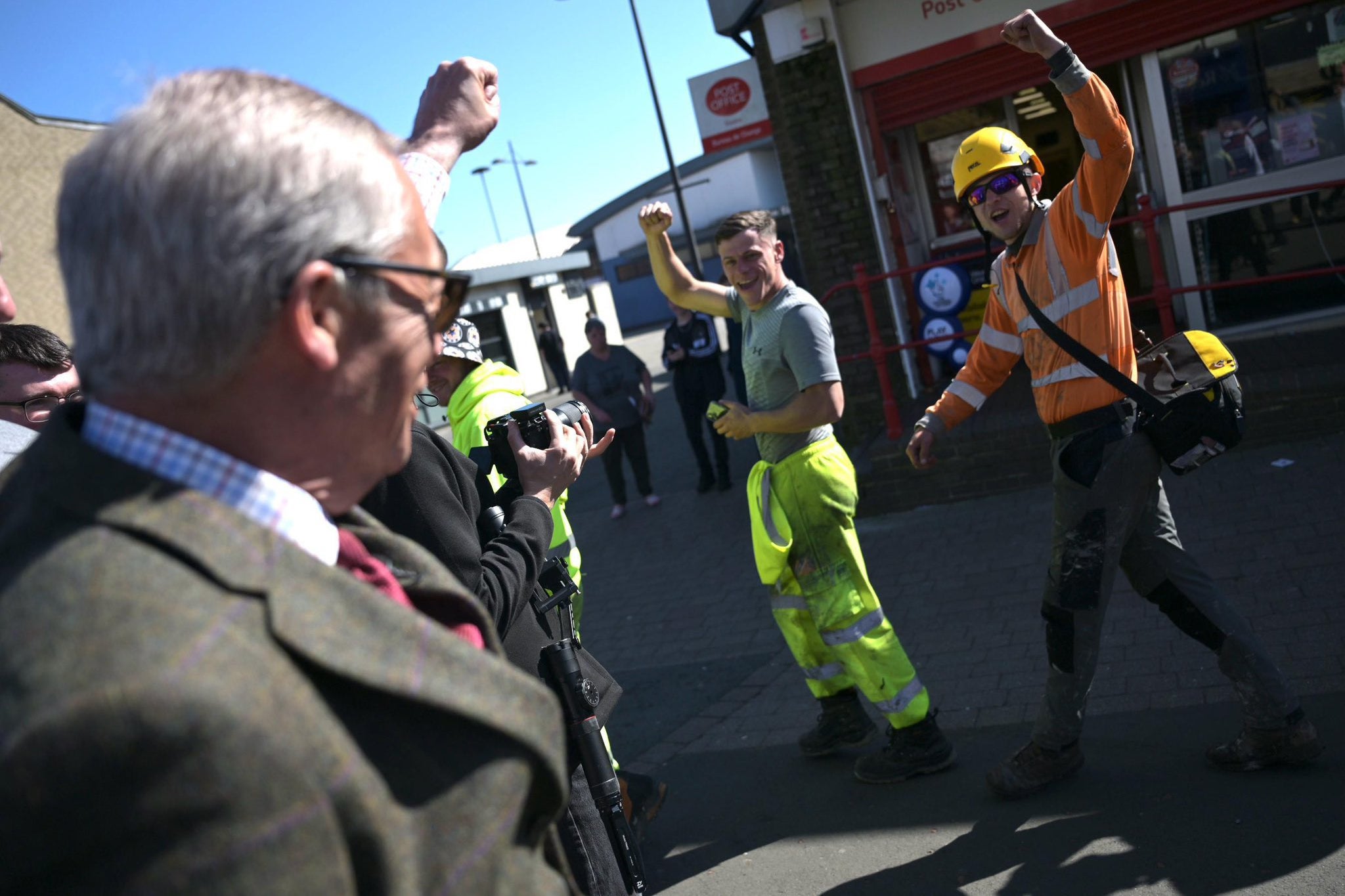
Reform’s promises, and Farage’s “aspirations”, might be paper-thin when you cut through the noise. But for communities that have weathered decades of political neglect, even aspiration – and, very simply, someone appearing to listen to them and vocalise what they are feeling – represents more than what’s previously been on offer.
The danger, then, isn’t just that Farage could rise up via grievance politics. It’s that Labour and the Conservatives still don’t seem to understand how, or why, this might happen. Starmer might be delivering detailed policy reviews, but he is losing at politics and optics where they really matter. He is failing to capture the narrative in a language that people can hear, because he and Rachel Reeves are still talking more to Westminster than to the Dog and Duck. And it is a sign of the prime minister’s own lack of confidence that there has been a muting of the one person who could reach into these communities: Angela Rayner.
Meanwhile, Reform is gaining strength because the mainstream parties refuse to properly engage with voters in these towns, or to offer bold and imaginative solutions to problems that have persisted for decades. Farage barely needs to try, given the litany of own goals.
Residents in places like Boston are tired of empty promises, but they aren’t stupid – as Nelson found, they’re used to finding hope in unusual places. They know Reform is a gamble, but what Farage is selling them is the dream of taking a risk in a world that feels as if it will never change if they don’t.
Join our commenting forum
Join thought-provoking conversations, follow other Independent readers and see their replies
Comments
Bookmark popover
Removed from bookmarks