Stab vests and kill drills: The children living in terror of being attacked in British schools
While other schools have fire drills, hundreds of pupils who go to Jewish schools are trained in what to do if confronted by a gunman. Nicole Lampert talks to the parents who are becoming too terrified to send their children to school and asks how this has become accepted as part of life in the UK?


The armed police are outside the school again. Not because of a fight or drugs: it’s more chilling. On the other side of the world, 15 Jewish people have been killed and 40 others are lying in hospital after two gunmen targeted a Hanukkah celebration taking place on Bondi Beach. And that means there’s an increased terror threat to British Jews.
But this is nothing new. Schoolchildren who attend Jewish schools in the UK are now sadly used to several layers of security, which would feel unthinkable to British pupils in other educational establishments. Even before October 7, on average, a Jewish school campus entrance would have two or three trained security guards and a couple of layers of gates or high walls.
Three months after the October 7 attacks, Isis issued its first official statement on the conflict, urging supporters to “strike the Jews wherever you can find them”, and as the threat has increased more and more measures have had to be put in place.
Like other schools, they have fire drills, but from a young age, Jewish children are also trained in how to react to an intruder in their school who has come to kill them. “I remember the first time my daughter told me she’d had a drill,” says Jo*, 53, who works in television and lives in north London. “I didn’t go to a Jewish school, and so I presumed she meant a fire drill. It was November, and I asked her, ‘Did you remember to put your coat on?’ And she said, ‘No mummy, we were inside. We all had to go to the corner of the room and the quietest person got a house point.’ It was then that I realised what this drill was for. She was six years old.”
When the alarm goes off, the youngest children – aged just 4 and 5 – are encouraged to play “sleeping bunnies”. Older children know that “the pupils nearest to the door need to put their desks across it to keep it shut, and then they sit in absolute silence”, adds Jo. “It goes on for about 20 minutes. The drills happen two or three times a year. Whoever makes a noise gets a detention. They know this is serious.”



Emily, a supply teacher, says she was shocked to see one of these terror drills in action while working at a Jewish school in London. “The first thing that struck me about the drill when it occurred was how completely focused the children were,” she recalls. “Gone was the excited chatter or silly behaviour normally found during a fire drill.
“As the siren sounded, the students immediately left their desks and got into position either beneath the nearest table or lined themselves up, with their backs against the walls, away from the outside view of the windows. The students knew this routine like the back of their hands. I’ll never how one student asked me in a hushed whisper with anxiety-ridden eyes: ‘Miss, do you think they’ll see me here?’”
Most of the entrances to the school have double doors. One doesn’t open until the other is shut. Around and outside the school gates, a rota of parents takes turns to patrol. Many of them have been trained by the Community Security Trust (CST), which also protects synagogues.
Even with all the security, haters find ways to make their mark. Michelle Morris, 35, a charity worker and mother of four, was stunned and disgusted to discover urine had been splashed all over the school gates at the primary school three of her children go to. “It absolutely reeked,” she says. “That same week, the keypad for the door of aJewish nursery had been coated in faeces. It feels like a violation, that anyone could hate that much.”

A friend who lives in Manchester tells me his daughter’s school is surrounded by a 10-foot wall, which is “ram-proof, everything-proof” and that each entrance has two security guards wearing bulletproof vests.
“Sometimes, there is a police presence. There are security cameras at every conceivable angle and panic buttons all over the school campus. There have been a lot more terror drills since October 7. There are massive sirens on the school building. It is extremely depressing that she has to go through all this when she is only six.”
Mia*, an artist who was born in Israel, now lives in London with her 14-year-old son, who is a pupil at Britain’s biggest Jewish school, JFS in north London, where there is a permanent police presence, two lots of security guards and a small army of CST and parent volunteers.
“As parents, we are constantly on edge. I didn’t send him to school for nearly two weeks. I was genuinely terrified and didn’t even explain the real reason to him because I didn’t want to pass that fear on.”
A few weeks after the October 7 attacks, Hamas announced a “Day of Rage” to take place across Europe, putting Jewish parents on extra alert. “Three police helicopters were circling above the school for the entire day,” adds Mia. “Parents were so agitated they simply parked their cars on the road leading to the school and stayed in them all day long.”
It is not just in school that they have to be on high alert. There have been numerous attacks on Jewish pupils going to and from school. JFS buses have had items thrown at them while children from another school, Hasmonean, have been attacked at the nearby tube station, Belsize Park.
“The children have people shouting ‘Free Palestine’ at them when they’re on their way home and some have tried to force them to repeat the slogans,” says Mia. “In at least one case, a child was physically assaulted for refusing. There were also incidents of people waiting near the school shouting ‘baby killers’ at pupils. I personally reported one such incident to the police.”
The security is there for a reason. There have been serious attacks at schools. People are on trial for other alleged planned massacres. Manchester’s largest Jewish school, King David, is also up the road from where, just a few weeks ago, two men were killed during an attack on a Manchester Synagogue on the holy day of Yom Kippur.
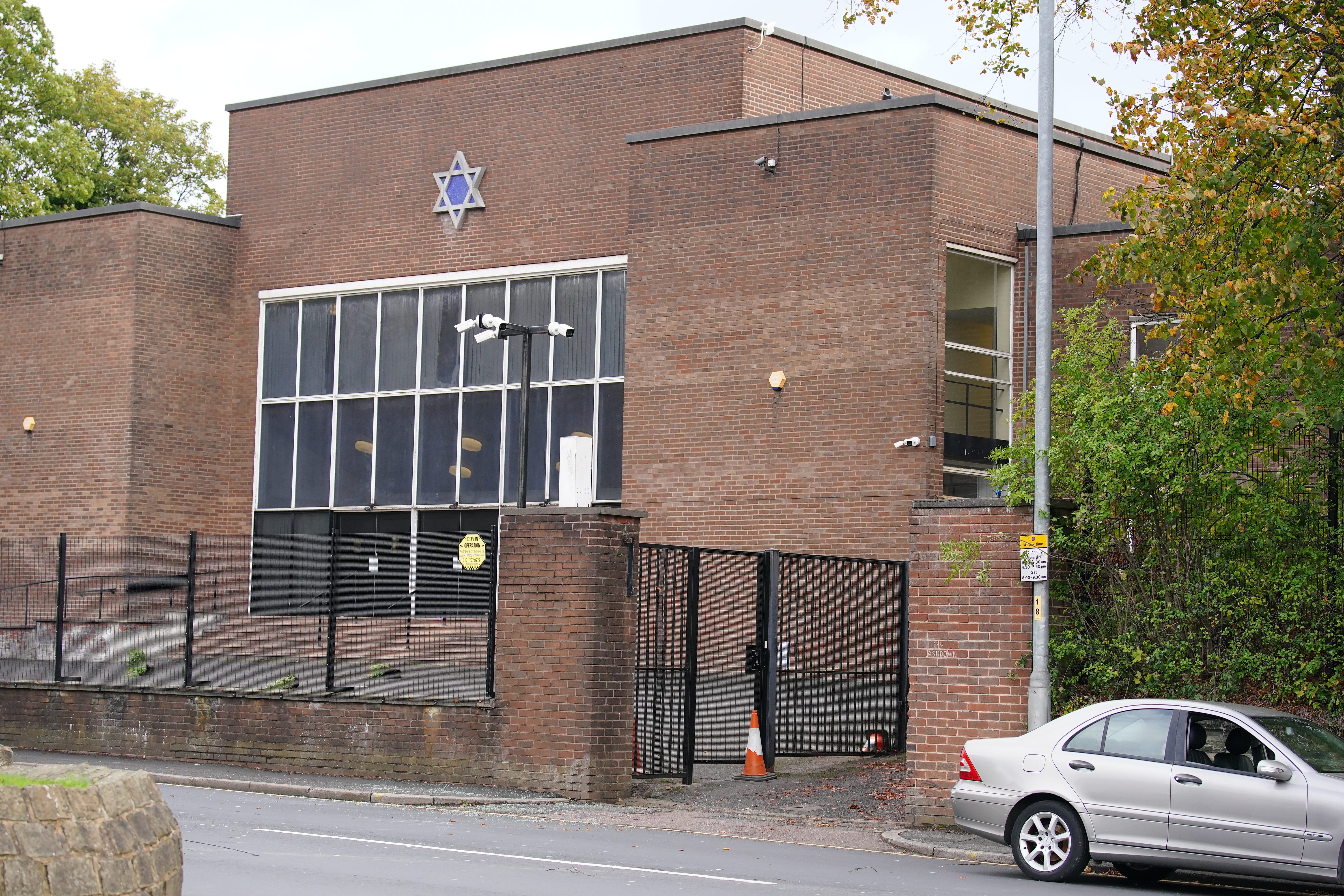
“It felt too close to home and has had a massive impact on the pupils,” says Mandy*, a mother of four whose children are at King David. “After the attack, some parents weren’t comfortable sending their children to school and didn’t feel safe. But we had more guards, and the police were there. The guards now have stab-proof vests, which they didn’t used to have.
“Some of the children take this in their stride, but my nine-year-old son has been affected by the synagogue attack. He makes me drive past there all the time; he wants to talk about it all the time. He had to write a piece about a real-life hero – his friends wrote about football stars, but he wrote about Rabbi Walker, who was at the synagogue that day. The school has offered lots of therapy to the children – it’s sad that this has to be the case.”
There are 46 mainstream Jewish schools in the UK and a further 91 in the ultra-orthodox community. The constant low-level anxiety is palpable in all the parents I speak to. Every time there is an attack on Jews anywhere in the world – there have been murders in France, America and now Australia – the school sends out emails telling parents that security is once again being tightened.
“I have three at [London Jewish comprehensive] JCos and one at a non-Jewish school, so I see both worlds,” says Elena, a doctor. “Parents whose children are not at Jewish schools don’t have that fear. I don’t think I’m an alarmist, but I feel an increasing sense of worry from the minute they get onto the school bus, until they are home.”
The alternative, of course, is sending children to a mainstream, non-faith school. It can be a tough choice. Some parents want their children to have a degree of Jewish education, and perhaps more are fearful about antisemitism in other schools – and wondering how early they should show their child how hostile the bigger, wider world can be.
“If we wanted to send our daughter to the local school, she would have been the only Jew there,” says Jo. “She plays football and is on a team with people from all religions.
“I talk to the other parents from other religious schools. We are the only ones who have to have security. It is hard to explain to a child why, when I can barely understand it myself.”
*Some names have been changed
Join our commenting forum
Join thought-provoking conversations, follow other Independent readers and see their replies
Comments
Bookmark popover
Removed from bookmarks