What’s that in the sky?! ‘Streak of fire’ expected over Eastern seaboard Tuesday morning
A NASA rocket launch is expected to be seen in several Eastern states on Tuesday morning
A “streak of fire,” as one report put it, is expected to be viewed over the Eastern seaboard Tuesday morning as NASA launches a sounding rocket.
The space agency’s Wallops Flight Facility in Virginia has announced the scheduled launch of a sounding rocket, a small rocket that flies to suborbital space, carrying experiments developed by college students.
The launch is expected to happen between 6 and 9 a.m. EDT on Tuesday.
“For those on the Delmarva Peninsula, weather permitting, you may catch a glimpse of the rocket in the sky,” the Wallops Flight Facility wrote on Facebook.
The News & Observer reported onlookers in multiple states will see a “streak of fire.”
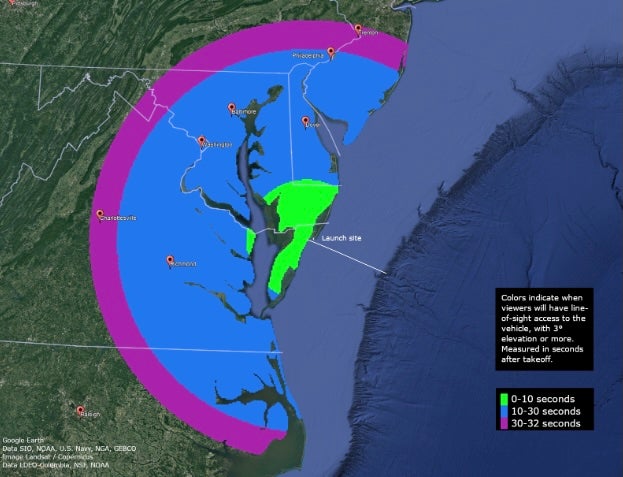
A map shared by the Wallops Flight Facility showed when viewers in different states may be able to see the rocket.
Within 10 seconds after takeoff, people on the Eastern Shore of Maryland will have line-of-sight access to the rocket.
Between 10 to 30 seconds after takeoff, those in Philadelphia, Dover, Delaware, Baltimore, Washington, D.C. and Richmond, Virginia, will be able to see the rocket.
About 30 to 32 seconds after takeoff, people in Trenton, New Jersey and Charlottesville, Virginia, will have sight of the rocket.
 NASA Curiosity rover discovers coral-like flower-shaped rocks on Mars
 Astronauts return to Earth with SpaceX after 5 months at the International Space Station
 Experts sound off after Trump and NASA fast-track a nuclear reactor on the moon: ‘The whole proposal is cock-eyed’
 Tom Hanks honours Apollo 13 astronaut James Lovell: ‘Godspeed you, on this next voyage’
 New evidence of giant gas planet around ‘Earth’s closest solar twin’
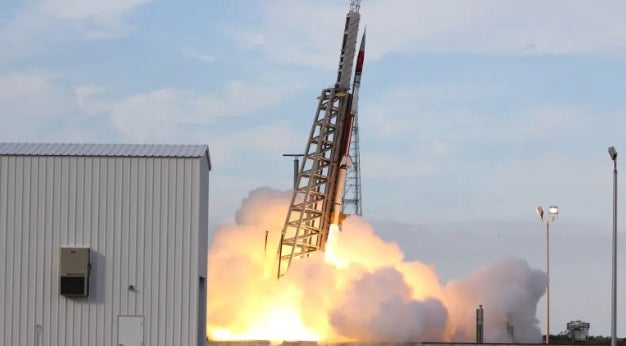
Even viewers in northeast North Carolina will be able to see the rocket 30 to 32 seconds after takeoff.
“The Terrier-Improved Malemute rocket is expected to reach an altitude of about 100 miles (162 kilometers) before descending by parachute into the Atlantic Ocean to be recovered,” according to a blog post from the Wallops Flight Facility.
The rocket is carrying experiments developed by eight university and community college teams part of NASA’s RockSat program.
“The RockSat program provides NASA-unique technical training and authentic, hands-on experiences, that prepare and equip students to enter the United States’ aerospace industry,” Victoria Stoffel, Wallops STEM team lead, said in a statement.
Some of the projects include the University of Alabama Huntsville’s deployable heat shield that generates electricity and Northwest Nazarene University’s robotic arm, “designed to track and capture objects in space,” according to the flight facility.
Join our commenting forum
Join thought-provoking conversations, follow other Independent readers and see their replies
Comments
Bookmark popover
Removed from bookmarks