Why are we afraid to say that football fans can be truly terrifying?
Violence at football is usually performative rather than actual, says Jim White, but there are fixtures where the swelling anger can boil into something dark


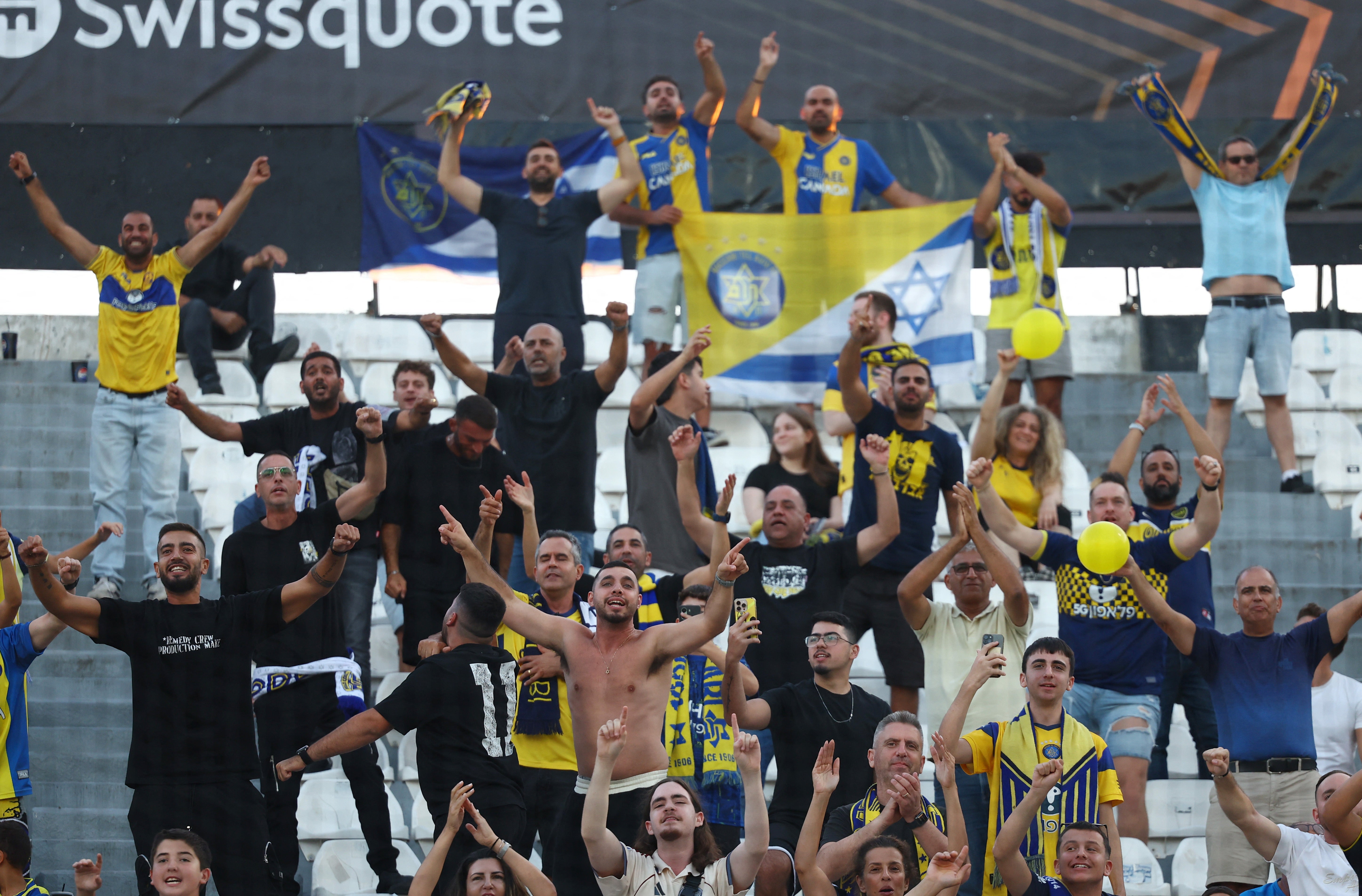
The decision of West Midlands Police to ban Maccabi Tel Aviv fans from attending the Europa League fixture against Aston Villa in Birmingham next month is head-scratching. The cops decided to issue the order because they “could not guarantee the safety” of the visiting supporters. So they told them they are not welcome. Normally, in such circumstances, it is those under threat who are protected. Not precluded.
Much of the violence at football is performative rather than actual. It's in the shouts and chants, the angry finger pointing. But there are fixtures where the swelling anger on both sides of the fences can boil into something more. Though in this case, it is not the overwhelming majority of the Villa supporters who are likely to be involved. Tommy Robinson, the right-wing firebrand who brought his “football lads” (his words) to London for the Unite the Kingdom march last month, has already called on his supporters to come and “support Maccabi Tel Aviv at Villa Park” – posting on social media wearing a Maccabi Tel Aviv club shirt.
Matches, particularly the big ones, particularly those involving long-term rivalries, are no fun to police. They involve lots of overtime, additional officers on the streets, a genuine threat of violence hanging in the air. Why are we afraid to say that some football fans can be truly terrifying?
But the police have procedures; they have operational experience. Some encounters, like Old Firm derbies in Glasgow or when Southampton take on Portsmouth or Swansea have a fixture in Cardiff, involve military levels of planning, of no-go zones and bussing in the away contingent under helicopter-buzzing escort. The idea is to ensure there can be no collisions, no clashes, that those who wish simply to see a football match are not inconvenienced by those who would prefer to have a ruck. And the cops are well versed at it. They know what they are doing. In truth, they are rather good at it.
The fear is that there are plenty who reckon that the very presence of a representative of Israel in Birmingham is a provocation, who believe Israeli athletes and sporting teams should not be involved in international competition, that the behaviour of the Israeli Defense Forces in Gaza needs to be confronted by a boycott of the nation’s representatives. It cannot be denied that this is set to be a highly flammable encounter.
It was in Amsterdam last November, when there were significant clashes around the game between Ajax and Maccabi. Hundreds of demonstrators turned out to confront the visitors. There was trouble on the streets the night before the game. There were dozens of arrests and several hospitalisations. For both sides this was opportunity to restage the war. Here was football, a sport that has a unique capacity to ignite tribal division, being used as tinder to inflame a seismic divide.
Someone is going to take umbrage. And the cops are admitting, however that anger might be manifested, they won’t be able to help. Which in its own way, may be a political statement: perhaps they are suggesting that, starved of resources by central government, they haven’t got the numbers to keep everyone safe in such circumstances.
Whatever their motivation, some have expressed support for the force’s action. The local MP, Ayoub Khan, an independent who stood at the last election on a ticket of opposition to the government’s stance on Gaza, was loudly in favour. In fact, he would like things to go further. He would like to see the match itself cancelled and for all sporting and cultural contact with Israel to cease. The pro-Palestinian eco-entrepreneur Dale Vince (who incidentally, also owns a football club, Forest Green Rovers) tweeted his support for the ban.
All the mainstream parties, however, took the opposite view. Keir Starmer expressed his clear annoyance. It was, he said, a terrible decision. But here’s the thing: the prime minister can’t do anything about it. Policing of football is not a political matter. Local forces have the ability to make their own judgment of circumstance and act accordingly. And it seems the West Midlands force would rather not have to cope with gobby pro-Israel visitors squaring up to angry pro-Palestinian demonstrators, many of whom are unlikely to be interested in attending the actual match.
The growing probability is, after the widespread condemnation of their decision, the West Midlands force will, for strategic and public relations reasons, backtrack. After all, they don’t want to cheese off too many of their paymasters. It seems more than likely that Maccabi supporters will, after all, be allowed to watch the game.
If they are, thanks to the ensuing fuss, of one thing we can be certain: there will now be many more pro-Palestinian activists alerted to their presence. Moreover, there may be plenty of the far-right sympathisers who have long been drawn to football, those courted by Robinson, who will see this as an opportunity to express their view with customary noise and aggression and seek to have a bundle with an opposition they see as lefties and Islamists. As a result, if the ban is lifted, the West Midlands police will now be faced with a far more difficult night than if they had quietly just let things go ahead as planned. They will have let themselves in for a long, dark night.
Join our commenting forum
Join thought-provoking conversations, follow other Independent readers and see their replies
Comments
Bookmark popover
Removed from bookmarks