Jane Goodall by her friends: ‘She was a much more complex character than most people might give her credit for’
Jane Goodall championed chimpanzee protection for more than six decades – but her gentle public persona was only part of the story. Diana Maclean speaks to those who knew Goodall throughout her career about the scientist’s inner toughness, her surprising spiritual side and why dogs were her true love


Most people associate her with being a gentle, loving person who elevated chimps and other animals to near-human status”, reflects National Geographic photographer Frans Lanting. “I've seen her many times on stage and behind the scenes, and indeed her energy was astonishing, but not so many people know that she was also very fierce.”
Working alongside Jane Goodall on her lecture tours over many years, Lanting would see this up close. He continues, “She would have no hesitation to correct interviewers or other people when she felt that an argument needed to be countered, facts needed to be corrected, and was fierce as well when it came to defending her values, and the goals that she wanted to achieve. She was a much more complex character than most people might give her credit for. We were looking forward to seeing her again. She was in California.”
And it was indeed mid-lecture tour that Goodall died, aged 91. “Last year, we celebrated her 90th birthday on a beach in Monterey; friends organised a gathering with 90 dogs, which turned into a riotous event.” Perhaps not as well known about Goodall is that beyond chimps, she loved dogs most. One of the last photos Lanting took of her was walking alone on the beach – but without any of the 90 dogs, which he felt captured that other side of her. “She became such a public figure that it was very difficult for her to have private moments in nature, and this was one private moment that we all cherished.”
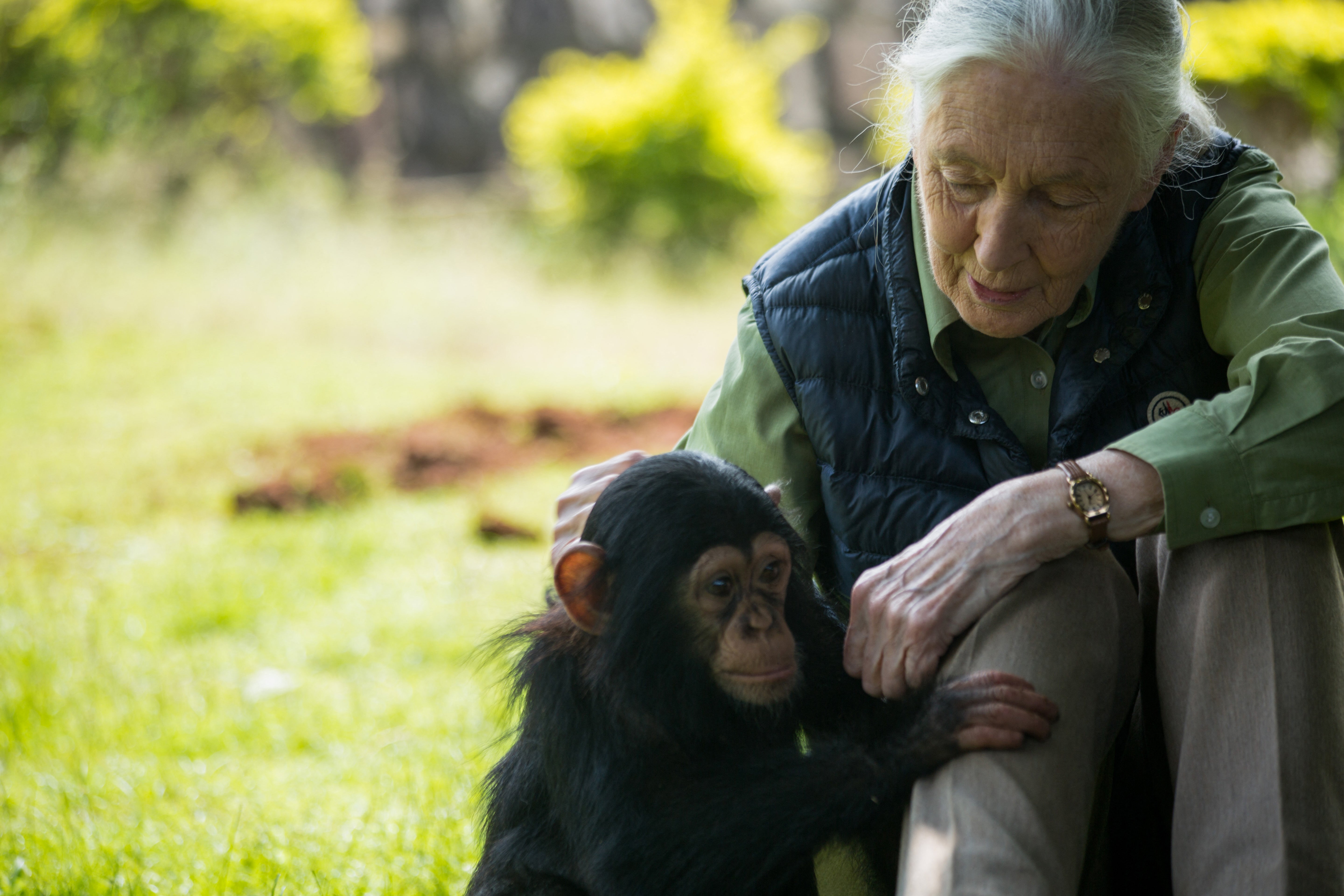
Dino J. Martins, evolutionary biologist and professor at Stony Brook University, recalls a rather more unnerving moment when he was trying to find Goodall in the bush, when she was left on a remote airstrip in Kenya. “At the last minute, the airstrip was changed to drop her off, so I had to drive 20km cross country and couldn't get there in time to meet her. Eventually when I arrived at the airstrip in the middle of nowhere – beautiful, rolling savannah – there was no Jane. Walking along the airstrip wondering how I was going to find her, I suddenly came upon her lying down flat in the long grass with her arms spread out, looking up at the sky, totally at peace, happy and just celebrating being in that landscape. And then off we went immediately to visit five rural schools.”
Martins visited Goodall in Gombe as a young naturalist and student. “We got off the boat and were basically assaulted by the resident baboons, at which point Jane appeared flapping her arms – immediately the baboons vaporised, they knew not to mess with her.”
But as an entomologist, Martins wasn’t interested in primates. “Although I wasn't paying attention to what everyone else was doing, she was kind, encouraging and genuinely interested in what I was looking at instead. Being a naturalist connected with her, because she was someone who looked at the living world holistically; her uniqueness was not only making groundbreaking discoveries about primates and animal behaviour, but also her brilliance as a scientist overall.”
Goodall and Martins eventually collaborated on school programmes and conservation restoration work. Sharing a commitment to communicating about the environment and our responsibility as humans, Martins explains: “One of the things I really valued with Jane was that she didn't draw a line between science and having a deeper spiritual view of the world of nature.
“Not in a trite or religious way, but in a much deeper way of thinking and relating to living things and to the planet. As a young scientist that was very influential to me. Jane encouraged and celebrated the deeper meanings, values and connections with nature, and was a role model who allowed those of us thinking of different ways of valuing nature that there were many different, holistic approaches to creating success in conservation.”

Dr Goodall was widely recognised for her work, receiving multiple awards and commendations, including being named on The Independent’s Climate 100 list of environmental pioneers on both its inaugural edition in 2024 and again just last month for the 2025 list.
Nigel Winser looked after Goodall during her visits to the Royal Geographical Society in London, often as a speaker. During his 29 years at the RGS, including as deputy director, he also accrued experience working on projects in similarly remote African locations. “I remember staying with her in Tanzania and seeing her go through her local village outside Dar es Salaam, getting the local community active for the Roots & Shoots programme. For her, no action – picking up a piece of litter – was too small. The simplicity and the conciseness of her message, based on her love of animals, resonated with young people and has never wavered. She was this very gentle, quiet person speaking softly, but with such authority, and that was key to how she operated.
“It looks romantic today, but let me tell you, Jane worked in tough conditions. You've got to be so careful to remember that, when you look at those beautiful pictures of her in the forest. Jane made it look easy, but she worked really hard as a field scientist.”
Goodall never forgot her field scientist roots, and part of her legacy is highlighting scientists and conservationists with the attention that she could bring to their work. Not least of those stories was the plight of jailed Iranian conservationists. Explained by Tanya Rosen, director of Central Asian programmes for Conservation X Labs: “In 2018 several Iranian wildlife conservationists were jailed on accusations of espionage. One of them, Kavous Seyed-Emami, died early on in prison. Friends, colleagues and strangers came together in an effort to help.
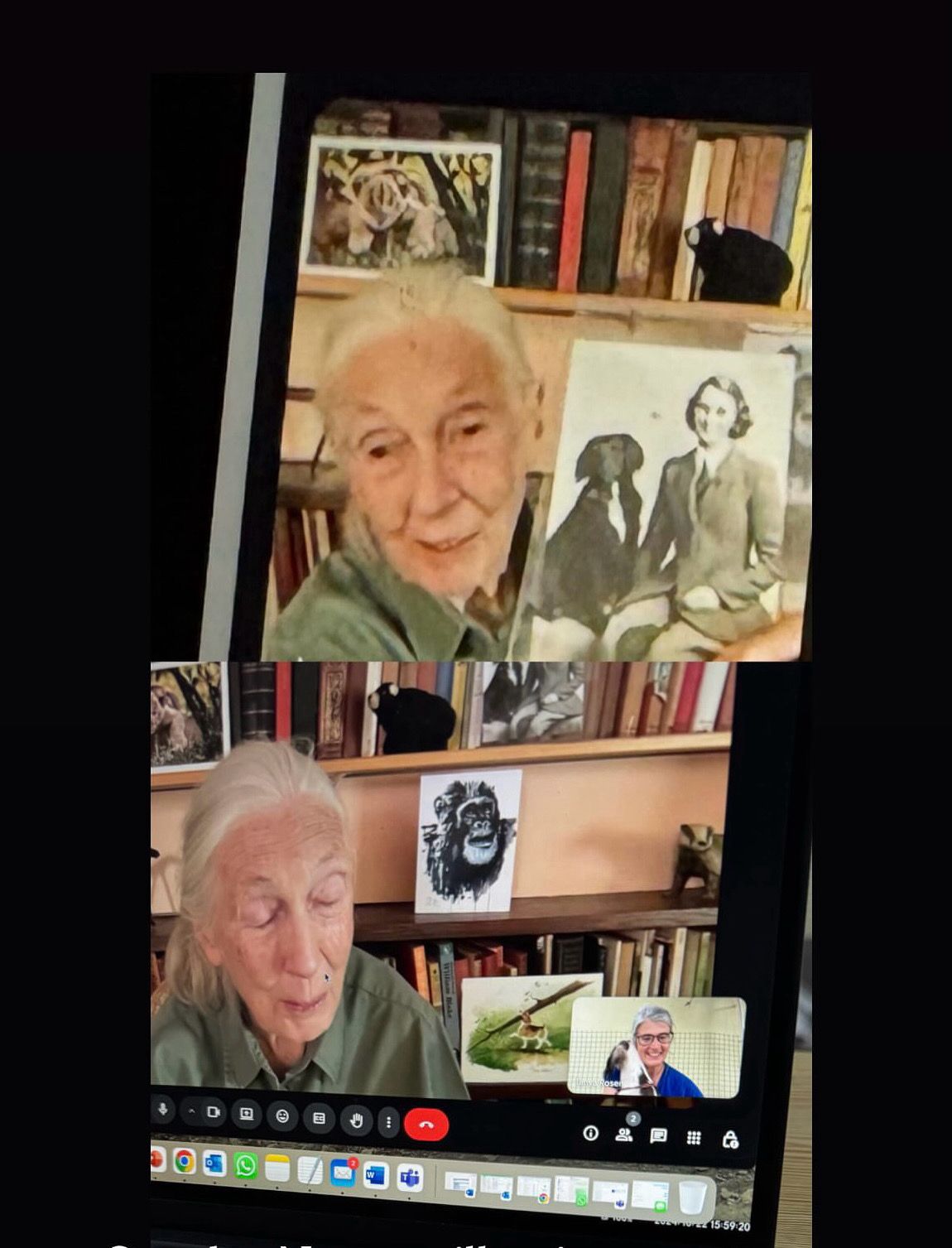
“Jane reached out through Frans Lanting and Shweta Khare Naik (director of JGI India) as she had been deeply affected by this story, and wanted to do more. I suggested she write personal letters that, through friends and family, could be read over the phone or smuggled into prison. And she did. For nearly six years, Jane wrote to them, and they wrote her back. In prison, it meant the world to them. At the end of August we had an impromptu video call with most of the group that had been jailed. At first, there was a quiet hesitancy. But soon, laughter began to thread through the silence. We talked about death, the dark times, and somehow even found a way to laugh about those too. It felt healing. She used her voice and platform to keep their stories alive. We made plans to see her in person, and to meet again online over Christmas.”
Goodall had a legendary ability to connect with people of all ages, from children to politicians. Martins remembers, “We would go to a park or a conservancy and then have a few minutes, waiting behind the scenes. But Jane would immediately ask, can I speak to the rangers, the carers, the people who are cleaning the cages? She knew how important they were, and she wanted to make them feel genuinely loved and and valued. I’ll never forget that.”
“She'd walk into the room and all eyes would turn towards her; there was an aura about her that just drew people to her. She made people feel significant and needed; every time she visited, I just always felt, ‘you can still teach me some more’. Every afternoon, we gave Jane two hours to rest and write,” says Alpana Patel, chairman of JGI Kenya for 20 years. “But she didn’t. Each visit, she would ask for the names of everyone she met, and on the day she left, she would give me handwritten notes to give all these people – minimum, 12 to 15 letters.” Goodall also had a notable lack of ego. “One time, we were hosted at Segera Conservancy, and out on a game drive. As we were looking at a spectacular lion, I noticed two guests in another car, and their cameras were not focused on the lion, they were focused on Jane. She found that really amusing.”

Conservationist, filmmaker and CEO of WildlifeDirect, Paula Kahumbu, worked with Goodall through JGI and the Roots & Shoots programme. “The most significant thing Jane gave me was the understanding that we are just another species on this planet, alongside showing us how chimpanzees are almost human. Her work showed how human negligence and our insane consumerism has the potential to destroy entire species – imagine losing chimpanzees just because somebody wants a unique looking ashtray? She was also incredibly kind, even when dealing with people who were neither kind nor good, which I found very inspiring. As one of the most productive, active and busy conservationists in the world, it’s very tragic that Jane has passed away, but then she was 91, and I cannot imagine her doing more than she’s already done.”
As a woman also working in conservation, Gladys Kalema-Zikusoka is the first female wildlife veterinarian in Uganda, and founder of the NGO Conservation Through Public Health. Goodall wrote the foreword for her book, Walking With Gorillas. “Jane inspired me because she was a woman out there doing things that women were not expected to do. She embraced community conservation very early on, including engaging and empowering women.”

Kalema considers just how far Goodall’s influence has reached. “Jane made the importance of conservation accessible to everyone. She went beyond other scientists by making conservation something to be understood by all, and not just an elite group. She knew that when you can understand something, you can protect it. In doing so, she then made wildlife and environment conservation more accessible to African governments, policy and decision makers, and African communities. The Roots & Shoots organisation has made Africans embrace her work even more. They feel like, yeah, she's part of us.”
It’s impossible at this point to sum up the legacies Jane Goodall has left us. However, Martins reflects on some of the most significant. “Jane inspired and empowered young people across Africa to take up the responsibility, become the voices for our environment and conservation, and be willing to speak and fight for it.
“Her love for working with young people, listening to them and inspiring them is absolutely one of her greatest legacies. She showed that one can be both a scientist, and a change maker. She gave her entire life to doing this.” Martins pauses. “We will miss Jane. Every time we emailed or spoke, the first question would always be: ‘Now Dino, how are your two doggies?’”
Join our commenting forum
Join thought-provoking conversations, follow other Independent readers and see their replies
Comments
Bookmark popover
Removed from bookmarks