This one thing could be ruining your sleep – and you were probably told it would help it
Dr Andy Galpin’s research has found the optimal protocols for a good night’s sleep – and fitness trackers, pets and room temperature could all be harming your efforts, he tells Harry Bullmore

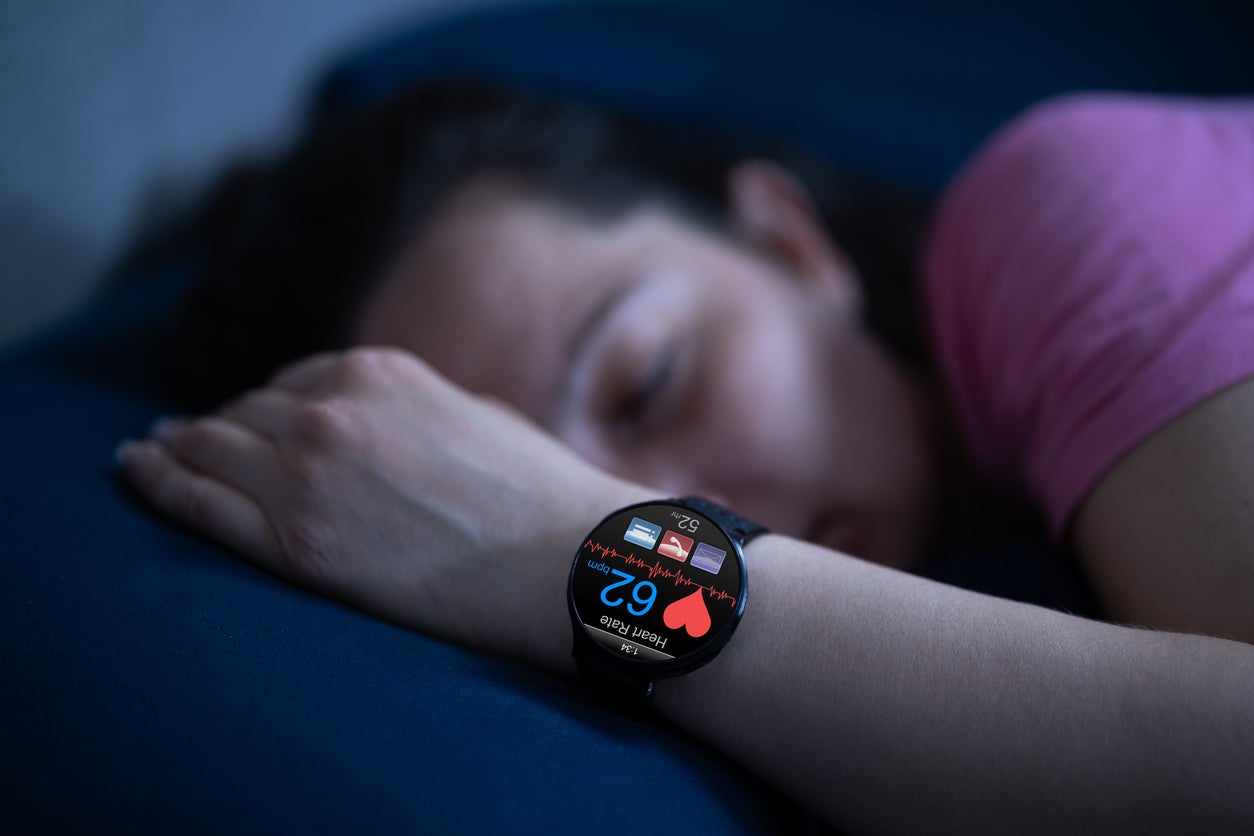
A significant number of the population now wear a smartwatch or fitness tracker. Modern ones don’t just track your fitness either; your health metrics and sleep come under scrutiny too.
This last point is proving problematic for some because it can cause orthosomnia – a term defined in the Nature and Science of Sleep journal as “the obsessive pursuit of optimal sleep metrics based on fitness tracker or mobile phone data”.
Somewhat ironically, sleep is the thing keeping people up at night.
“Any tracker or wearable can give you a pretty good idea of sleep duration,” Dr Andy Galpin, a leading human performance scientist and co-founder of sleep optimisation company Absolute Rest, tells me on the eve of his keynote speech at Healf’s HX25 wellbeing event.
“But another factor that is equally, or more, important is sleep quality. Depending on what wearable you’re using, you’re probably getting a massive disagreement on the time you spend in different sleep stages – rapid eye movement (REM), deep, etc.
“That’s not really what scientists consider to be sleep quality, but that’s what the consumer thinks quality is – ‘What was my score on my wearable?’ These are non-medical devices that are not accurate and they’re not actually depicting sleep quality.”
Through this jumbled messaging, people who are sleeping fairly well can receive poor feedback on their time between the sheets, leading to a sharp rise in cases of orthosomnia, Dr Galpin says. But there are alternative ways to measure the success of your sleep, as well as some easy research-backed hacks for waking up feeling your best. So, what are they?


The free way to measure your sleep quality
Effective sleep is a composite of your sleep duration, quality, regularity, timing and subjective factors such as how you feel and perform in day-to-day life, according to Dr Galpin.
His tech-free method for measuring your sleep quality is simple, and it centres around how you feel the following day.
“If I wake up feeling fully refreshed, I’m sharp, my energy is awesome, I train, I recover, I feel great, and then I’m sleepy at night – I don’t really care what a fitness tracker says,” Dr Galpin explains.
“If your daytime function is really good then you probably don’t need to be messing around too much with your sleep, because your physiology and neurology will actually take care of what your body wants in response to the physical and cognitive demands in your life.”
Dr Galpin also adds that sleepiness is normal, and even desirable, at certain points in the day.
“You should be a little bit drowsy in the early afternoon,” he says. We need to build sleep pressure and you should feel tired at night.
“...You might want to be at 100 out of 100 energy levels, all day, every day, but that’s not realistic to every situation.”
The problem, Dr Galpin says, is that people who wake up and feel raring to go are pretty hard to come by nowadays.
“If somebody is like that, it’s often because they’re on a load of stimulants and sleep medication,” he continues. “They tell you they feel great during the day, but they’ve had 12 espressos, then they take a bunch of sedatives at night.”
Read more: Four science-backed ways to make your daily walk even better for your health
How to improve your sleep
Sleep issues are inarguably widespread, leading many people to grow tired of feeling tired all the time. Dr Galpin was part of a team that produced a 2025 paper in the Lifestyle Medicine journal detailing “all scientifically known” environmental factors impacting your sleep quality, and the “exact protocols” you can use to trump them. You can find a version of this table below.
“These are the things most people don’t pay attention to,” says Dr Galpin. “And if they do, they’re just told to keep their bedroom cold, dark and quiet. But if I live in a city, I have buses that are constantly going by my apartment and I can’t control the light outside – all of this is in the paper.”
While not in the table below, consistent sleep timing and regularity are further “incredibly important” factors to consider, Dr Galpin adds.
Environmental factor | Optimal protocols |
Noise exposure | “To minimise noise-induced sleep disruption, current World Health Organisation (WHO) guidelines recommend noise limits of 45 dB(A) for road traffic, 44 dB(A) for rail traffic and 40 dB(A) for air traffic during the sleep period.” The study says people sensitive to noise-induced sleep disruption might benefit from using earplugs. Existing research does not support the use of noise machines. |
Light exposure | “Starting three or more hours before bedtime and continuing while doing any necessary wakeful activities during the sleep period, light exposure at the eye should be less than or equal to 10 lux using the melanopic EDI (equivalent daylight illuminance).” This is a very soft, dim level of light. To achieve this, the paper recommends using “warm white” lightbulbs and adds that blue light glasses may be helpful in environments where the light cannot be controlled. “During the sleep period, melanopic EDI should be less than or equal to 1 lux. Light-blocking items such as blackout blinds and eye masks make this easily attainable. If there is a need for bedroom devices that emit light, such as alarm clocks, it is preferable to choose ones that emit red light.” |
Screen time | The impact of devices with screens on sleep is likely to be small, the paper says. But there are steps you can take to further reduce this impact, such as lowering the brightness settings. “If agreeable, use programmes that reduce short-wavelength light emissions around sleep,” the paper advises. “If screen time contributes to bedtime procrastination, consider interventions to limit screentime, such as disabling the autoplay setting on television streaming services. “If possible, turn screen-based devices off or disconnect them from 30 minutes before sleep until when you wake up for the day ahead. If there is a need to be contactable, keep a ‘dumbphone’ in the bedroom.” |
Temperature | “When practical, maintain a cool sleep environment (perhaps 17-21C) with moderate relative humidity (perhaps 40-60 per cent),” the paper states. “At low ambient temperatures, having a hot (40-42.5C) 10-minute shower or bath one to two hours before bed, using a heated eye mask (perhaps 40C) for about 20 minutes before bed, wearing additional clothing layers in bed, using a high tog (a rating of greater than 10) duvet, selectively warming the distal skin (eg by wearing socks) and turning on the heating in the second half of the sleep period can support sleep. “At high ambient temperatures, having a cool (not cold) shower or bath one to two hours before bed, adopting a side-lying sleep posture, wearing either minimal cotton clothing or sleeping naked, using a low tog (a rating of less than five) duvet or sheets alone, resting on a mattress and pillow that maximise heat dissipation, implementing active cooling at the start of the sleep period (by using a fan, for instance) and maintaining euhydration through adequate fluid intake can reduce heat stress and facilitate sleep.” |
Air quality | “High levels of certain forms of particulate matter in the air might disrupt sleep. In such conditions, air purification devices might support sleep. It is plausible that maintaining a clean sleep environment, including regularly washing bedding, may also improve air quality.” |
Sleep ergonomics | “Supine [lying on your back] sleep postures exacerbate sleep-related breathing problems. When indicated, positional therapies should be used to move individuals into side-lying sleep postures. In the case of simple snoring, inclining the bed can improve respiration.” |
Odorants | “When in keeping with personal preferences, lavender essential oil can be used to aid sleep, in part by reducing anxiety.” |
Bed partners | “Bed partners with conflicting sleep preferences should carefully weigh the pros and cons of sleeping in separate beds before deciding whether the potential upsides of the prospect of better sleep outweigh any perceived downsides. In general, pet owners should not share beds with their pets unless there is a compelling reason to.” |
Sleep-monitoring devices | “The potential usefulness of sleep trackers should be considered on a case-by-case basis. In general, however, people without clinical sleep disorders who are anxious about their sleep should be discouraged from tracking their sleep at present.” |
Undiagnosed sleep disorders
The assessment and subsequent tips above will work on someone whose poor sleep quality comes as a result of their environment.
However, Dr Galpin’s primary prescribed step in solving your sleep problems is to gain an insight into whether or not you have a sleep disorder, as the vast majority go undetected and they affect tens of millions of people across the globe.
“There’s insomnia, there’s restless leg syndrome and then there’s a whole bunch of sub-disease ones,” Dr Galpin says. “But if you go to a sleep hospital, they’re only looking for apnoea. If you have anything else that falls under this list, you just get told, ‘Here are drugs or a CPAP [a continuous positive airway pressure device which keeps your airways open while you sleep]’.”
Dr Galpin likens it to being rushed to hospital after a car crash. Your knee is facing the wrong direction, but an X-ray reveals there are no broken bones, so despite your horrific injuries, you are told you are fine.
“That’s what sleep medicine is like,” he says. “If you have a medical issue going on, there’s no amount of meditation, L-theanine or blue light blockers that are going to make a difference. These are correctable things, but the solution you’re providing is nowhere close to the problem you actually have.”

You may not have a sleep disorder or any underlying issues, but if you consistently struggle with your sleep, Dr Galpin recommends starting with “high-fidelity testing” or a consultation with an expert who looks beyond apnoea.
This is the aim of his company Absolute Rest – a three-month individualised sleep study conducted on a consumer, which uses multiple sensors to ensure the brain, heart, lungs and muscles are functioning properly. This information is then used by experts to create a personalised sleep optimisation plan.
“We’ve had precision nutrition for about a decade, precision medicine has been here for around 20 years and it’s getting better, but precision sleep is primordial – it’s just getting started,” Dr Galpin says.
“We’re spending billions each year on sleep, but it’s getting worse, and that’s because we’re spending our money on really bad testing, drugs and CPAPs. These things are great in the right situation, but they’re not going to do anything for something like a circadian disorder.”
Dr Galpin’s list below contains some of the signs that you might be suffering from a sleep disorder:
- You have “copious amounts of stimulants” or use powerful supplements throughout the day
- Excessive snoring
- Excessive daytime sleepiness
- It takes you longer than 20 minutes to fall asleep
- You’re waking more than once per night most nights
- It takes you more than 15-20 minutes to go back to sleep after you wake up
“All of these things are correctable if you use the right tool in the right situation,” he says.
Read more: The science-backed exercise method that can help fight the effects of ageing
Should you use a fitness tracker to record your sleep?
A fitness tracker can be a double-edged sword for your sleep, according to Dr Galpin.
“Even if they’re not accurate, sleep trackers can be good for accountability,” he says. In other words, people will be more likely to make positive changes to their sleep routine if they know someone, or something, is keeping tabs on it.
“Awareness is another positive,” he adds. “Some people are convinced they have huge sleep disorders and they tell people they’re sleeping three or four hours per night – it’s like a badge of honour, because it’s what their mum or dad always talked about. Then the tracker finds they sleep for six or seven hours, so it can be a bit of a reality check.”
This, Dr Galpin says, can be helpful for the masses. Where fitness trackers fall short is their accuracy in assessing sleep quality, and the part they play in orthosomnia.
“It’s the circumstances where people go, ‘Oh my God, I feel great, but my tracker said my deep sleep is only an hour, and my friend is at an hour-and-a-half all the time, so now I’m going to take this drug because I heard about it on a podcast.’”
Dr Galpin also says the concept of “deep sleep” as one of the four sleep stages – presented on most fitness trackers as deep, REM, light and awake – is problematic.
“When you hear the phrase deep sleep, you want deep sleep,” he explains. “But it has nothing to do with the quality of your sleep, or the freshness you feel after – it just happens to be the name of a stage. If deep sleep was rebranded as ‘Tom sleep’, no one would care about it.”
This fixation with certain sleep stages can contribute considerably to the development of orthosomnia.
Dr Galpin summarises: “Fitness trackers can be good, you just have to be careful. Use them judiciously and appropriately, and try to use the best parts of them without being sucked into the downsides.”
10-second tips
- Wash your bedding weekly
- Aim to keep the air temperature between 17–21C, and the relative humidity at 40 and 60 per cent, in your bedroom
- Use dim lighting in your home in the three hours before sleep
- Stop using screens at least 30 minutes before sleep
- Do not share a bed with pets if possible
- Use sleep trackers cautiously, especially if they trigger negative emotions around sleep
Read more: If you struggle to stay fit, try adding these nine simple science-backed behaviours into your week
Read more: A cardiac nurse says these five daily behaviours can reduce your risk of heart disease
Join our commenting forum
Join thought-provoking conversations, follow other Independent readers and see their replies
Comments
Bookmark popover
Removed from bookmarks