After 50 you need to train smarter – the nine rules for strength training in midlife, according to experts
As time goes by you need a savvier approach to training than you did in your 20s, says Harry Bullmore, who gets advice from a top fitness coach on how to do that


NHS guidelines encourage adults aged 19-64 to complete two-and-a-half hours of exercise per week, or a bit less if it’s more intense, alongside a couple of “strengthening activities". But exercising at 19 tends to feel very different to exercising at 64.
Not only do your social, work and family commitments mount up as you advance through life, but your ability to recover from intense exercise also reduces. Yet the benefits of exercise, and strength training in particular, become more valuable the older you get for injury prevention, freedom of movement, and heart health.
Patrick James, head coach at Marchon Victoria gym, understands this better than most. Despite more than a decade of experience working as a coach, he counts persuading his mum to lift weights as one of his top achievements to date.
“She’s 67, and always felt that if she walked regularly and did the gardening, she didn’t need to do it,” he says. “But if you want to walk up the stairs and get out of a chair in 10 years’ time, you need to strengthen your legs.”
It started with a simple twice-weekly bodyweight circuit; kneeling press-ups off the sofa, squatting to a chair, rows with a weight in the garden and single-leg hip thrusts. Now she is the proud owner of three different kettlebells and completes four or more home workouts each week.
“She can feel the benefits of it now – that rush of endorphins, feeling healthier and feeling stronger,” James says.
Those aged 50 and up can experience similar results sans gym, with just a couple of weekly workouts, he adds. This approach maximises the juice-to-squeeze ratio of your exercise efforts.
Here are his tips on how to maximise your workout.



Tip 1: Consider your exercise choice
“In your younger years, you can afford to train poorly and get away with it,” James says. “As you get older, moving towards your 50s, 60s and 70s, you can’t. Whether through hormones or your body’s ability to synthesise protein, the rate at which your body can adapt and recover from exercise slows down.”
But this doesn’t mean you should stop exercising – quite the opposite. James’s solution is to box smart.
“I can’t train my 65-year-old client the same way a bodybuilder in their 20s trains,” he explains. “He might have played rugby back in the day and now he has very little cartilage in his knees, so it hurts to do a heavy back squat, so I have to find an exercise or variation that allows him to train the same muscles without it being painful.”
For example, instead of heavy barbell squats, James might prescribe goblet squats to a box, reducing the range of motion to one that is comfortable for the client.
Tip 2: Lift lighter weights for more repetitions
Lowering the weight you’re lifting and the number of repetitions you’re lifting it for can reduce pressure on certain joints and minimise discomfort during strength training workouts.
“Heavier strength training – lifting a heavy weight for five repetitions or less – will put a bit more pressure through the joints,” James says. “You can get a similar stimulus for building muscle and maintaining strength from lifting lighter weights for 10-20 reps.”
For example, you might substitute the five sets of five heavy barbell squats mentioned above for three sets of 10-20 goblet squats to a box.
“The intensity will be a little bit lower, but you’ll still get a great stimulus to develop muscle and build a stronger body,” says James. “And for most people, the joints will feel better through doing some strength training, if they build it up gradually.”
The key is to start with lighter weights and exercises with smaller ranges of motion, then progress over time.

Tip 3: Challenge yourself
There does have to be an element of challenge in a strength training exercise to ensure it’s effective for building strength and muscle, James says.
“We don’t need to be training to failure [the point where your muscles are too tired to complete another repetition] on every set, as someone in our 50s or 60s,” he explains. “We just want to make sure the sets we do are somewhat challenging so we can create a good stimulus for muscle growth. If we can do that consistently, then, over time, we are going to get stronger.”
Take a “little and often” approach and aim to hit major muscle groups in the legs, glutes, back, chest and shoulders twice a week.
Tip 4: Embrace the full-body workout to maximise efficiency
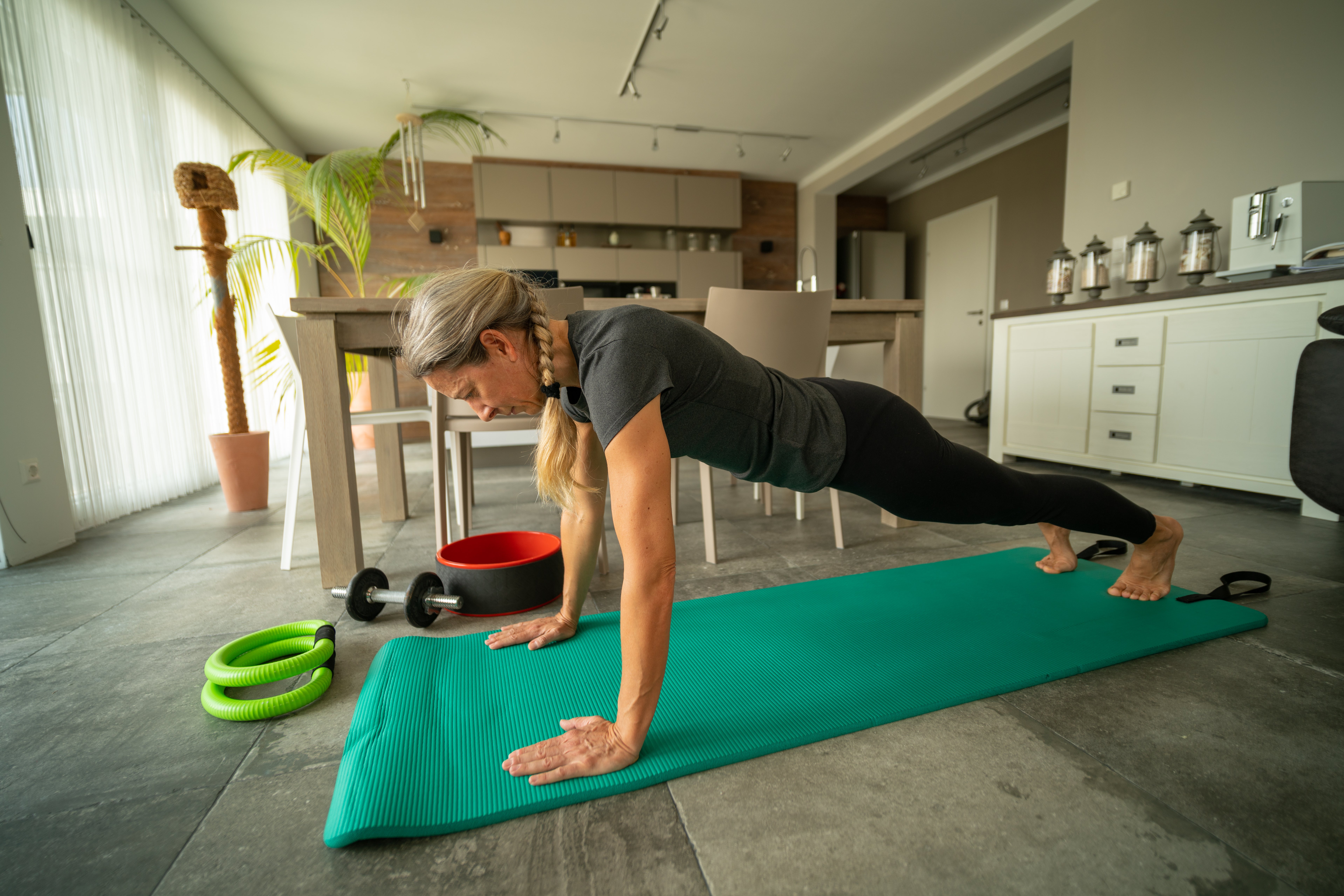
Rather than focusing on a single muscle each session, James recommends doing full-body workouts two or three times per week.
“For building muscle, we know that one set done three times per week is better than three sets done once per week,” he explains, adding that the more you work a certain muscle and movement pattern on any given day, the more it will take out of you. The quality of the exercise will also decrease as you tire, leading to diminishing returns.
By spreading each muscle’s workload through the week, you can keep your body feeling fairly fresh and ready for the rigours of daily life – as well as your next workout.
Tip 5: Get your priorities straight
Six to 10 sets per week for each major muscle group should be sufficient to build muscle for most people, James says. If you want to focus on developing a certain area, you might add a couple of extra weekly sets or exercises that target those muscles.
“You want to prioritise the big muscles in your sessions – these are usually working in the compound or multi-muscle exercises you can lift more weight with,” he says. “In the lower body, aim to hit the quads, glutes and hamstrings. In the upper body, there are the pecs in the chest, the lats in the back and the delts of the shoulder.”

Tip 6: Progressive overload is essential for continued results
The body adapts to get better at the things we consistently ask it to do, so strength training can be seen as a conversation with our muscles.
Every time we lift weights, we are telling our body that we want to become stronger. If we make a strong enough case, doing sufficiently challenging exercises, then over time it will adapt by bolstering our bones, tendons, ligaments and muscles.
This is why we have to apply progressive overload: the process of gradually increasing the difficulty of our workouts over time, in line with our increasing strength and fitness levels. You need to increase the weight, up the number of sets and repetitions, or switch to a more challenging exercise variation, relative to your rising strength level, to send the body a clear message that you want to continue to grow stronger, rather than just maintain what you have or lose muscle.
Tip 7: Find low-impact ways to raise your heart rate
If you are new to exercise, James advises opting for a lower-impact form of cardio – for example, using exercise machines such as exercise bikes, rowing machines and ellipticals, which make it easy to get your heart rate up with a low risk of injury.
Using these machines once or twice a week to get a bit out of breath can deliver plenty of health benefits, including improved heart health and reduced risk of several major illnesses.
These more intense activities should also be underlined by a healthy dose of daily movement – “Aerobic activities such as longer walks.”
Tip 9: Put enjoyment first
Enjoyment is the most important, and most overlooked, tenet of a successful exercise plan. You could have a scientifically-optimised training plan for building muscle, but if you don’t follow it because you don’t enjoy it, it’s going to be redundant, James says.
“It’s about finding a plan that someone can adhere to, enjoy and be consistent with,” he says. “And if you’re consistent, you’ll most likely see results.”

The four-move workout
This is a beginner workout with minimal equipment, which works the main muscle groups of your upper and lower body and should take no more than 30 minutes. Do three sets of 10-20 repetitions of each exercise, and repeat two to four times per week.
The aim is to perform at least 10 repetitions in every set, while using a weight challenging enough that you cannot easily lift it for 20 repetitions.
“As you start to adapt to the training and become familiar with the movements, try to either increase the weight or number of reps.”
If you don’t own any weights, a filled water bottle or rucksack can be used instead, but James recommends investing in a couple of dumbbells or kettlebells to broaden your exercise horizons if you’re training at home.
“You can get a set of kettlebells for around 20 quid,” he says. “Start with a 5kg and 10kg weight, and as you get stronger, you can buy heavier options.”
Exercise 1: Squat to chair or sofa
Sets: 3 Reps: 10-20 Rest: 90 seconds
Coach’s notes:
- If you are not using a weight, hold your arms out straight in front of you
- If you are using a weight, hold it against your chest in the goblet position
- Place your feet just outside hip-width apart with your toes turned out slightly
- Take a big breath in and hold it as if someone were going to punch you in the belly
- Take two seconds to lower your bum to the chair in a smooth, controlled motion
- When it touches the chair, stand back upright, breathing out as you do so
- Keep your eyes looking straight ahead with your chest upright throughout the movement
- Over time, you can make this exercise more challenging by increasing the depth of the squat or by increasing the weight or reps
Exercise 2: Romanian deadlift
Sets: 3 Reps: 10-20 Rest: 90 seconds
Coach’s notes:
- Hold the weight in front of your thighs in both hands with your arms straight and relaxed
- Place your feet hip-width apart with your toes pointing straight ahead
- Take a big breath in at the start of the rep
- Bend your knees slightly, then keep them in this position throughout the exercise – this is important for preventing you from using your lower back rather than your lower body muscles
- Lower the weight in a straight line toward the ground by hinging at your hips, keeping it close to the front of your legs throughout
- As you do this, think about pushing your hips back horizontally as if you are closing the fridge door with your bum
- At the same time, let your shoulders come forward like you are looking over a cliff
- Stop when the weight reaches the middle of your shin, then stand back up
- Your back should remain in a relatively straight position the whole time
Exercise 3: Press-up to chair or sofa
Sets: 3 Reps: 10-20 Rest: 90 seconds
Coach’s notes:
- Find a chair, sofa or another sturdy raised surface to press up from. This makes the exercise slightly less challenging than a standard press-up – the higher the surface, the easier the exercise will feel, so you can progress to lower surfaces over time to make the exercise more difficult
- Place your hands on the surface, just outside shoulder-width apart
- Keep your bum squeezed and hips forward so that your torso and hips stay in one line
- Bend at the elbows to lower your torso until your chest touches the chair or sofa, then press through your hands to return to the starting position
- Start on your knees, and over time, you can progress to your feet as you get stronger
Exercise 4: Single-arm row
Sets: 3 Reps: 10-20 Rest: 90 seconds
Coach’s notes:
- Support yourself on the back of a chair or sofa with one arm while you hold the weight in the other hand
- Keep your back flat and your torso roughly parallel to the ground
- As you row, think about pulling your elbow towards your trouser pocket rather than pulling the weight straight up to your chest
- Finish the rep with the weight at the bottom of your ribcage, then slowly lower it back toward the ground until your arm is straight
Join our commenting forum
Join thought-provoking conversations, follow other Independent readers and see their replies
Comments
Bookmark popover
Removed from bookmarks