Results are in for one of the clearest measures of global heating in 2025. It should be raising alarm bells
Scientists consider this to be one of the clearest measures of long-term global warming
The world’s oceans absorbed more heat in 2025 than in any year since modern records began, according to a major international analysis.
Ocean heat content rose by 23 zettajoules – the equivalent of detonating hundreds of millions of Hiroshima atomic bombs, or roughly 200 times humanity’s global electricity consumption in 2023 – according to the analysis published in Advances in Atmospheric Sciences.
Unlike sea surface temperatures, ocean heat content is a measure of how much excess energy the world’s oceans are storing over time, including at depth.
“The ocean is the hottest on record,” says Dr Kevin Trenberth, co-author of the study and an honorary academic at the University of Auckland.
“We’re looking at creating a very different planet – do we really want to do that?”
The study was released days after 2025 was confirmed as one of the three hottest years on record.
The analysis draws on four datasets – three observational products from the Institute of Atmospheric Physics at the Chinese Academy of Sciences, NOAA’s National Centers for Environmental Information and Copernicus Marine as well as an ocean reanalysis product – which together show that ocean heat content reached the highest level on record in 2025.
Oceans are central to the climate system because they absorb over 90 per cent of the excess heat trapped by greenhouse gases.
Scientists consider ocean heat content one of the clearest measures of long-term global warming because it reflects how much heat gets accumulated over time.
The warming is not uniform. The study found that in 2025, around 16 per cent of the global ocean area reached a record-high ocean heat content, and around 33 per cent ranked among the three warmest values in their local records. The warmest areas included parts of tropical and South Atlantic, the North Pacific, and the Southern Ocean.
Ocean warming trends have been stronger since the 1990s than in previous decades, the study noted, adding that ocean heat content in the upper 2,000m set new records in each of the past nine years.
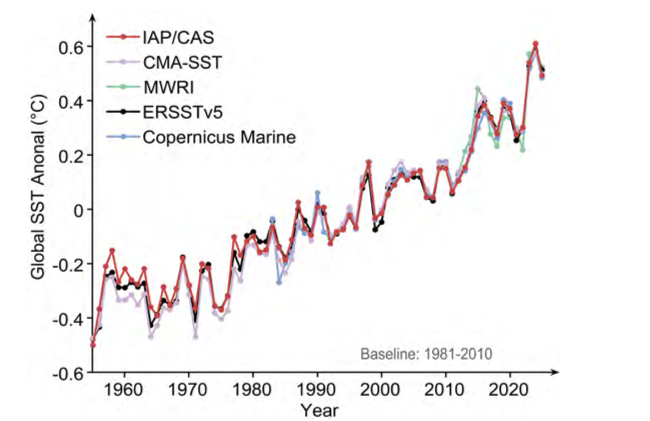
Sea-surface temperatures were also high in 2025, though slightly below 2023 and 2024. The analysis noted the shift from El Niño to La Niña conditions in the tropical Pacific was a key reason for the small dip. Even so, global annual mean sea-surface temperature in 2025 remained about 0.5C above the 1981-2010 average baseline, making it the third warmest year in the instrumental record.
Warmer oceans affect weather patterns worldwide by adding heat and moisture to the atmosphere. The authors say this can increase evaporation and heavy rainfall and help fuel more extreme tropical cyclones and other weather events. The analysis points to widespread flooding and disruption in parts of southeast Asia in 2025, drought in the Middle East, and flooding in Mexico and the Pacific Northwest.
Rising ocean heat also contributes to sea-level rise through thermal expansion and increases the risk of marine heatwaves and ecosystem stress.
The authors argue the findings show the ocean will continue to accumulate heat as long as the Earth’s energy imbalance persists.
Join our commenting forum
Join thought-provoking conversations, follow other Independent readers and see their replies
Comments
Bookmark popover
Removed from bookmarks