Lord of the Flies review – This bold, brilliant series will terrify parents as much as Adolescence
Jack Thorne is back with another horrifying tale of teenage boys and violence, marking the first ever TV adaptation of William Golding’s influential novel
Before masculinity was toxic, before colonialism was a dirty word, there was William Golding’s Lord of the Flies. A staple of classrooms and thrice adapted for film, the cautionary tale of children reverting to a primal savagery is one of the most influential narratives in all of literature. But what is it about the present moment that makes the BBC think it is ripe for a four-part primetime reimagining?
An aircraft, carrying a manifest composed largely of school-age boys, goes down on an uninhabited tropical island. Summoned by Ralph (Winston Sawyers) blowing a conch, the children form a fragile society. Ralph is elected their chief, Piggy (David McKenna) his trusted, but bullied, lieutenant. Jack (Lox Pratt), runner-up in the chieftain vote, leads the group’s hunters, alongside Simon (Ike Talbut), a sensitive boy who serves as envoy between the two camps. They are British children of the immediate postwar era, hardened by the conflict and resolved to retain a stiff upper lip. “My father is in the navy, and he says there aren’t any unknown islands left,” Ralph tells his people. “The Queen has a picture of this island.” But thoughts of home – of Blighty and Her Maj – quickly become secondary to the harsh realities of life in their new home. Hope for rescue is subsumed by an atavistic desire to survive.
Golding’s classic novel was written as a response to imperialistic boys-own adventure fantasies, which fantasised a world in which children would bring the civilising force of British “values” to unconquered lands. Adapted here by Adolescence writer Jack Thorne (if other writers are available, British telly commissioners don’t seem to have realised), the narrative is more concerned with the teetering patriarchy than the end of Empire. “You don’t know anything about my father,” volatile Jack rages at gentle Simon. “No, but I know my father,” Simon replies. “And I have suspicions that they’re just the same.” Absent the steer of adults (“grown-ups just know things,” laments Piggy), their fragile society mirrors the world they’ve left behind. Some take responsibility, some shirk it; some defer to authority, some resist it. “Toilets, water, hut-building,” Jack lists off. “This is boring.” And so, the camp becomes divided by boys becoming men in very different ways.
“The child is father of the man,” wrote William Wordsworth in 1802. Two centuries on and Thorne has reignited public conversation about how we treat children, what we expose them to, and the impact that has on their eventual adulthood. His Lord of the Flies renders the themes of Adolescence in parable form. The tormented, divided soul that exists in all people – which generates fear and creates the conditions for violence – is present, too, in children. The boys on the island, unshackled from influence and responsibility, behave like adults. They tussle for power, imagine exogenous terrors into existence, rationalise their behaviours through the prism of survival. Their fathers – the men they will grow up to be – are present in the figures of these prepubescent castaways.
Like George Orwell’s Animal Farm, William Golding’s Lord of the Flies is often approached by readers too young to fully understand it. This adaptation makes no apology for being aimed at adults. Blood-soaked pig hunts, trippy hallucinations, surges of sudden, shocking violence: Thorne’s island is a brutal place. Yet the BBC knows, too, that this narrative will resonate with Gen Z audiences (it is, after all, the basic premise of Fortnite) who eat up social satires like The Hunger Games and Squid Game, both of which owe a debt of gratitude to Golding. The issue is that the plot necessarily requires an almost entirely preteen cast, playing off one another in the depths of the jungle. Some of the acting here has the feeling of school drama, precocious children declaiming with excessive confidence. This unevenness is tempered with a rousing score, by Cristobal Tapia de Veer, and Mark Wolf’s arresting cinematography.
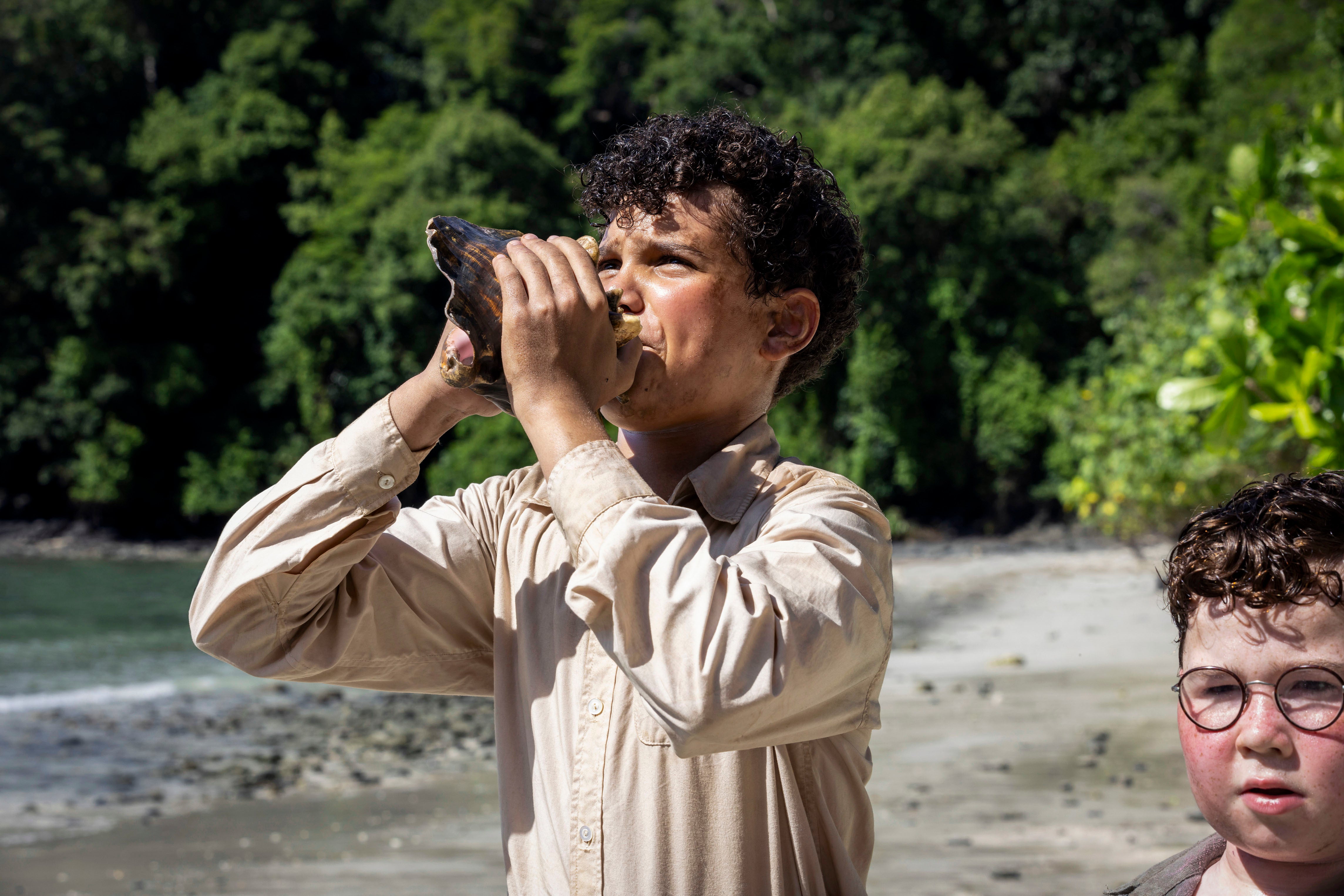
But even if some exchanges feel clunky, Lord of the Flies works because its coterie of child stars is largely very well cast. McKenna, as Piggy, is particularly convincing, as is Pratt, as the unravelling Jack. And while some elements of this adaptation – the use of fisheye photography, or the uncanny CGI wild pigs – don’t quite work, it is overwhelmingly a bold, ambitious vision for the novel. Thorne and series director Marc Munden do not hold back. The four-episode series, shot largely on location in Malaysia, feels feral. Liberated from cans of Lynx Africa, you can almost smell the body odour emanating from these writhing bodies.
“Fancy thinking the Beast was something you could hunt and kill,” the imagined monster snarls, as the boys descend into chaos. For the second time in a year, after Adolescence, Thorne has written a television show that will terrify parents. In bold colours, Lord of the Flies depicts the, often inscrutable, journey to irreversible acts of violence, all perpetrated by little boys with spindly limbs, unbroken voices, and wide, seemingly innocent, eyes.
Join our commenting forum
Join thought-provoking conversations, follow other Independent readers and see their replies
Comments
Bookmark popover
Removed from bookmarks