Sorry, Mr President, but Xi runs the world now
As Donald Trump gives himself a ‘12 out of 10’ for the biggest meeting of his Asia tour, he might think he’s won the day. But China’s Xi Jinping is the one left holding all the cards, writes Mary Dejevsky


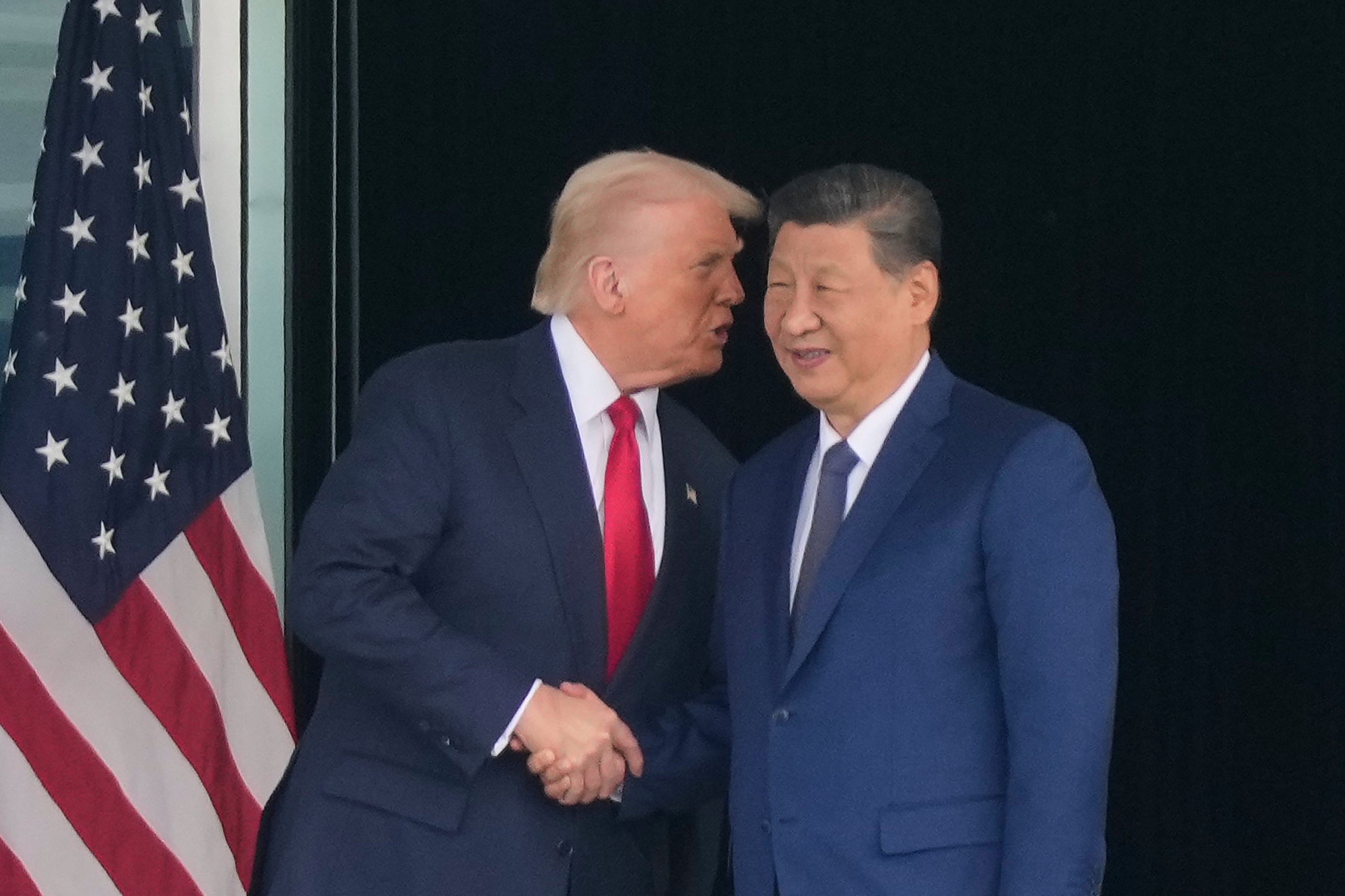
The world can breathe a small sigh of relief. There is not going to be a war between its two biggest economies, at least not yet. The US and Chinese presidents both looked quietly pleased as they staged a protracted handshake for the cameras ahead of their meeting in the South Korean port of Busan. Donald Trump was typically hyperbolic, describing the meeting as “12 out of 10”, and “a great success”; Xi Jinping said the two sides had reached “a consensus” and expressed hopes for partnership, while admitting that differences exist.
The specifics suggest that China is delaying the controls it had announced on exports of rare earths, while Trump has agreed to delay the introduction of punitive, 100 per cent tariffs, and to reduce tariffs on goods the US regards as being linked to the drug fentanyl. China has committed to increasing imports of US agricultural goods.
It appears that the talks concentrated on immediate bilateral economic issues, with China’s stance on Russia and the Ukraine war, as well as its intentions towards Taiwan – the central security issue in US-China relations – apparently being parked as too difficult for the current encounter.
But even the limited degree of progress apparently made is not nothing. That the meeting should happen at all was never to be taken for granted, and while the results look more like a holding operation than a breakthrough, the agreement to continue talking is positive.
Some of the criticisms may also reflect not just inflated expectations, but a failure on the part of diplomats, politicians, and yes, the media, to come to terms with the way Trump handles “abroad”. Perhaps it is time to get used to a world in which powerful leaders meet and talk to each other without all the dots and commas of a joint declaration, or even a fixed agenda, having been finalised through layers of sherpa meetings in advance.
To be sure, there are risks in such an approach – graphically illustrated by the disastrous White House ambush of Ukraine’s Volodymyr Zelensky. But this was Trump’s first face-to-face meeting with Xi since 2019, and a lot has changed, to the point where this could reasonably be described as more of a preparatory meeting than a summit. As such, it has brought a measure of stability both to US-China relations, and – so far as Trump’s fixation with tariffs and continuing judicial battles in the US allows – to the international trading system.
At least as worthy of note as the results, however, is the regional context. When Trump arrived in South Korea, he was on the last leg of a journey that had probably combined a greater number of substantial destinations than had any one tour by any recent US president.
There was a stopover in Qatar, to review progress on the Gaza ceasefire. Then there was a day in Malaysia, to sign trade agreements with, among others, Vietnam; to announce (alongside the Malaysian prime minister) what was called a peace deal to end hostilities between Cambodia and Thailand; and to put in an appearance at the annual summit of Southeast Asian nations (ASEAN), being hosted by Malaysia for the first time in 10 years. He then flew to Japan, where he met the new prime minister and discussed, as he did everywhere, tariffs and trade, with a dash of Pacific security.
But it was the last leg, and the meeting with Xi in advance of the Asia-Pacific Economic Cooperation summit, that was by far the most keenly awaited. There was a widespread sense that the fate, if not of world peace, then of the world trading system, could hang in the balance, with fears that the mercurial character of Trump combined with Xi’s potential refusal to give any quarter could leave bilateral relations worse off. Mercifully, that did not happen.
This does not mean, however, that all is now plain sailing in US-China relations, even if the focus is limited to the economic and trade front. As it happens, I was in Kuala Lumpur when Trump made his appearance at the ASEAN summit, and there are two observations from there that have a bearing, if not on what could happen next, then on the longer term.
Since the start of Trump’s second term, he has dominated the international scene in a way that few leaders have. Yet his stay was not the all-consuming, headline-dominating event that it might have been in the Western world. The same applied to the anticipation of the Trump-Xi encounter.
In this regional perspective, Trump comes across as less consequential, somehow smaller, than he does at home. This is a bustling, rushing, hustling section of the globe, governed mostly by non-Western, in fact rather Trumpian, mercantilist values, and there is a tangible sense that it is gradually orienting itself towards China as the new/old hegemon. The priority is not to take one side or the other, but to avoid conflict.
There is concern that Trump’s flurry of trade agreements with Vietnam, Cambodia, Malaysia and Thailand are part of an effort to slow, if not curb, China’s growing economic reach in the region, even as his visits to longstanding US allies – Japan, South Korea – were seen through a security, rather than trade, prism. Some also saw Trump’s brief appearance at the ASEAN summit as an intimation of US interest in drawing that organisation closer to the US and the West, and away from its current delicate balancing act.
It seems to me that Trump’s priorities lie with trade, both as a good in itself and as a means of avoiding conflict; that he sees the potential of Southeast Asia in both respects; and that his preference is for dealmaking with China that allows for peaceful competition in the Pacific – albeit (and this is where the snag comes in) on US terms. How much of a snag this is may become evident as and when the promised trade talks with China progress.
Join our commenting forum
Join thought-provoking conversations, follow other Independent readers and see their replies
Comments
Bookmark popover
Removed from bookmarks