Why the King and Prince William need to open the books on their enormous riches
The senior royals have been able to amass a great fortune without any scrutiny, writes Alan Rusbridger. For most of their subjects, these are testing financial times – now is the time for transparency

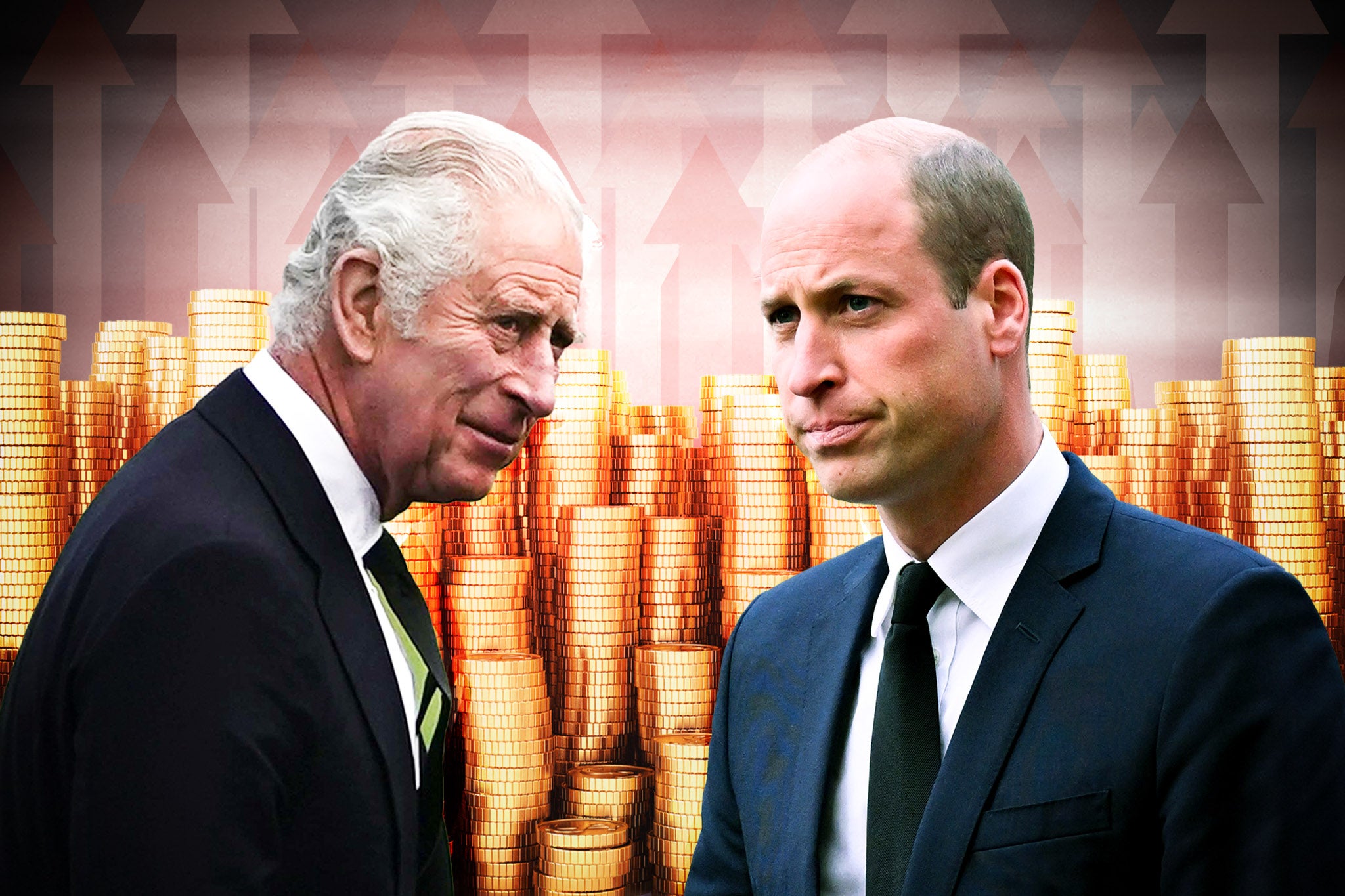
If King Charles were a brand, it would be part Hovis, part Dalai Lama, part Duchy Originals. Artisanal craft blended with a big dollop of spiritualism. Capability Brown meets Inigo Jones, with a Highland twist.
But is it just possible that the King is also just a bit…. greedy? And so was his mum, and so is his brother Andrew, and so is his son William?
That was certainly the impression left by the second episode of David Dimbleby’s three-part BBC documentary series, What’s the Monarchy For? Yes, it’s all about duty, selflessness, and serving the people. But is it also about becoming filthy rich?
When a Dimbleby interrogates a monarch, we have one grand hereditary dynasty questioning another. Whereas Charles is ultimately a Saxe-Coburg, David Dimbleby is a descendant of Richard, whose hushed tones narrated the coronation of Elizabeth II in 1953.
His own brother, Jonathan, was the authorised biographer of Prince Charles in 1994 and the interviewer for a film that same year, in which he famously asked the king-in-waiting if he had been “faithful and honourable” to Princess Diana.


And now we have David getting in on the act. At 87, he has the air of a stern but kindly headmaster, unable to conceal his disappointment at the apologetic wretches who have been summoned to his study for questioning.
None more so than the former chancellor, George Osborne, who, in a fumbling way, tried to explain why he had blessed arrangements that would help ensure that Charles, by the time he ascended to the throne, would be a billionaire.
On the page, a transcript would show Dimbleby behaving as a model of BBC due impartiality. But on screen, he seemed to convey infinite disdain with the raising of a single eyebrow. A finger resting insouciantly on his temple spoke volumes as he asked Osborne whether the Queen “purred with pleasure” at the generous settlement he fixed for her. A scratched earlobe looked like a form of semaphore to the viewers.
Now there are aspects of the royal family’s wealth that I find it hard to get worked up about. Their art collection may or may not be worth around £24m. His mother apparently bequeathed Charles about 100 horses, worth a little bit more than that. There's a stamp collection worth £100m and jewels worth perhaps £533m. Fine by me, especially if they are generous in loaning the art around so that others can admire it.
But what really got Dimbleby’s eyebrows arching were two things: the sheer torrents of cash the King and Prince William trouser each year, along with their relaxed view of their sense of duty when it comes to paying tax. That, plus the secrecy surrounding it all.
The rot began with the late Queen’s father, George VI, according to Dimbleby. He managed to persuade the government of the day that the family was so impecunious that they shouldn’t be required to pay income tax. All other royals, dating back to Queen Victoria, had had no problem with the idea of paying their dues. “And so, for decades,” observed Dimbleby drily, “the Windsors’ wealth grew unchecked.”
There was an outcry in 1992 when it was casually announced that the ordinary taxpayer would be required to fork out for the £34m rebuilding of Windsor Castle after a fire ripped through the building. In response, the Queen graciously consented to pay some income tax.
But she had also used a little-known sovereign power – Queen’s Consent – to shield or exempt the royals from any laws that might affect their wealth or other interests. According to Dimbleby, our monarch ensured that at least 160 laws that the rest of us have to follow would not apply to them. They included health and safety regulations, the Race Relations Act and anything relating to equal opportunities – but, crucially, also excluded the royals from scrutiny about their growing wealth.
It was Osborne who, while slicing an eye-watering £81bn out of public spending in 2011, came to a cosy deal in which the palace would get a proportion of the profits of the crown estate, which is, when all said and done, just a highly lucrative modern property company.
Dimbleby described this as a “fantastic mechanism” which, in practice, guaranteed that it would work like a ratchet: the cash could only ever go up – never down. That meant the supposed family running costs, which stood at around £30m in 2012, reached £72m this year. If Osborne had created a system that merely kept pace with inflation, the notional cost of the royal family would today be around £43m.
Osborne – unnerved by the Dimbleby eyebrow – spluttered that these were tiny sums compared with the defence budget or the NHS. And that if we had a president instead of a king – David Dimbleby, say – he'd probably want lavish dinners and big houses too.
Game set and match to Dimbleby.
But that wasn’t even half of it. Because Dimbleby then moved on to the incredible sums of loot that flow from two private, vastly lucrative estates, the Duchies of Cornwall and Lancaster, into the kingly and princely pockets – around £50m a year split between Charles and William.
Never mind the stamp albums and horses, this is where it feels appropriate to call it out for what it is: greed. Seventy-two million pounds represents the hypothetical cost of keeping the monarchy on the road. The rest is avarice. These two men have their royal snouts in the ancestral trough. They have done absolutely nothing to deserve these eye-watering riches. But the carcass is there, and they intended to pick it clean.
Dimbleby stared at the crumpled figure of Lord Soames, who had somehow been inveigled to mount some sort of tattered defence on behalf of this avarice, and demanded: “Is he [Charles] aware and maybe embarrassed by the luxury of his life?” Soames mumbled something about “a very, very strong sense of duty”.
Championship points to Dimbleby.
Almost in passing, the great inquisitor noted that William “seems to be a bit secretive about his wealth. Unlike his father, he is refusing to publish his tax returns.”
As to the ultimate source of all these riches, there was little time to dwell on the unfortunate business of the Royal Africa Company (RAC), set up by Charles II. “The fact is,” said Sathnam Sanghera, a historian of empire and slavery, “that a certain amount of the royal family’s wealth came from the transportation, kidnapping, rape, murder of Africans.”
Sanghera noted, almost mildly, that when RAC slaves arrived in places like Barbados, they had the initials of the Duke of York – Charles II’s brother – branded into their flesh.
That horrible image is difficult to dislodge. But so is the bare-knuckled self-enrichment of two men who feel entitled to dip their elbows in the slop by virtue of birth.
For most of their subjects, these are testing times, but not for the two people at the top of the tree. All due credit for our grandest hereditary interrogator for shining a rare light on such royal grubbiness.
Join our commenting forum
Join thought-provoking conversations, follow other Independent readers and see their replies
Comments
Bookmark popover
Removed from bookmarks