How can we get to Sicily by train on a single booking?
Simon Calder answers your questions on marathon rail journeys, cheap all-inclusives, Polish city breaks and Concorde

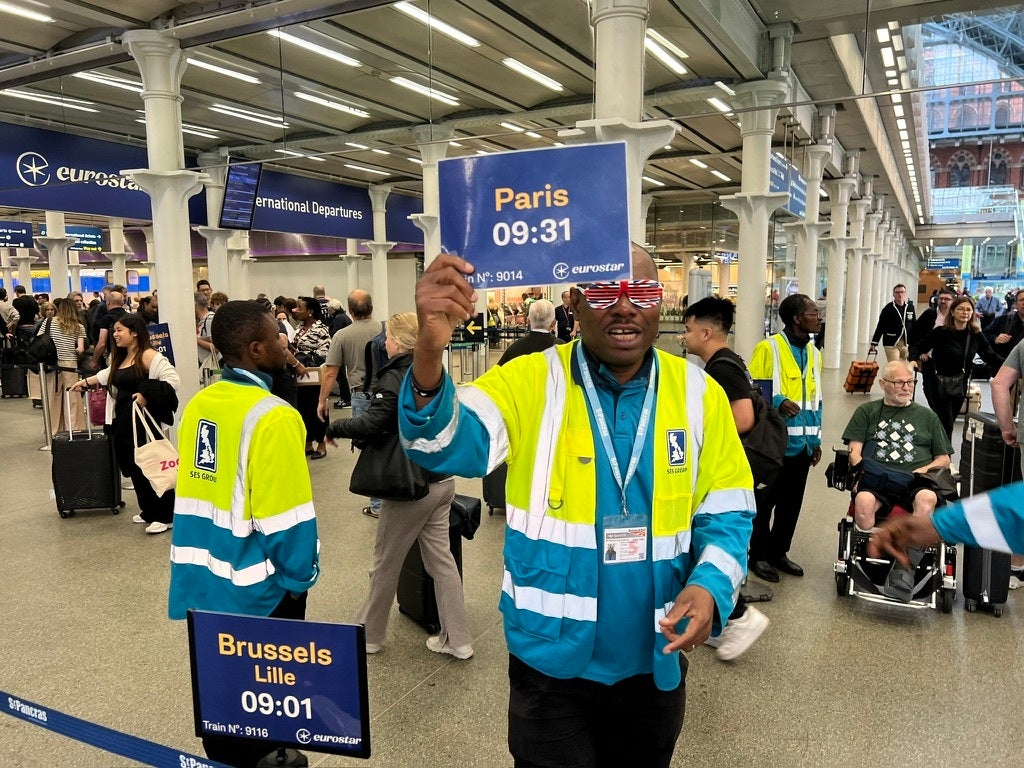
Q What’s the best way to get end-to-end rail tickets to travel to and from destinations in Europe (Sicily in this case) from a single source?
Andy H
A If you are starting in London, then Trainline is straightforward. On a trip a month from now to Palermo Centrale – the handsome station at the end of the line – the company is quoting £203.
The journey, as you might expect, is something of a marathon. You would start at 9.31am from London St Pancras International with a train to Paris, with a couple of hours to cross the French capital before the onward train to Turin – due to arrive at 8.23pm. You will be hoping this train is punctual because there are just 17 minutes to transfer to the 13-hour overnight train to Salerno in southern Italy. During the booking process you are offered a couchette (basically a camp bed in a compartment) on the overnight segment for £15, which I would certainly take.
At Salerno on the morning of day two, you board the InterCity express for the nine-hour ride to Palermo – including the exciting aspect of Europe’s last train-ferry. The whole train is shunted onto a ferry for the crossing of the Strait of Messina.
Starting somewhere else in Britain other than the capital? A message will pop up saying: “To get to Europe, you need to take a Eurostar train from London St Pancras. At the moment, you must first book your Eurostar ticket and then buy your tickets separately for the journey to London St Pancras.” Which rather illustrates the mess that European rail is in: even the market leader for international train bookings cannot sell you a through ticket.
If you are simply after convenience, Trainline is probably still the best bet. But the locations at which you will be changing trains are well worthwhile a longer stay. A company such as Byway will be able to build an itinerary for you that includes hotel stays – and may create a trip based on an Interrail pass, if that is the cheapest way to make the journey. A flight from London to Palermo on the same day, meanwhile, is exactly £100 cheaper at £103.
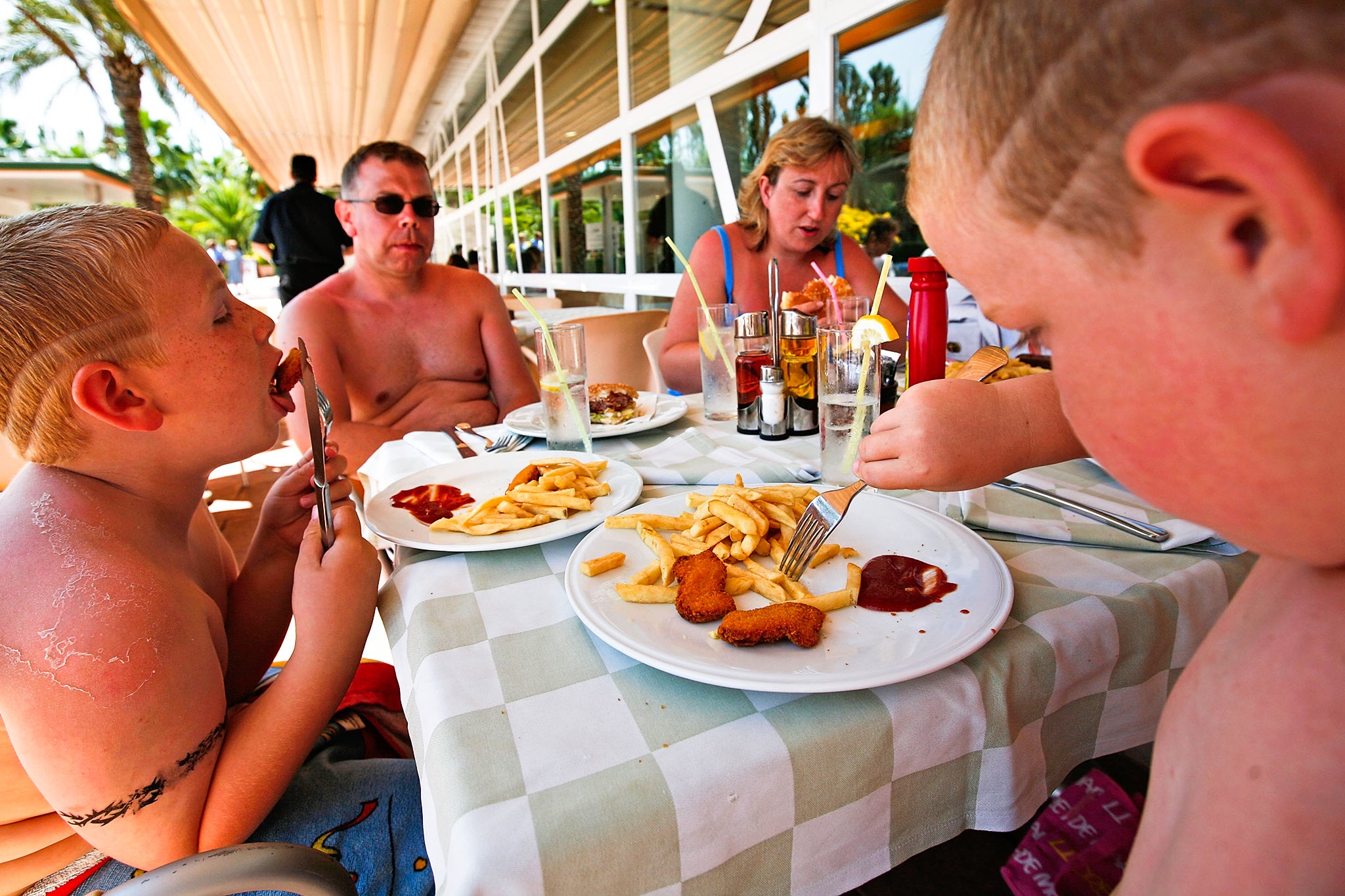
Q Do bargain all-inclusive holidays inevitably have poor food and entertainment? I would like to save money but I don’t want a dismal experience.
Sharon Z
A Let me first set out what a typical all-inclusive holiday involves. Most British travellers who book them are flown to a Mediterranean destination (with Turkey currently the clear leader for all-inclusives) and bussed to the resort. There, they are given a wristband that indicates their entitlement to unlimited food – usually from a buffet – and alcoholic drinks up to a certain standard. Entertainment, ranging from a couple of musicians to a full-blown cruise-ship-type show, may be on offer too.
I have stayed in relatively few all-inclusives, and they have each been slightly different. The best was in Greece, at a resort just south of Rhodes airport, with excellent, fresh food. I was encouraged enough to sample the salad; normally I steer clear, because raw food comes with some microbiological risk in the Med. There was no entertainment, but there was a convivial, taverna-like ambience, lubricated by decent local beer and wine.
A vast resort in Hurghada, Egypt, was notable for having several speciality restaurants one could eat at for no extra charge. One notable feature is that waiters are swift to bring you drinks, but in return you are expected to be swift in tipping them reasonably (about 100 Egyptian pounds, £1.60, for a round – or every few drinks if you are alone).
Elsewhere – in southern Turkey, on Tenerife and in Puerto Vallarta, Mexico – the experience has been much less rewarding. The economics depend on industrial-scale catering for as many people as possible, and also upselling to better drinks. The easiest way to do the latter is to make the “free” offering unpalatable.
More widely, I am concerned about the lower quality of experience on an all-inclusive; you are financially incentivised to stay in the resort. Such insularity means you miss out on what the resort and region have to offer. Also, all-inclusives distort behaviour; if I believe I have paid for as much as I can drink, then I might unwisely consume too much. The ethical agency Responsible Travel describes all-inclusive holidays thus: “Bad for the environment, bad for local communities in the resort destinations, and bad for their customers as there is little or no authenticity to their holiday.”
I can, though, see the appeal for anyone who wants to conserve cash. When choosing one, take the view that you will get what you pay for – and avoid the very cheapest.
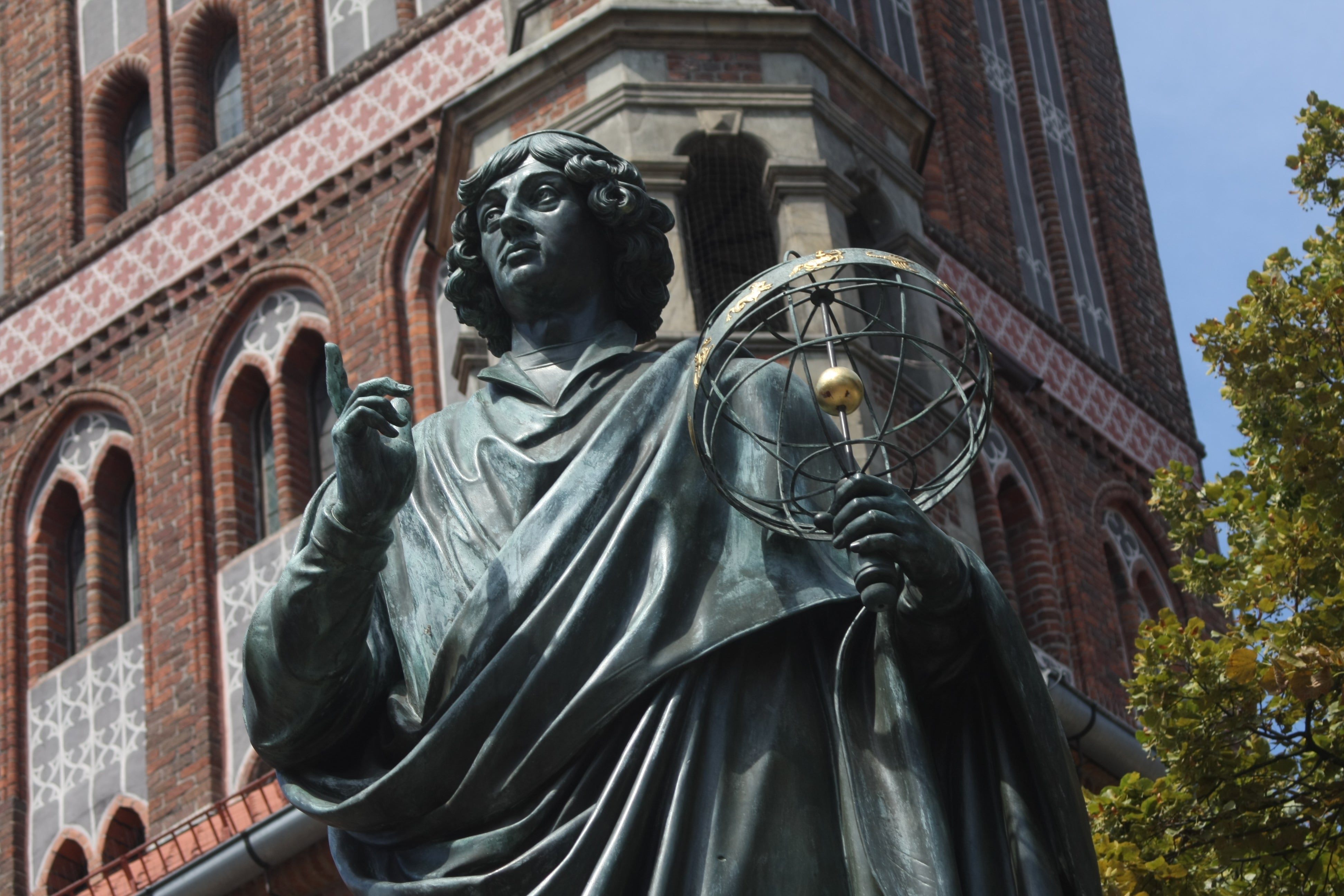
Q I am visiting friends in the Polish city of Torun next month. Have you been? If so, what do you recommend both in the city and around?
Linda C
A Yes, I enjoyed a summer visit to the fine city of Torun in north-central Poland, and heartily recommend a visit. The old quarter is a Unesco world heritage site; the accolade was awarded for “a remarkably well preserved example of a medieval European trading and administrative centre, located on the Vistula River”. Unlike many Polish cities, Torun was largely undamaged by the Second World War.
Winter will be a different experience from my summer strolls; the average high in February is 3C, compared with 24C in August. So you may spend rather less time than I did outdoors admiring the timber and red-brick houses, which are protected by gently crumbling walls and towers.
Fortunately there is plenty of interest within those structures. The local celebrity is Copernicus, and the house where he was reputedly born in 1473 is preserved as a museum devoted to the astronomer’s life and work. The font in which he was baptised is located in the 13th-century St John’s Cathedral – which also has a viewing platform. As with any Polish city, there are countless excellent locations to eat and drink well at low prices.
Do not neglect the nearby attractions. Poland’s leading health resort, Ciechocinek, is 15 miles south, and features a bizarre array of “graduation towers” whose function is to process the spa water. And you will probably be flying in and out of the city of Bydgoszcz, which has been handsomely refreshed with post-industrial landmarks. Trains to and from are cheap, fast and frequent.
If you can possibly extend your stay, then Gdansk – about 110 miles north – is worth two or three days on its own. But Poland is so accessible that you can easily return to the region, perhaps in summer.

Q Did you ever fly on Concorde?
Barry F
A As readers of my Friday travel newsletter may have seen, I flew once on the supersonic jet. It was January 1986: Pet Shop Boys topped the charts, ahead of Dire Straits and Whitney Houston. Those of us on average wages could not dream of flying supersonic on British Airways from London Heathrow to New York JFK. A travel agent pal with access to special deals had taken his girlfriend as a surprise on the Air France Concorde from Paris. But that was as close as I got – until researching for a book called Work Your Way Around the World. I was responsible for a chapter called Working a Passage: revealing options for free or cheap travel in return for a bit of work.
On the travel grapevine I heard rumours that it was possible to act as an air courier on Concorde: taking charge of “time-sensitive documents” that needed to speed across the Atlantic, and which could only be carried as personal baggage. Securicor, the delivery firm involved, sold the opportunity to be the passenger notionally responsible for this precious cargo for a flat £150 for a one-way transatlantic Concorde flight. I called the number I had been given, posted off a cheque (ask an older relative) and waited.
On the day, there was no actual time saving involved for the courier. Four hours before the flight I turned up at a warehouse in Feltham, close to the airport, where my dress (jacket and tie) was checked and I was briefed. “Do as you’re told and don’t cause any fuss,” was the order of the day. A van took me and the mailbags to BA’s check-in at Terminal 3. After more standing around, I was finally given a ticket with loads of baggage tags, a boarding pass and a last-minute bag of news film. I went through security and was allowed the thrill of making free nationwide phone calls from the British Airways Executive Lounge.
To the crew’s credit, they treated me the same as all the proper passengers, even though it was painfully obvious I was an amateur. I loved the dinner, the drinks, the cigar and the visit to the flight deck. And, especially, the speed.
Email your question to s@hols.tv or tweet @SimonCalder
Join our commenting forum
Join thought-provoking conversations, follow other Independent readers and see their replies
Comments
Bookmark popover
Removed from bookmarks