EU entry-exit system: ‘Just run that past me again …’
The Man Who Pays His Way: there seems no end to the questions and confusion about Europe’s digital borders scheme
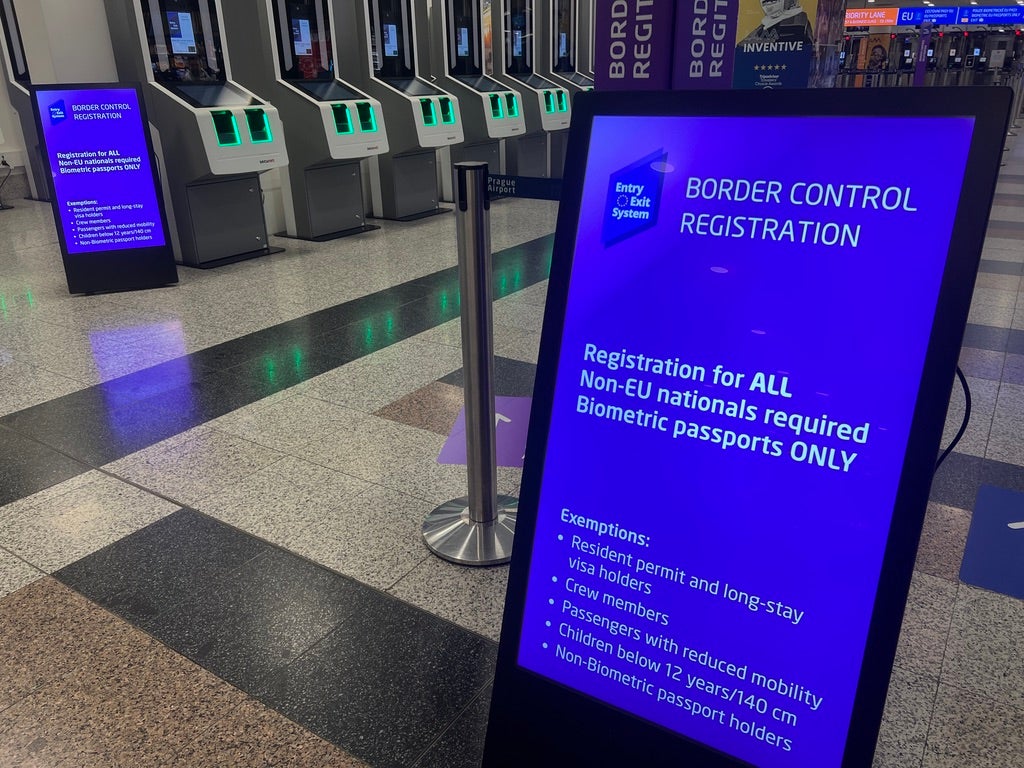
As you will know if you have been following the saga of the EU entry-exit system: more and more British travellers are becoming subject to the digital borders scheme for the Schengen area, which is due to be complete by 9 April.
As that deadline approaches, more concerns are being raised by readers. Over the past few days I have been snowed under with questions about the EU entry-exit system. I have answered a fair spread of the main concerns and selected a few common questions below.
Those of us who have registered still have to wait in the massive queues at European borders! We are registered, where is the quick entry system? Kristen Covo
Wouldn’t it be marvellous to imagine that there is a separate queue for people who have passed the test and had their fingerprints and facial biometrics registered? However, that was never part of the plan. The only difference is that, after you join the long queue for biometric registration, you will not have to do the fingerprint part – just the facial biometric.
There is a widely held misapprehension that, having gone through biometric registration once, you are qualified to use e-gates in future. Unfortunately, this is far from the case. The entry-exit system registration is entirely a European Union enterprise, while the system for admitting third-country nationals is down to each member state.
There should, in theory, be some kind of electronic message sent from the registration kiosk saying roughly, “Kristen has passed the registration hurdle; she will be along soon to enter the country.” But that is a long way from sauntering up to the eGates and smiling (or rather frowning) your way through.
Which countries might be having the most difficulty dealing with the EES? “Paul the Youtuber”
Briefly, to turn your question around: the nations probably having the least difficulty coping with the roll out of the entry-exit system are those where entry points have a very high proportion of European Union citizens – well above the 65 per cent average for a typical Schengen area border crossing. That might be “non-hub” airport locations such as Luxembourg, Berlin or Gothenburg.
At the other extreme: holiday airports serving Spain, Portugal and Greece where very large numbers of arriving and departing passengers are from the UK. But this week I asked the Spanish tourist office in London how it was going and was assured: “Spain fully intends to meet the EU stipulated guidelines and to have the EES running by 10 April.”
Is it worth booking a quick trip to a quiet airport this winter to complete the first biometric registration? If we do this would our second visit to the Schengen area require kiosk use or would we be able to go straight to border control – missing the kiosks? Matthew Pile
A tempting strategy: go to Luxembourg, Berlin or Gothenburg now to save time later. But as explained above: being registered allows you only to shave a few seconds off the time taken for the obligatory re-registration. In time, most British (and other non-EU) nationals will be registered, and the overall process for a planeload of passengers should be noticeably swifter.
If the queues are really deterring you, then waiting might help. A decade or two would be even better, because by then I predict facial biometric technology will be so advanced that you and I will breeze through formalities – even as second-class, third-country nationals.
Couldn’t we allow UK travel agents to install these machines in shops and allow British citizens to use them before they travel? Stephen Brunt
Another excellent idea – but one that will never happen, I fear. What would be good: rolling out the smartphone app created for the EES by Frontex, the EU’s borders agency. Unfortunately it would save only a small amount of time – you cannot register your fingerprints – and take-up has been negligible.
For EU citizens arriving in Schengen area from a non-Schengen country: is it also so difficult to go through the passport control? Marek Zalinski
No, all citizens of European Union nations – and the wider Schengen area – are carrying on as always. At a Schengen area frontier, there are basically two queues. The fast one, labelled EU/EEA/CH, is for:
- Nationals of the EU (whether their country is in Schengen or not)
- CItizens of the wider European Economic Area (EEA), namely Iceland, Liechtenstein and Norway.
- Swiss people (CH is the international country code for Switzerland).
The slow one is for everyone else.
You will find at many ports of arrival there is an additional queue – but this will be for entry-exit system kiosks or pre-registration, which is just a necessary hurdle to cross before you are allowed to line up for the non-EU processing.
You may or may not thank me for reminding you that, had we not voted democratically to leave the European Union and negotiated to become “third-country nationals”, we would be whizzing past the non-EU stragglers, too. In fact, what we chose to do is to more than double the length of those lines – because British passport holders make up more than half of the people who cross borders in and out of the Schengen area.
Simon Calder, also known as The Man Who Pays His Way, has been writing about travel for The Independent since 1994. In his weekly opinion column, he explores a key travel issue – and what it means for you.
Join our commenting forum
Join thought-provoking conversations, follow other Independent readers and see their replies
Comments
Bookmark popover
Removed from bookmarks