What happens if EES makes me miss my connecting flight?
Simon Calder answers your questions on missed connections in the new EU entry-exit system, making your own way to Nepal and compensation for missed connections

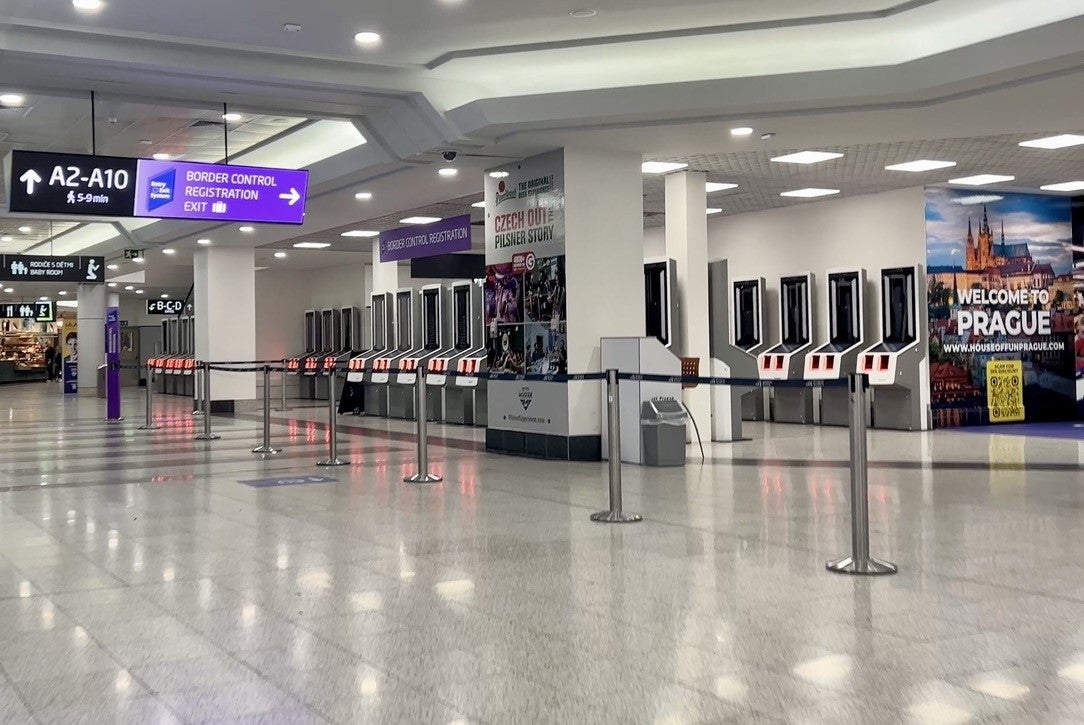
Q You have been writing a lot about the entry-exit system. What worries me is changing planes at an EU airport. If I am held up and miss my connection, even having to stay overnight, what are my rights?
Mahesh P
A For the benefit of readers who have had the good fortune not to have heard of the entry-exit system (EES): this is the plan to connect every frontier crossing point in the Schengen area (comprising all EU nations except Ireland and Cyprus, plus Iceland, Norway and Switzerland) with a central database.
On the first occasion on which the traveller comes into contact with the system, it will create a digital record: registering your face and fingerprints, along with personal data from your passport. On subsequent crossings of the Schengen area border, the facial biometric will be checked against this record.
As you realise, this can increase the time taken at frontiers. Importantly, this is not going to affect anyone transferring direct from the UK to points beyond the Schengen area. Typically, British travellers use Air France via Paris CDG to reach worldwide destinations.
On arrival, you follow the “Transfer” signs and the worst that happens is an extra security check. A fair number of passengers, though, will be connecting through EU hubs to reach other “Schengen” destinations – Edinburgh via Amsterdam to Warsaw, for example, or Manchester via Munich to Naples.
In these cases, you must be admitted to the Schengen area before you proceed to your connecting flight. Some airports have special arrangements to try to ensure passengers make their flights. At Frankfurt, for example, there is a long-established system for tight connections: you might see your flight departure showing up on a screen indicating a “fast-track” opportunity.
Sadly, some transfer passengers will miss their connections. I have heard reports of long waits at Paris CDG and onward European flights departing (according to one traveller) “half-full” because of EES hold-ups. Were this to happen to you, the airline should rebook you on the first available flight and provide accommodation if necessary. Personally, though, I am steering clear of tight connections until the system has bedded down.

Would you risk Kathmandu journey via a ‘self-transfer’?
Q I am travelling to Kathmandu in Nepal next month, and have been holding off booking flights from London in the hope they might get cheaper. But fares are rising, with Qatar Airways currently nearing £1,000 return. I have seen prices of around half as much online – but they include the phrase “self-transfer”. Would you risk it?
Maurice E
A Probably not. First, some basics. There are no longer any direct flights between the UK and Kathmandu, and I do not foresee them being reintroduced any time soon. So a change of planes is always required.
Qatar Airways via Doha is the main approach. Turkish Airlines via Istanbul is another viable option, as is a combination of Emirates and FlyDubai via Dubai. In all these cases, you (and your luggage) will be transferred “airside”; no need to go through passport control. Should a late first flight mean you miss the connection, the airline will arrange onward transportation for you, as well as a hotel and meals if necessary.
I tapped in a request to Skyscanner, the fare-comparison site I use, and found a “self-transfer” itinerary for £486. It involves an afternoon Pegasus flight from London Stansted to Istanbul’s second airport, Sabiha Gokcen, with a two-hour and 10-minute gap before an Air Arabia departure to Sharjah. A bit tight, but I have found Pegasus reliable and would take the chance. Arrival is at dawn the following day, with a nine-hour wait before the onward leg, also on Air Arabia, to Kathmandu. This long wait appeals: a chance to explore Sharjah, Dubai’s sister city, for the morning. The connection to Nepal gets in at a reasonable hour, 8.45pm, allowing for a proper night’s sleep.
Coming back, though, the enterprise is doomed from the start. The first leg is on SpiceJet, a decent Indian budget airline, to Delhi. But you won’t be allowed on board unless you happen to have a valid Indian visa. Even if you have cabin baggage only and vow to stay airside, the carrier will point out that you need to be documented for the destination on your booking, which is Delhi.
My recommendation: take the £1,000 Qatar Airways fare. At this time last year, I was in Nepal, for which I paid Qatar Airways an uncomfortable £1,636 return in economy class. You’ll save a fortune compared with me.
Can we claim for a missed connection due to delays?
Q We were booked on KLM from Athens via Amsterdam to Inverness on a Saturday night. A late departure from Athens meant we reached Amsterdam too late for the Inverness connection. KLM couldn’t rebook us until Monday. Due to storm disruption there was almost no hotel availability in Amsterdam, so we ended up having to book the first night at the Waldorf Astoria for €549 [£480]. With our checked bags in the transit system, we also bought basic clothes and toiletries. Are we entitled to full reimbursement of the hotel, essentials and meals? And should we get additional compensation for arriving two days late?
John I
A Air passengers’ rights rules have two aspects. The first is the duty of care an airline must discharge regardless of the cause of a long delay, cancellation or (as in your case) missed connection. The carrier is obliged to provide meals and accommodation as appropriate. In circumstances where there is widespread disruption such as extreme weather – as opposed to a one-off aircraft problem due to a mechanical issue – airlines may tell passengers to find somewhere to stay and send in the bill for reimbursement.
Your first night hotel was much more that KLM would like to pay, but the airline will surely know the city was very heavily booked on that night and cough up. Carriers have in the past disputed expensive meals, and/or demanded itemised receipts to ensure that you are not claiming for alcoholic drinks. You may face pushback on the “basic clothes and toiletries” – there is no definitive rule, but I imagine anything much over €30 (£25) will be called into question.
The other aspect of passengers’ rights is compensation when the airline is at fault. Bad weather is regarded as an “extraordinary circumstance” and saves the airline from having to pay out. But your travel insurance – if you have some – may make a modest payment of perhaps £100 per person for such a long delay in returning home. Meanwhile, I hope you enjoyed your unexpected day in Amsterdam.
Email your question to s@hols.tv or tweet @SimonCalder
Join our commenting forum
Join thought-provoking conversations, follow other Independent readers and see their replies
Comments
Bookmark popover
Removed from bookmarks