World’s first autonomous passenger ship unveiled in Japan
Japan’s ageing population could hit its shipping industry and affect transportation between islands, experts say
A world-first passenger ferry with advanced autonomous navigation has been unveiled in Japan, an Asian non-profit which is involved in a project to commercialise automated vessels announced on Thursday.
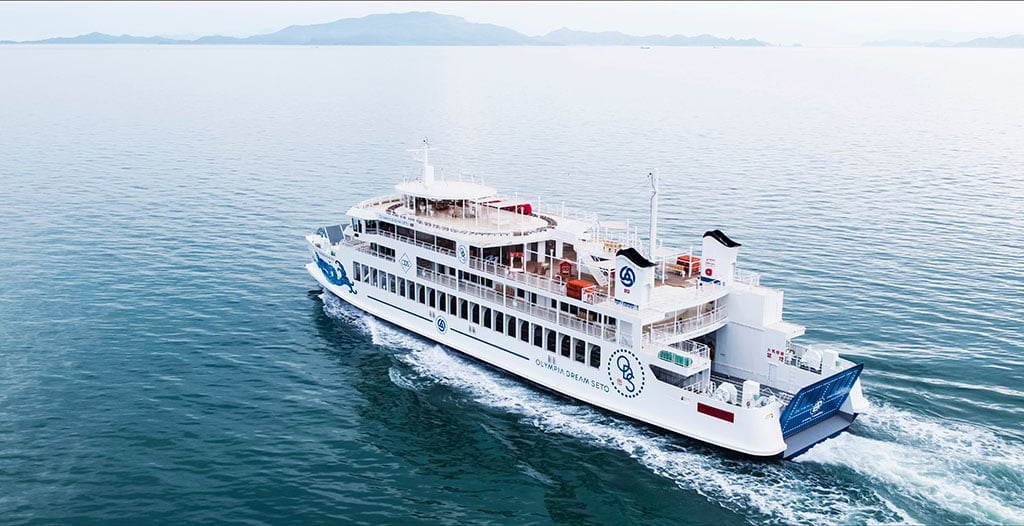
The Olympia Dream Seto ferry transports passengers between the Shin-Okayama port in Okayama Prefecture and Tonosho port in Kagawa Prefecture, and would start operating semi-autonomously from 11 December, according to the Nippon Foundation.
As Japan experiences a shrinking and ageing population, the country has been facing a crisis of human resource scarcity across several fields.
One such field is the coastal shipping industry, in which over half of the crew members are over the age of 50, according to some estimates.
Japan is home to dozens of small islands, which depend heavily on daily ferry routes to stay connected with the core islands of Honshu, Hokkaido, Kyushu, and Shikoku.
“The Nippon Foundation Fully Autonomous Ship Program is leading the world in carrying out demonstration testing of fully autonomous navigation for coastal shipping,” the organisation said on its website.
Through the success of its testing, the foundation said, it “seeks to create further opportunities for technological development in this field, promote innovation in Japan’s logistics, economy and social platforms, and support related technological development”.
“Many crew members on remote island routes are from the area the route serves, and there is a possibility of crew shortages on these routes. This will make reduced service on remote island routes unavoidable, inconveniencing the people who live in these areas,” the Nippon Foundation said.
“We believe that fully autonomous navigation is one way to address these social issues,” it says.
The Olympia Dream Seto passenger ferry is set to begin commercial operations using autonomous navigation by the end of next March at the earliest, Nippon Foundation executive Mitsuyuki Unno said.
While tech giants have been making strides in developing self-driving cars and other autonomous vehicles for the road, there are still several hurdles for such navigation in the seas.
For instance, there is a lack of telecommunications infrastructure between land and sea, and comparatively lesser development of obstacle avoidance technology for sea-faring vessels.
But with Japan, being a world leader in Internet of Things (IoT), artificial intelligence (AI), and image analysis, experts hope autonomous ship navigation could set sail in the country.
An earlier stage of the current project tested six vessels by five groups of companies, including in Tokyo Bay, from 2020 to 2022.
The current phase of the project, expected to go on till 2026, aims at improving the technology’s implementation along with developments in collision-avoidance as well as auto berthing (docking) and unberthing (leaving) of ships.
Join our commenting forum
Join thought-provoking conversations, follow other Independent readers and see their replies
Comments
Bookmark popover
Removed from bookmarks