‘Star factory’ birthing stars 180 times faster than our galaxy could solve Big Bang mystery
The discovery could help solve a long-standing mystery about the early universe
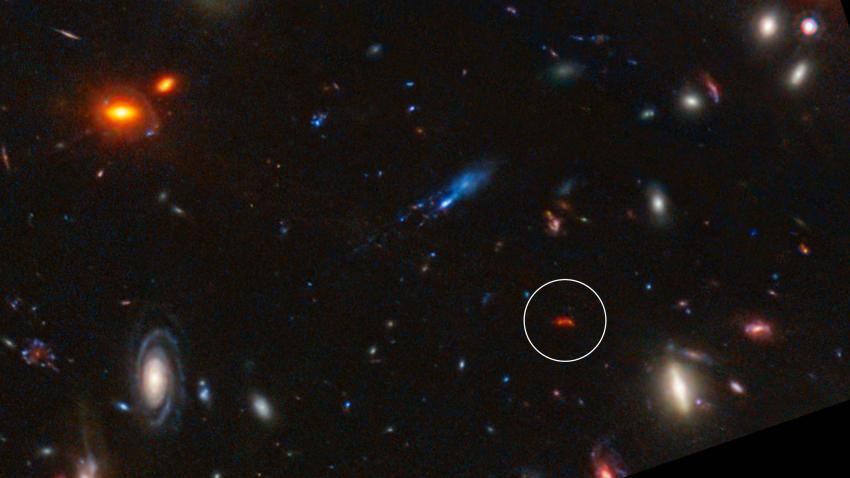
Astronomers have uncovered a galaxy that forms stars 180 times faster than our own Milky Way.
Observations through the ALMA telescope, which is one of the largest in the world, revealed a previously unknown superheated “star factory” that existed less than a billion years after the Big Bang.
An international team of researchers analysed the light from the primordial Y1 galaxy, which has taken over 13 billion years to reach Earth.
The discovery could help solve a long-standing mystery about how galaxies grew so quickly in the early universe.
“We’re looking back to a time when the universe was making stars much faster than today,” said Tom Bakx, a postdoctoral researcher at Chalmers University of Technology in Sweden, who led the research.
“Previous observations revealed the presence of [cosmic] dust in this galaxy, making it the furthest away we’ve ever directly detected from glowing dust.
“That made us suspect that this galaxy might be running a different, superheated kind of star factory. To be sure, we set out to measure its temperature."
By measuring the temperature of the superheated cosmic dust, the astronomers were able to confirm that it was an “extreme” star factory.
“Even though it's the first time we've seen a galaxy like this, we think that there could be many more out there,” said co-researcher Yoichi Tamura, an astronomer at Nagoya University in Japan. “Star factories like Y1 could have been common in the early universe."
Y1 is manufacturing stars at an “extreme rate” of 180 per year, which is unsustainable on cosmological scales, according to the scientists. By contrast, the Milky Way produces only around one star per year.
“We don't know how common such phases might be in the early universe, so in the future we want to look for more examples of star factories like this,” said Dr Bakx.
“We also plan to use the high-resolution capabilities of ALMA to take a closer look at how this galaxy works.”
The discovery was detailed in Monthly Notices of the Royal Astronomical Society, in a paper titled 'A warm ultraluminous infrared galaxy just 600 million years after the big bang’.
Join our commenting forum
Join thought-provoking conversations, follow other Independent readers and see their replies
Comments
Bookmark popover
Removed from bookmarks