Solar eclipse appears in the sky – but is visible mostly to penguins
Eclipse was only total over Antarctica
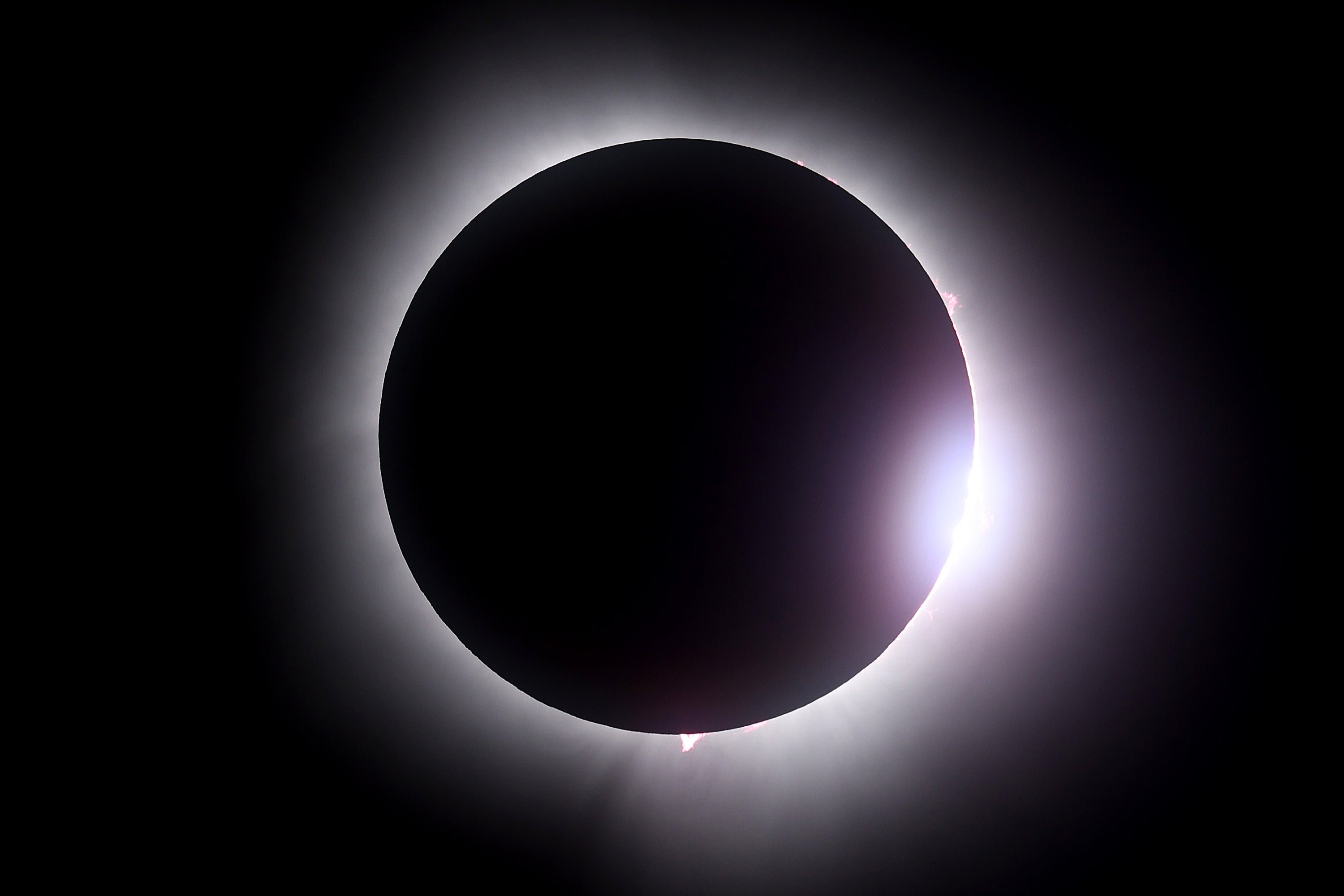
The world has been treated to its first solar eclipse of the year – but not many people were around to see it.
A total solar eclipse happens when the planets align so that, from the Earth, the Moon moves in front of the Sun. That can lead to a dramatic vision of the Sun being blocked out in the sky, as well as an eerie dark on the Earth.
The eclipse travelled over Antarctica, meaning that it visible mostly to penguins, though the path of totality also stretched over the Concordia Research Station, the most remote research base on the Earth.
What’s more, the eclipse was total but “annular”. That describes eclipses where the arrangement of the Moon, the Sun and the Earth mean that the Moon appears smaller in the sky, blocking out less of the Sun and therefore having a less dramatic effect on the light.
That happens because the Moon’s orbit is not circular but egg shaped, bringing it sometimes closer to and sometimes further away from the Earth. At those further points, its size is not enough to block out the full view of the Sun.
Such eclipses are sometimes referred to as a “ring of fire”, because the flaming edge of the Sun is still visible around the Moon.
The next solar eclipse will come on 12 August. But it will, once again, be mostly in places that are cold and largely unoccupied, such as Greenland and Iceland.
But the total eclipse will also be visible in Spain, Russia and a small part of Portugal. And there will be a partial eclipse visible in parts of Europe, Africa and North America.
The next lunar eclipse will come much sooner, on 3 March. That will be total, and visible in Asia, Australia, Pacific Islands and the Americas.
Join our commenting forum
Join thought-provoking conversations, follow other Independent readers and see their replies
Comments
Bookmark popover
Removed from bookmarks