Northern lights to appear in UK tonight after ‘cannibal’ solar storm
Two coronal mass ejections will collide to deliver colourful auroras over the UK and US
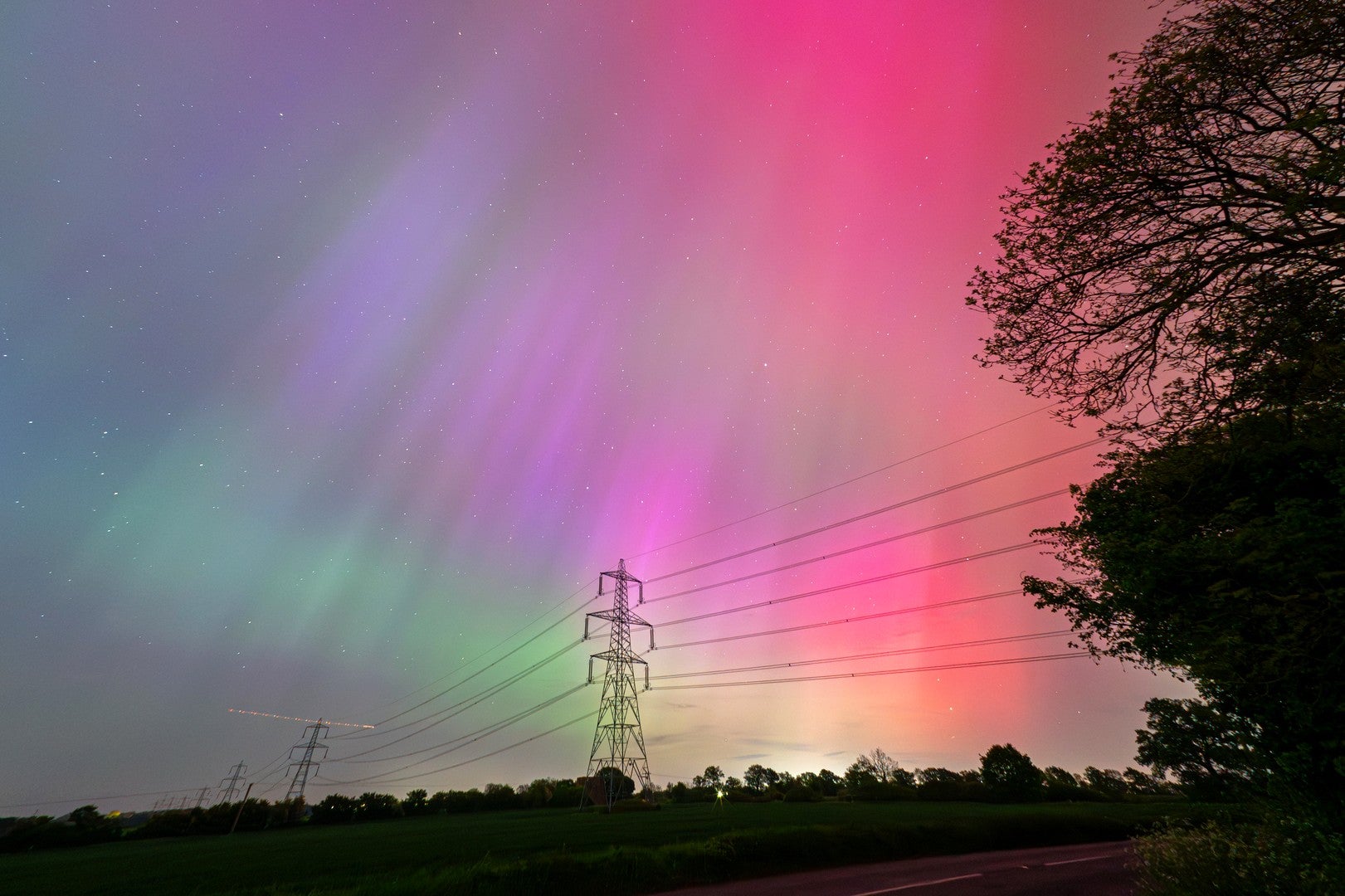
An incoming pair of solar storms will bring northern lights to latitudes as far south as Birmingham and Norwich on Monday night, according to the latest forecasts.
The two Earth-directed coronal mass ejections (CMEs) erupted from the Sun just hours apart over the weekend, with the second and larger CME expected to engulf and overtake the first just before they reach our atmosphere.
The rare even is referred to as a “cannibal CME” by scientists, and is expected to produce spectacular auroras in the Northern and Southern Hemisphere.
The latest space weather forecast from the UK Met Office suggests the northern lights could be visible from Monday night until Wednesday night across most parts of the country.
“A fast-moving coronal mass ejection (CME) that departed the Sun late on 30 August is forecast to arrive at Earth late on 1 September or early on 2 September,” the weather agency stated.
“Following its arrival, a significant enhancement of the auroral oval is likely, potentially continuing into 3 September.
“At peak activity, and where skies are sufficiently dark and clear, aurora may be visible as far south as East Anglia, the Midlands, Wales, and other regions at similar geomagnetic latitudes – without the need for photographic equipment.”
The US National Oceanic and Atmospheric Administration (NOAA) predicts that the aurora borealis will stretch as far south as Michigan, Montana and New York.
In the Southern Hemisphere, peak activity will see the southern lights, or aurora australis, across southern parts of Australia and New Zealand.
Auroras occur when the material emitted from the Sun during a CME interacts with the Earth’s atmosphere, producing colourful light displays in the sky.
They are best viewed in areas with low light pollution and with minimal cloud cover.
The latest weather forecast from the Met Office suggest the early morning hours of Tuesday, 2 September, will offer the best chance to view the northern lights.
In the US, clear skies are forecast for easterly areas like New England, the Great Lakes and Montana.
Space weather forecasters warn that a waxing gibbous Moon may partly hinder the visibility of the celestial spectacle at certain times.
Join our commenting forum
Join thought-provoking conversations, follow other Independent readers and see their replies
Comments
Bookmark popover
Removed from bookmarks