Netanyahu is leading Israel to pariah status – and Starmer can’t stop him
Opposition to the war in Gaza is growing around the world, with even Trump voicing his concern about scenes of starvation. But, writes Donald Macintyre, Israel’s prime minister is also fighting for his political survival


By Benjamin Netanyahu’s standards, there was something almost ritualistic about his reaction to Keir Starmer’s policy shift towards recognising a Palestinian state. There was the tendentious accusation that such a state would be a “reward for monstrous terrorism”; a faint accusation of 1939-style passivity in the face of Nazism, with his reference to the “appeasement” of Hamas; the hollow claim that an independent Palestine would pose a “jihadist” threat to Britain itself.
But, for now, the Israeli prime minister has more pressing worries than the rapidly mounting European discontent at the starvation and mass killing of civilians in Gaza. Because that discontent is apparently shared – at least on some days – by Donald Trump. Netanyahu has already hastily U-turned by agreeing to “humanitarian pauses” and the delivery of at least minimal UN aid to abate a famine he was still insisting just days ago did not exist.
This doesn’t mean that Trump is yet ready to apply irresistible pressure on Netanyahu to agree to a ceasefire on terms Hamas would accept. But either way, such concessions, however limited, were not what his two most ultranationalist and seemingly indispensable ministers, Bezalel Smotrich (who briefly threatened to quit at the beginning of the week when he heard about the aid U-turn) and Itamar Ben Gvir, signed up for. And that’s a problem for Netanyahu – because if they had resigned, that could have spelt the end of his coalition.
That malign dynamic has been central to Netanyahu’s pursuit for 22 months of what he accurately promised would be a war of “mighty revenge” after the murder and kidnapping of Israelis on 7 October 2023.
The past week – the images of starvation, the moves by the UK, France, and now Canada, towards recognising Palestine, the pressure from Trump – have all thrown a renewed light on how Netanyahu has pursued the war in Gaza. They also raise the question of how long he can survive in power.



As long as the war lasts, Netanyahu is able to stave off the almost inevitable prospect of a commission of inquiry, which would expose all the failures that allowed October 7 to happen on his watch.
He consistently blames the military and the intelligence services for those failures. Their now mainly resigned or sacked heads argue that he was repeatedly warned during 2023 that the huge divisions generated by his efforts to neuter the country’s judiciary were weakening Israel and affording an opportunity to its enemies.
An inquiry might also excoriate him for what is seen across a wide spectrum of Israeli political opinion as his continued willingness before 7 October to allow Qatar to fund Hamas and keep it in power. That scenario provided the perfect excuse for not negotiating peace with the Palestinians on the grounds that they had a leadership divided between Hamas in Gaza and Fatah in the West Bank.
But keeping together the most right-wing government in Israel’s history serves another, still evolving, purpose. Only such a government, in return for favours like the unopposed expansion of settlements in the West Bank, would be prepared to take steps like the judicial “overhaul” and the currently planned sacking of the attorney general, Gali Baharav Miara. And those together offered the best chance of halting Netanyahu’s ongoing criminal trial on three corruption charges (which he denies).

That said, his success so far in navigating US pressure, such as it has been for most of the war, and the demands of his cabinet extremists, is a testament to the world-class political skills of a man who has not become Israel’s longest-serving prime minister by accident.
Netanyahu has managed to weather a series of crises to get to the Knesset summer recess when the threat to his coalition is automatically, if temporarily, abated.
As Amos Harel, a military analyst on the liberal Haaretz newspaper, speculated on Wednesday, the prime minister has probably in the last few days been sending out a characteristic double message, assuring Smotrich and Ben Gvir that he will resume the war once Trump is placated, while suggesting to the anguished families of hostages still in Gaza that a ceasefire to release at least some of them is imminent.
For as long as Joe Biden was the American president, Netanyahu lined up with Smotrich and Ben Gvir in preference to the White House, a stance strongly fortified by his own lifelong ideological opposition to the Palestinian state that Biden was committed to.
And he managed to escape any real sanctions (apart from one pause, now reversed by Trump, in the delivery of ultra-lethal 2000lb bombs) for serially ignoring US warnings to protect civilians in Gaza. Indeed, his attitude to Biden recalled a private remark to some settlers he was filmed making way back in 2001: “If they say something… so what? ... The Americans are something you can easily manoeuvre.”
When Trump took office, Netanyahu had reason to think he no longer even had to “manoeuvre”. The funding and weapons supplies were unabated. He beamed seraphically in the White House while Trump unveiled his plan to evacuate Gaza’s two million residents and establish a “Riviera” by the Mediterranean Sea. Netanyahu has continued to endorse the expulsion of Gazans – a war crime – as “the Trump plan”.
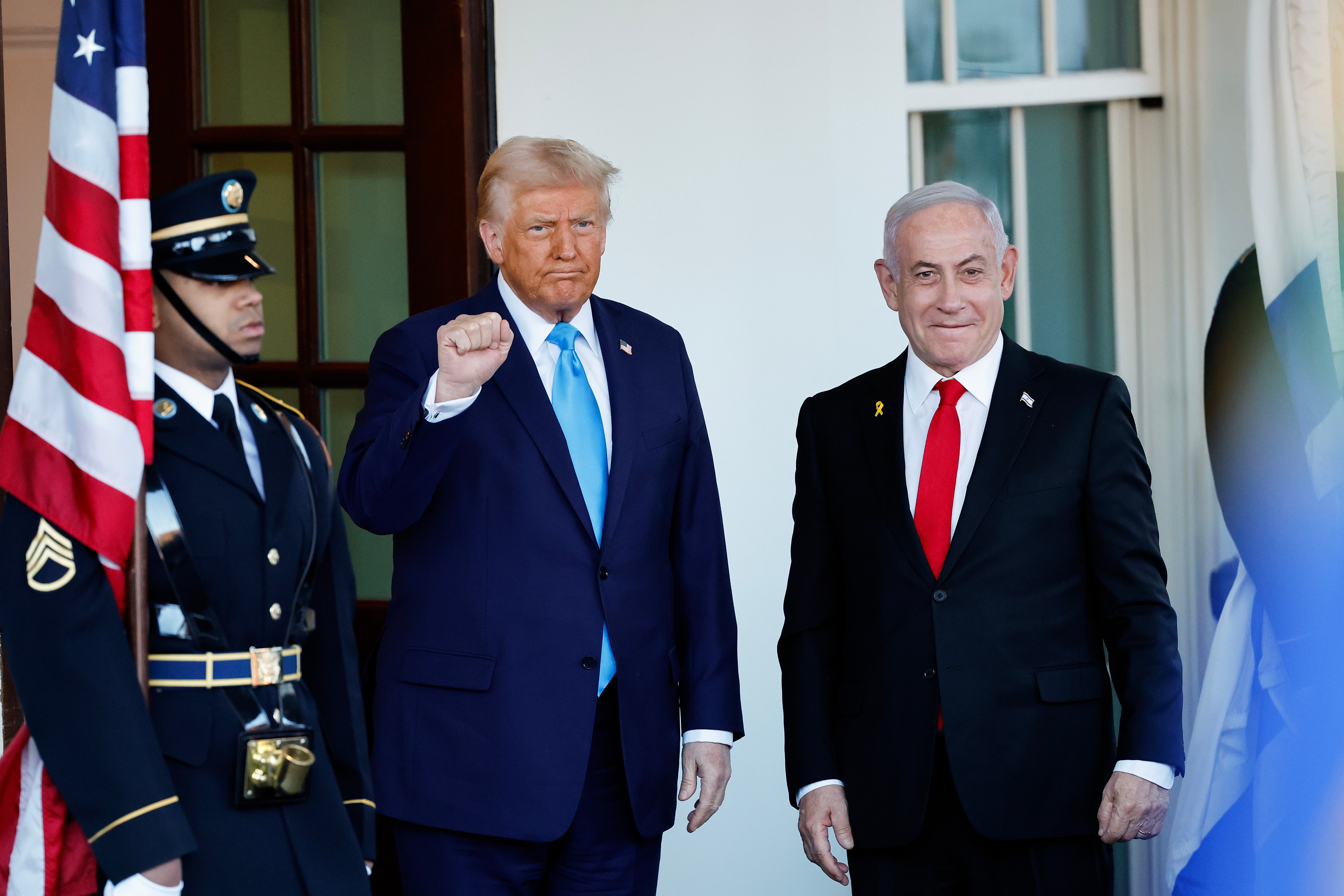
No one – perhaps not even the chronically unpredictable Trump himself – knows whether the US president will continue to tolerate the Israeli prime minister’s resistance to a deal that would end the war. But now that even Fox News is showing pictures of devastation and starving children in Gaza, Netanyahu can’t be quite as certain that he will.
At home, Netanyahu, who must face an election by October 2026, is not popular beyond his own hard-core voters.
It’s not just that the polls show that more than 75 per cent of Israelis are prepared to see an end to the war to bring back the remaining 50 hostages – alive or dead – it’s also that even the euphoria generated by the 12-day war Netanyahu launched on Iran did not produce the expected bounce. A poll for Israel’s Channel 12 showed that his current coalition would win only 49 of the Knesset’s 120 seats compared with a 61-strong majority for the opposition.
It would be crazy to write off the chances of a politician as adept as Netanyahu surviving over the coming year – or even that he could somehow assemble a winning coalition when an election finally comes. How this will be affected by Britain’s – and now Canada’s – provisional decision to recognise a Palestinian state remains to be seen. Though welcome, they will have little practical effect without tangible sanctions to back it up.
Many will be puzzled by the conditionality of Starmer’s shift. If Palestinians have a right to statehood, do they have any less of one if a Gaza ceasefire is agreed? That said, it’s 16 months since the ranking Jewish politician in the US, Democrat senator Chuck Schumer, warned that Israel’s 75-year-old prime minister risked leading his country into “pariah status”. The growing, if belated, momentum of opposition to the Gaza war by foreign governments suggests that this has finally begun to happen.
Join our commenting forum
Join thought-provoking conversations, follow other Independent readers and see their replies
Comments
Bookmark popover
Removed from bookmarks