Police investigation underway into England flag pinned on famous white horse
English Heritage removed the flag hours after it was installed

Police have launched an investigation after a historic Wiltshire landmark, Westbury White Horse, was pinned with a large St George’s Cross.
English Heritage promptly removed the installation later that day, noting that the pegs used caused "minimal damage" to the centuries-old carving.
Initially, Wiltshire Police stated no criminal offences were believed to have occurred, and therefore no investigation would take place. However, a police spokesperson confirmed on Tuesday that an inquiry is now underway.
He said: “Following an assessment of the Westbury White Horse by English Heritage, we have received a report regarding minor damage being done to the horse through the use of pegs.
“We are in the early stages of our inquiries.”
The white horse was carved into the chalk grassland below an Iron Age hillfort at Bratton Camp in Wiltshire.
Local records suggest the horse originally appeared in the late 1600s, probably to commemorate the supposed Battle of Ethandun which is thought to have taken place at Bratton Camp in 878 AD.
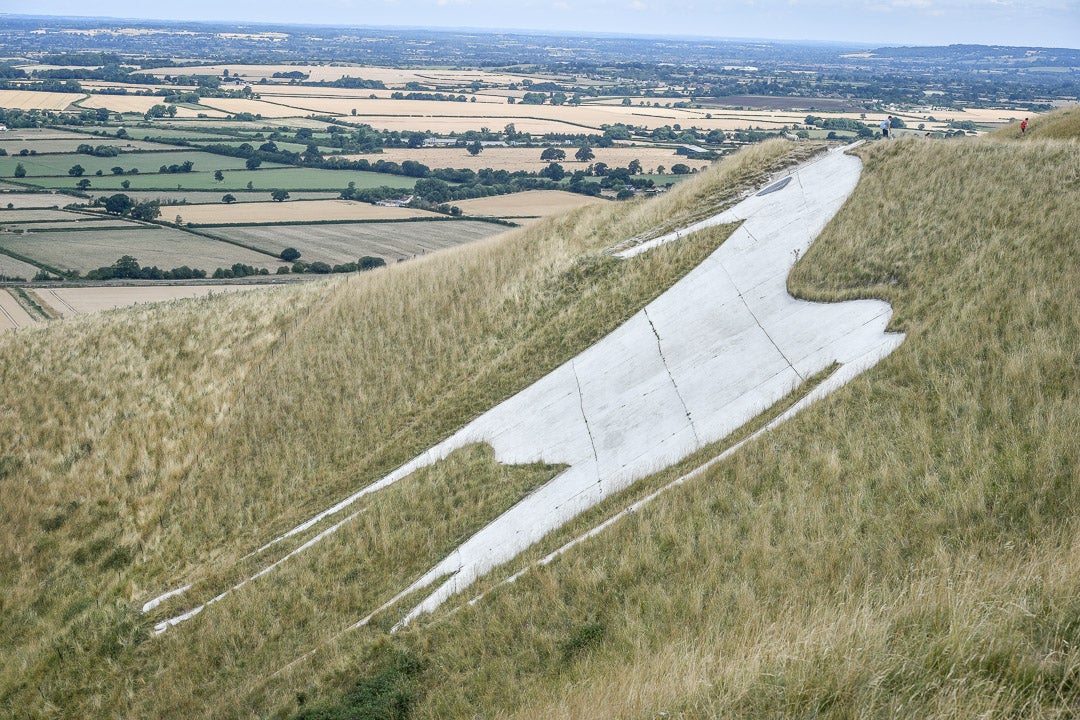
The reason the St George’s Cross was pinned to the horse is unclear.
However, there had been widespread flying of Union and St George’s Cross flags across the UK following an online campaign.
Some people celebrated the campaign, while others claimed the increased number of flags was a result of xenophobia or racism.
It is not the first time Westbury White Horse has been turned into an English flag after English Heritage removed red plastic from the local landmark during England’s 2018 World Cup campaign.
The horse originally had to be scoured to keep it white, with the last recorded scouring taking place in 1853.
In the 1950s, it was covered in white-painted concrete but this turned grey and was replaced in 1993.
English Heritage researched methods for cleaning the horse, with a specialist steam cleaning system first used in 2006.
The system creates a clean surface, which environmentally friendly white paint can then be applied to.
There have been further cleaning and repainting rounds in 2011, 2016 and 2018.
In 2023, an extensive clean and repair work took place.
This involved a conservation team abseiling down the near-vertical face of the horse.
Bookmark popover
Removed from bookmarks