Storm Goretti: What to know as emergency warning sent to phones
The system is designed for use during the most likely emergencies to affect the UK
People in areas most at risk to Storm Goretti have been sent a government emergency alert to their phones.
The storm arrived in the UK on Thursday, bringing gusts of up to 100mph as a rare red warning for “dangerous, stormy” winds was issued for parts of the South West.
The Met Office said “violent gusts” will hit parts of Cornwall and the Isles of Scilly between 4pm and 11pm on Thursday, bringing a potential danger to life.
People are warned to expect damage to buildings and homes, very large waves, flying debris resulting in danger to life, power cuts and public transport cancellations.
Meanwhile, an amber snow warning on Thursday night and into Friday morning could bring up to 30cm of snow in Wales and the Peak District as part of a “weather bomb” hitting the country.
Several yellow weather warnings remain in place as Met Office chief forecaster Neil Armstrong described Storm Goretti as a "multi-hazard event" with heavy rain, strong winds and snow.
As such, the Cabinet Office has issued two alerts, which cause sounds to blare from people’s phones, to those in areas forecast to be affected by the storm. People in Cornwall received a second alert at around 5pm on Thursday, after a first was sent at 3pm to those living on the Isles of Scilly.
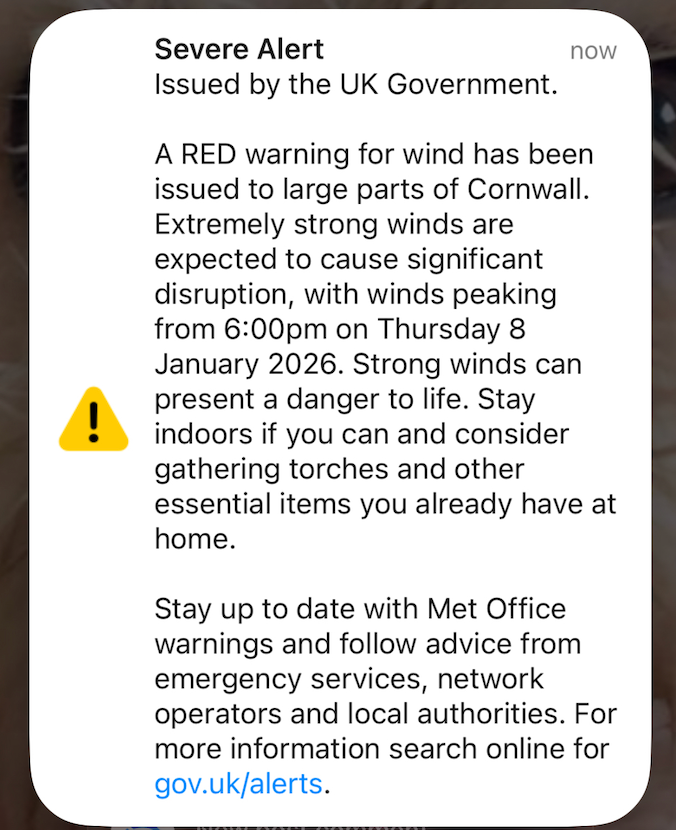
About the alerts, a Cabinet Office spokesman said: “The Met Office has issued a red warning for the Isles of Scilly and Cornwall from 4pm until 11pm on Thursday January 8.
“In light of the damaging winds and associated disruption, the Cabinet Office is issuing two Emergency Alerts to people in affected areas.
“The first was sent at approximately 3pm on Thursday January 8 to people in the Isles of Scilly. The second will be sent at approximately 5pm on Thursday January 8 to people in Cornwall.
“The Emergency Alert system will send a message to every compatible mobile phone in the impacted areas, containing information about the red warning and guidance on how to stay safe.
.jpeg)
“Compatible mobile phones will make a loud siren-like sound even if they are set on silent. The sound and vibration will last for about 10 seconds.
It is the fifth time alerts have been used in this way.
What is the national emergency alert system?
The UK’s national emergency alert system is designed to warn the public if there is a danger to life nearby.
When sent, mobile phones connected to 4G and 5G networks will vibrate and emit a siren sound for up to 10 seconds. Some smartphones also read out the message to recipients. The alarm will also sound even if the device is set to silent.
Phone users will be prompted to acknowledge the alert by swiping or clicking the message before being able to continue using their device.
The system, which is modelled on similar schemes in the US, Canada, the Netherlands and Japan, is intended to be used in life-threatening situations, including flooding and wildfires.
It has been tested twice, in April 2023 and September 2025.
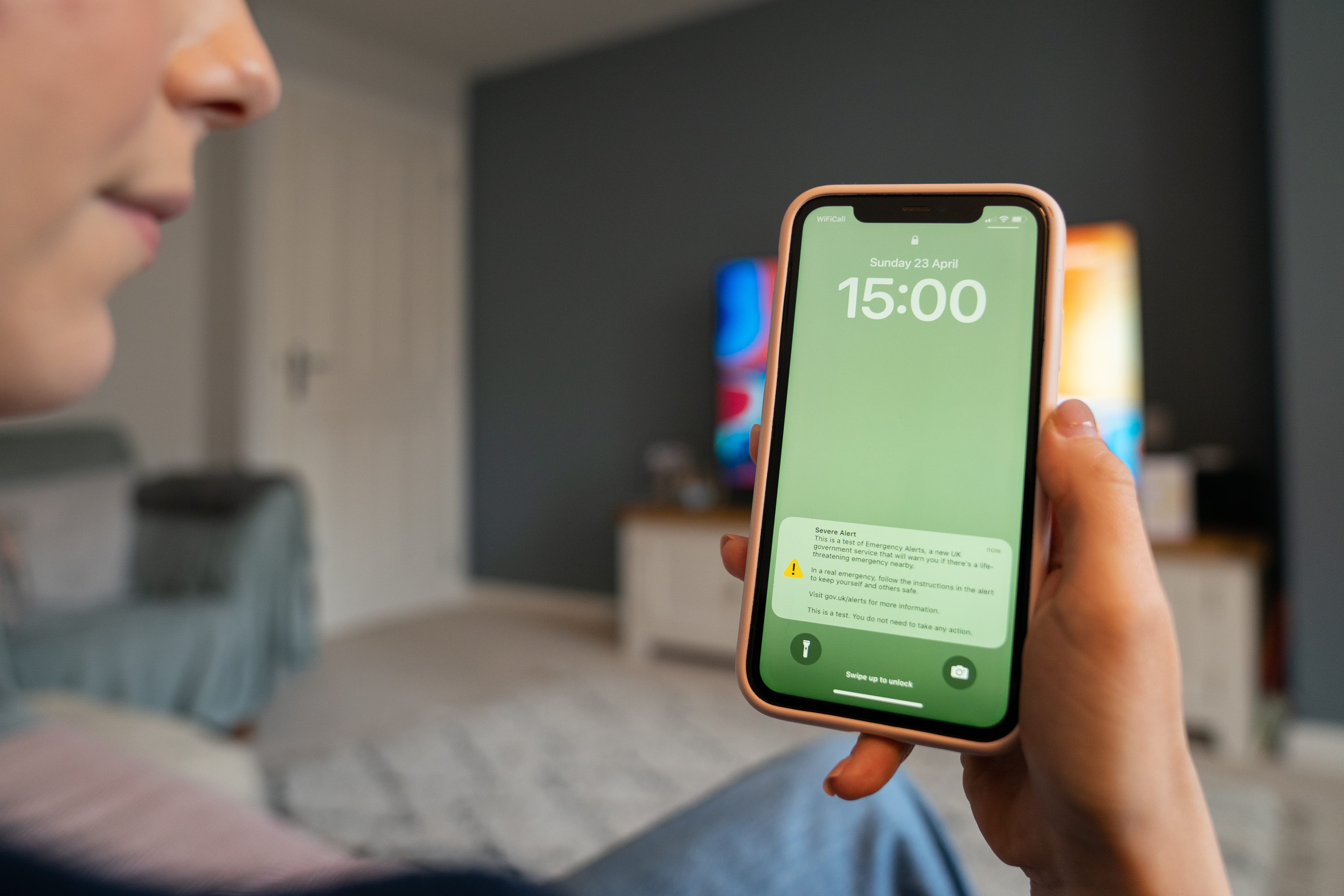
Prime Minister Sir Keir Starmer confirmed the success of the exercise in 2025, writing on X: “Tens of millions of phones successfully sounded across the country during today’s Emergency Alert test.
“This is an important step in keeping people safe during national emergencies.”
The government has used the system to issue real warnings five times, including in January 2025 during Storm Eowyn, to warn people in Scotland and Northern Ireland about severe weather.
Approximately 3.5 million people across Wales and south-west England received an alert during Storm Darragh in December 2024.
A 500kg unexploded Second World War bomb found in a Plymouth back garden triggered a warning to some 50,000 phones in February 2024.

Messages can be targeted to relatively small areas to pinpoint those at risk.
Around 15,000 phones were alerted during flooding in Cumbria in May 2024, and 10,000 received a warning during flooding in Leicestershire in January 2025.
The system is designed for use during the most likely emergencies to affect the UK and warnings would also be transmitted on television, radio and locally by knocking on doors.
The AA recommends that drivers do not interact with the message until stopped in a safe place with the engine switched off.
There are concerns that the sound could reveal hidden phones belonging to domestic abuse victims, and groups are advising them to opt out of the alert.
To opt out, iPhone users should go to settings, search for “Emergency Alerts”, and turn off Severe & Emergency Alerts.
Android users can do the same by searching “Emergency Alerts” in settings and switching off Severe & Emergency Alerts.
Join our commenting forum
Join thought-provoking conversations, follow other Independent readers and see their replies
Comments
Bookmark popover
Removed from bookmarks