China’s ‘ghost particle’ machine could solve science’s greatest mysteries
A futuristic underground observatory located in the hills of China could uncover a whole host of secrets
For years, physicists have been baffled by the discovery of mysterious “ghost particles”.
The scientific name for them is “neutrinos”, which are neutral sub-atomic particles with no electric charge. They can’t be captured using electric or magnetic forces and can freely pass through physical matter.
But thanks to a new liquid dome in a futuristic underground observatory located in the hills of China, particle physicists are containing these elusive particles in the hope that it will uncover hidden scientific secrets.
The sphere contains 20,000 tonnes of a substance known as a liquid scintillator, while neutrinos are constantly fed through the ground from two nearby nuclear power stations. The whole spherical structure is lined with a thin layer of acrylic and contained within a protective cylinder filled with 45,000 tonnes of pure water.
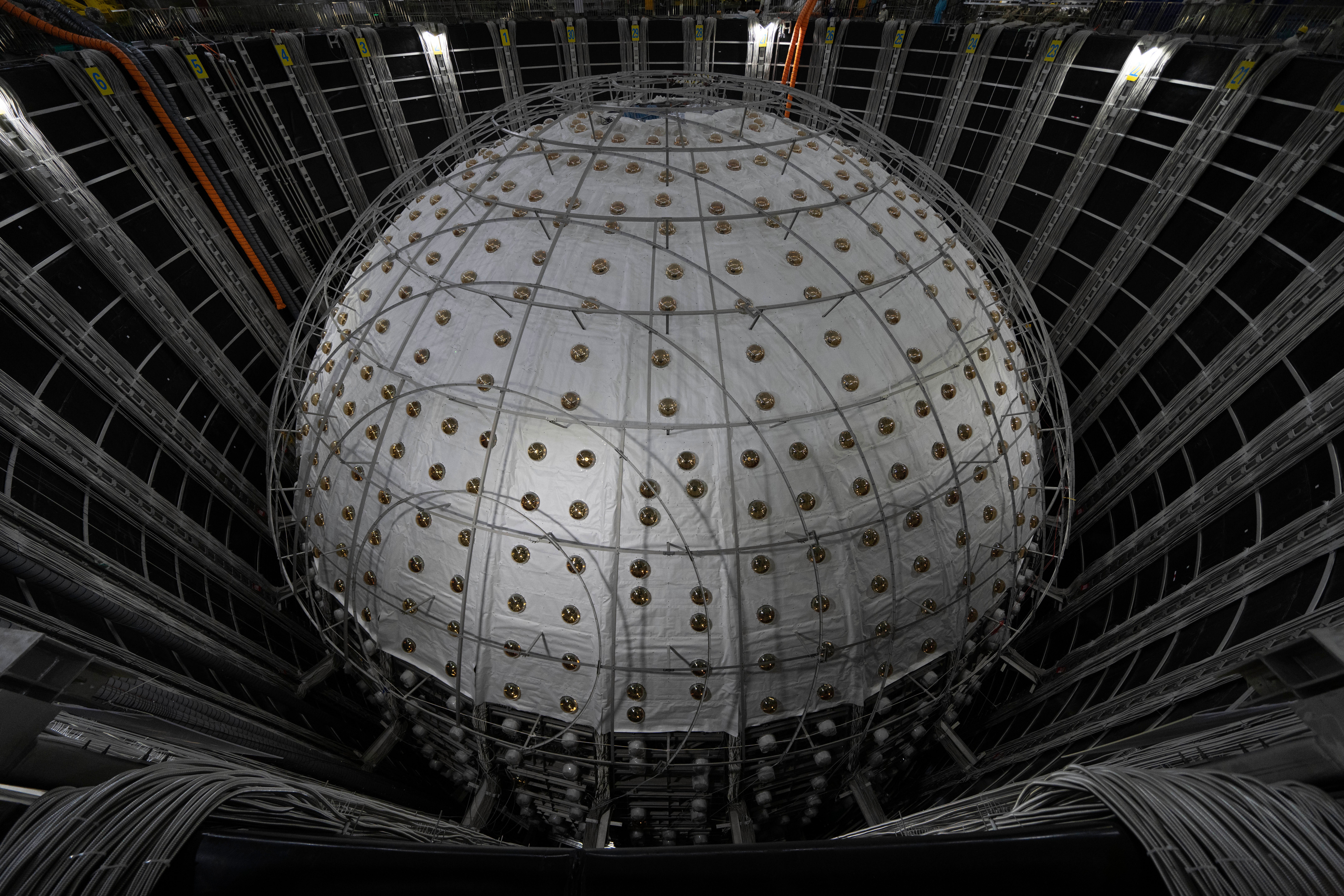
As the neutrinos collide with the protons in the scintillator, they release minuscule but recordable flashes at a rate of about 50 a day, which are remotely monitored, measured and ranked in mass by scientists across the globe.
Wang Yifang, from the Chinese Academy of Sciences which collaborated with 700 physicists worldwide, told The Times: “We are going to know the hierarchy of the neutrino mass, and by knowing this, we can build up the model for particle physics, for neutrinos, for cosmology.”
Neutrinos are the most abundant particles in existence as they can be generated by stellar fusions of supernova explosions. He explained that this research on subatomic particles can help shape “our understanding of the universe”.
He believes that it will only take six years to generate 100,000 flashes, at the 50-a-day rate, and create enough statistically significant readings.
Neutrinos were first predicted by an Austrian physicist named Wolfgang Pauli back in 1930, where he theorised the presence of a particle with no electric charge or mass and an ability to freely pass through matter. In fact, about 100 trillion neutrinos pass through our bodies every second, according to research.
On the discovery, he said: “I have done a terrible thing. I have postulated a particle that cannot be detected.” He placed a bet on a case of champagne that no one would be able to capture a neutrino. But a quarter of a century later, he lost this bet to the liquid scintillator facility in China.
Now we have the knowledge that there are three types of neutrinos - electrons, muons and tau - and each of the forms can morph from one to another. By analysing these scientists can potentially unlock the key to understanding science’s greatest mysteries, such as why there is more “matter” than balancing “anti-matter”.
Join our commenting forum
Join thought-provoking conversations, follow other Independent readers and see their replies
Comments
Bookmark popover
Removed from bookmarks