Project to dry out Charles Rennie Mackintosh’s Hill House at ‘critical’ stage
The property in Helensburgh, Argyll and Bute, which was built in the early 1900s, has been badly affected by rain damage.
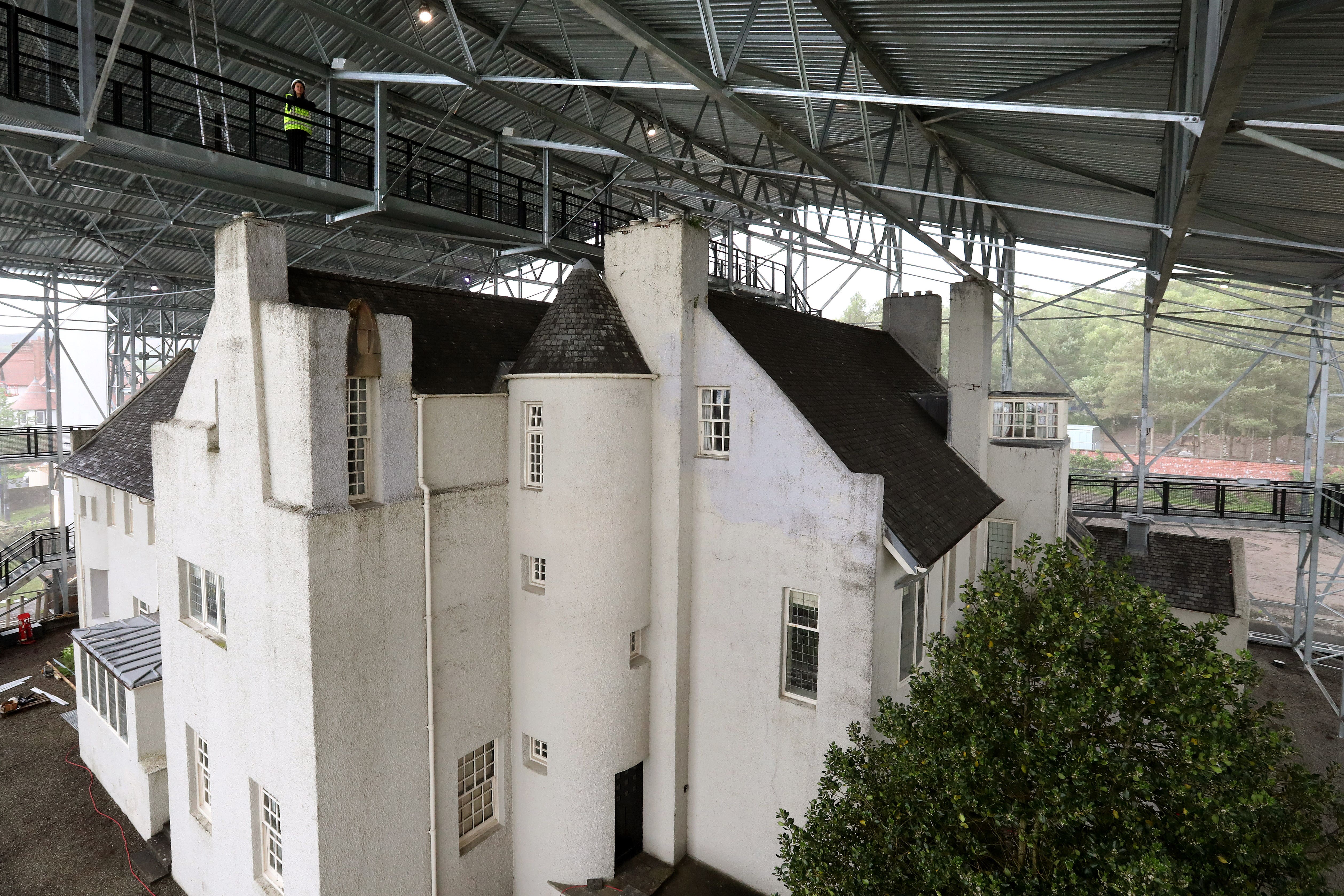
A project to dry out Charles Rennie Mackintosh masterpiece the Hill House has reached a “critical juncture” with the removal of the cement render that contributed to the water damage problem.
A giant steel box around the property in Helensburgh, Argyll and Bute, was completed in 2019 to protect its saturated walls from further damage from the elements and enable it to gradually dry out as part a long-term conservation programme.
The Hill House has been badly affected by the driving rain of Scotland’s west coast since its construction in 1904.
A Portland cement render, or “skin”, was applied to the building in 1902-04 under Mackintosh’s instruction when it was thought to be a wonder product that would protect against the elements.
However the render did not live up to expectations and over the decades water penetration damaged both the structure of the house and the bespoke interior decoration.
After several years sheltered by the steel box, the walls of the Hill House have now dried out enough for the render to be painstakingly chipped off.
The house was commissioned by Glasgow book publisher Walter Blackie and the interior design of the house was a collaboration between Mackintosh and his wife Margaret Macdonald.
Phil Long, chief executive of the National Trust for Scotland (NTS), which cares for the property, said: “It’s difficult to overstate the international importance of Mackintosh and Macdonald and of the Hill House, and so delivering this project is of vital importance in preserving Scotland’s and the world’s design heritage.
“From the moment they were realised, Mackintosh’s designs had a profound effect on the development of early 20th-century international architecture and design, and more than a century later they remain startling.
“The Hill House is one of the architect’s greatest remaining masterpieces, and in its breath-taking interiors, realised in collaboration with his wife, the artist and designer Margaret Macdonald, their combined vision reached its peak.
“This is why restoring this building is of such vital importance to Scotland’s and the world’s creative heritage.
“Thanks to the National Lottery Heritage Fund’s generous support, the project has reached a critical juncture.
“The removal of the render allows us to explore the detailed construction of the building and gain further insight into Mackintosh’s architectural innovation, as well as the constraints he was overcoming.
“The protective box has controlled the drying out of the building, which if done too fast may have caused further damage.
“After expert analysis, it was clear that full replacement of the often-patched Portland cement render was the only tenable option for enabling the restoration work that ensures the building’s long-term survival.”
NTS said in the coming months, it will continue to work with internationally-recognised specialists to finalise a replacement surface render that will maintain the integrity of Mackintosh’s vision but will have the ability to “breathe”.
Mr Long said this will ensure moisture is not trapped and that the Hill House is fit to survive many more decades of west coast weather without the need for a protective box.
The work to conserve and restore the Hill House is part of the National Trust for Scotland’s Mackintosh Illuminated project, which is supported by the players of the National Lottery through £1.1 million in development support from the National Lottery Heritage Fund.
Liz Davidson, NRS project director for Mackintosh Illuminated, said: “The Hill House’s restoration is just one aspect of the Mackintosh Illuminated project which we aim to roll out over the next two to three years.
“By 2028, on the 160th anniversary of Mackintosh’s birth, the Hill House should no longer need its protective box and, ahead of that, with the National Lottery Heritage Fund’s support, we will be completing internal conservation work and developing new and accessible interpretative and learning materials, as well as a programme of community engagement.”
Bookmark popover
Removed from bookmarks