Retired HGV driver undergoes heart bypass using gene therapy to reduce risks
The procedure aims to extend the lifespan of blood vessels used during the graft process in the surgery.
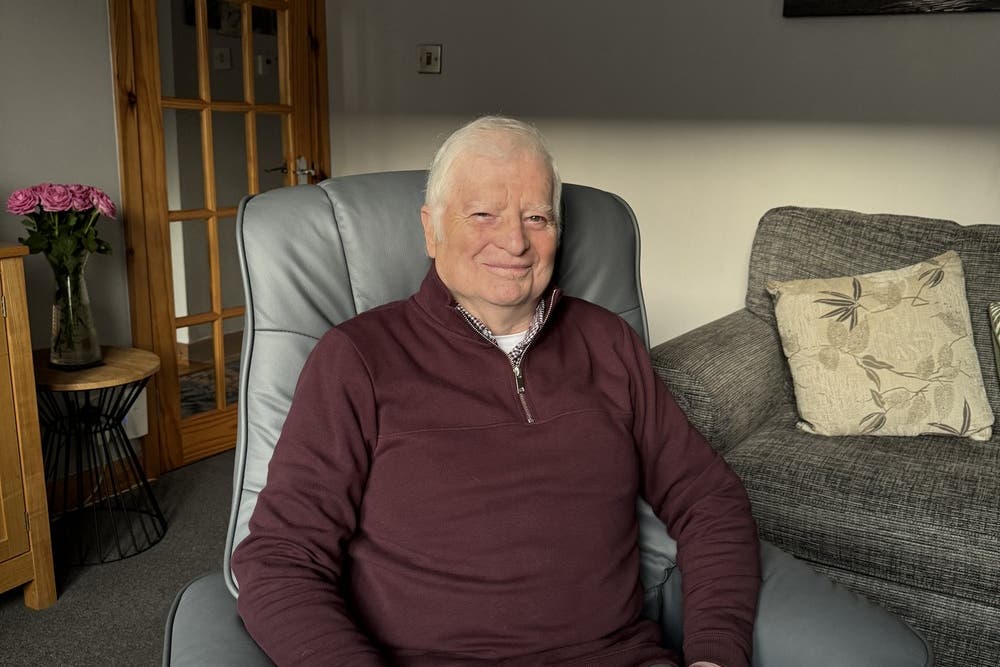
A retired HGV driver was the first person in the world to take part in a clinical trial to extend the lifespan of blood vessels in the heart, using gene therapy.
John MacDonald, 73, suffered a heart attack at his home in Stornoway on the Isle of Lewis in August.
He agreed to take part in the clinical trial during heart bypass surgery, and was flown to the Golden Jubilee University National Hospital in Clydebank, West Dunbartonshire, for specialist care funded by the British Heart Foundation (BHF) within the same month.
The grandfather-of-three underwent open heart surgery, using a vein in his leg as a graft to create a new route for blood to flow to his heart.
The Protect study uses gene therapy during coronary artery bypass graft surgery.
Led by NHS Greater Glasgow and Clyde (NHSGGC) and the University of Glasgow, it is hoped to extend the lifespan of blood vessels used during the graft process.
Vein grafts used in this type of surgery can fail because they are not designed to withstand the high pressure of bloodflow from the heart.
During the operation, researchers treated the vein to be grafted with a viral vector carrying a gene, TIMP-3, for a protein involved in tissue remodelling.
Professor Jesse Dawson, director of research and innovation at NHSGGC, hailed it as an “exciting milestone for cardiovascular research”.
TIMP-3 gene therapy is hoped to prevent thickening and blockage of the graft, potentially prolonging its effectiveness, and is delivered at the time of surgery directly to the graft following removal from the leg and to the affected tissue prior to grafting into the heart.
The procedure has been developed through partnership with NHSGGC, co-sponsor of the clinical trial, as well as the British Heart Foundation research team, and is expected to extend a patient’s health and life expectancy, and reduce the need for further surgeries.
Mr MacDonald, who had stents fitted following a cardiac arrest 13 years ago, was soon able to work in the garden and return to driving.
He said he felt “on top of the world” and no longer suffered from lethargy following the surgery.
“I can’t get over how I’m feeling,” he said. “I was managing to go for walks two or three weeks after getting out of hospital, I’m driving again now, and I’ve been doing wee bits around the garden.
“I can go up and down the stairs in the house now, I don’t feel lethargic anymore. My health is just fantastic.
“I feel 100% better than I was after I got my stents 13 years ago. I feel on top of the world actually.”
The study is sponsored by NHSGGC’s research and innovation directorate in partnership with the University of Glasgow and in collaboration with NHS Golden Jubilee and the University of Edinburgh, while the clinical trial is supported by the Medical Research Council and BHF.
Mr MacDonald said: “My wife and I thought, if it’s going to benefit me in the years to come, and benefit others in the future, then I would like to do that.
“This experiment could not only prolong my life, but it could prolong my healthy years.
“We as a family are forever grateful to a magnificent team who have fixed my failing heart and given me my quality of life back.”
Colin Berry, professor of cardiology and imaging at the University of Glasgow and interventional cardiology consultant for NHSGGC and NHS Golden Jubilee, said: “Millions of people around the world are living longer due to the benefits of bypass surgery.
“The heart surgeon will typically use one artery and two or more veins as bypass grafts. However, in the years after surgery, the veins commonly narrow and may block leading to angina, heart attacks and heart failure. Our team has developed a new approach to prevent vein graft failure.”
Prof Dawson said: “By using gene therapy during bypass surgery, we aim to improve the durability of vein grafts and reduce the risk of complications.
“Our ultimate goal is to help patients not only live longer but enjoy a better quality of life after surgery.”
Professor James Leiper, director of research at the British Heart Foundation, said: “This pioneering study is an inspiring reminder of how far gene therapy, which was once a distant scientific ambition, has come.
“Research funding from the BHF over many years laid the groundwork for this study, generating the knowledge needed to move this research out of the lab and towards the clinic.”
Bookmark popover
Removed from bookmarks