Horned ‘hell heron’ fossil found in Sahara upends what we knew about iconic Jurassic Park dinosaur
Researchers say find represents new phase of evolution for fish-eating Spinosaurus
A newly discovered Spinosaurus species has revealed that the iconic Jurassic Park predator might not have been fully aquatic but more like a “hell heron” that waded through shallower waters.
The fossil was unearthed by a team of around 20 researchers in the central Sahara region of Niger, offering critical clues to how the giant beast moved.
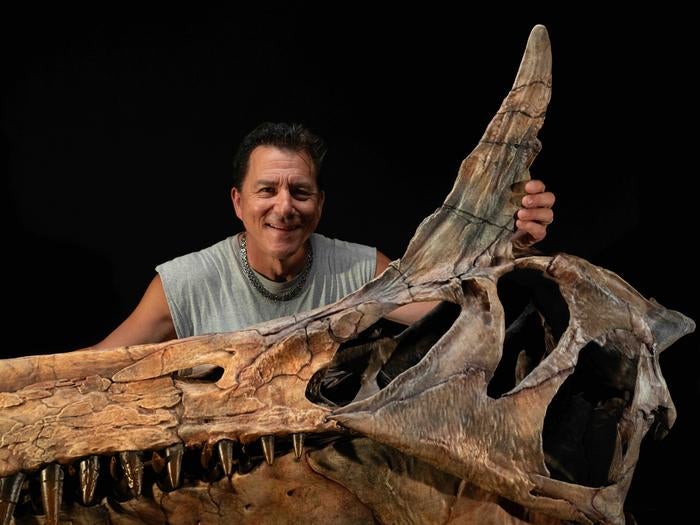
The horned species, named Spinosaurus mirabilis, had scimitar-shaped crests on the back that were sheathed in keratin. The crest was likely a brightly coloured display feature, curving towards the sky as a blade-shaped beacon.
Previous Spinosaurus fossils had only been seen in coastal deposits close to the shoreline, leading some researchers to suggest they could have been fully aquatic predators that pursued their prey underwater.
The new fossil shows the ancient beasts also lived inland, 500-1,000km from the nearest marine shoreline, likely in a forested inland habitat dissected by rivers.
After analysing other fossils found in the area, researchers said the Spinosaurus likely lived with long-necked dinosaurs in a riverside habitat about 100-95 million years ago.
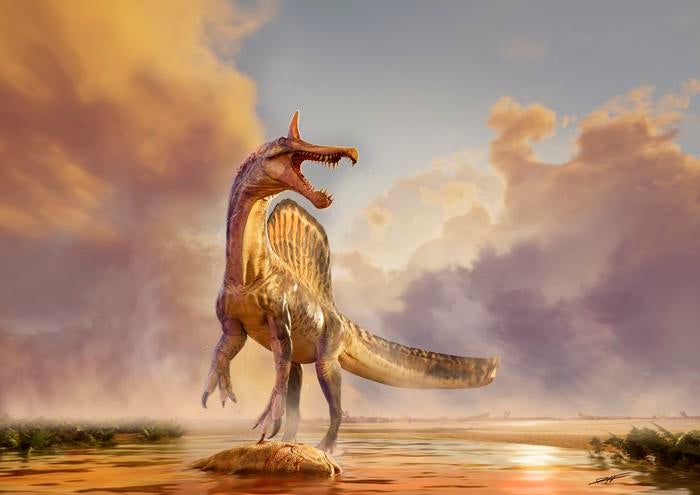
“I envision this dinosaur as a kind of ‘hell heron’ that had no problem wading on its sturdy legs into two meters of water but probably spent most of its time stalking shallower traps for the many large fish of the day,” palaeontologist Paul Sereno, an author of the new study published in Science, said.
Researchers also found that Spinosaurus mirabilis had interdigitating teeth, with those of the lower jaw protruding outwards and between those of the upper. Such an arrangement would have made a deadly trap for catching slippery river fish.
The find represents a new phase of evolution for this group of massive, fish-eating dinosaurs, the study noted.
In the first phase during the Jurassic Period, the giant reptiles developed their elongated skulls for fish-catching. In the second, during the Early Cretaceous Period, Spinosaurus spread as predators along the coast of the Tethys Sea.
This led to the third phase in which species like S mirabilis specialised as shallow water predators in northern Africa, researchers said. “This find was so sudden and amazing, it was really emotional for our team,” Dr Sereno said.
“I will forever cherish the moment in camp when we crowded around a laptop to look at the new species for the first time, after one member of our team generated 3D digital models of bones we found to assemble the skull — on solar power in the middle of the Sahara,” he said.
Join our commenting forum
Join thought-provoking conversations, follow other Independent readers and see their replies
Comments
Bookmark popover
Removed from bookmarks