The time of day when you eat could be key to success for intermittent fasting
Not all time-restricted eating patterns are effective, research finds
The time of day when you eat could make a big difference to health results from intermittent fasting, scientists say.
Time-restricted eating, a form of intermittent fasting, has emerged as a popular diet approach as it focuses on when people eat rather than strictly limiting calories.
In this approach, people restrict their daily food intake to a defined time window, such as consuming meals only between 10 am and 6 pm.
The rationale behind it is to give the body a break from digestion to allow for metabolic shifts, such as burning fat instead of glucose.
While previous studies have assessed whether time-restricted eating works, little attention has been paid to the role played by meal timing and duration, say scientists from the National Taiwan University.
Now, a new review of clinical trials conducted across the world shows that when people eat may be as important as how long they eat for.
The research reveals that eating earlier in the day could support better metabolic health than eating late, even within time-restricted eating patterns.
Time-restricted eating was found to be effective in improving metabolic health compared with usual diets, with a reported higher adherence than traditional calorie restriction.
However, not all time-restricted eating patterns were found to be effective.
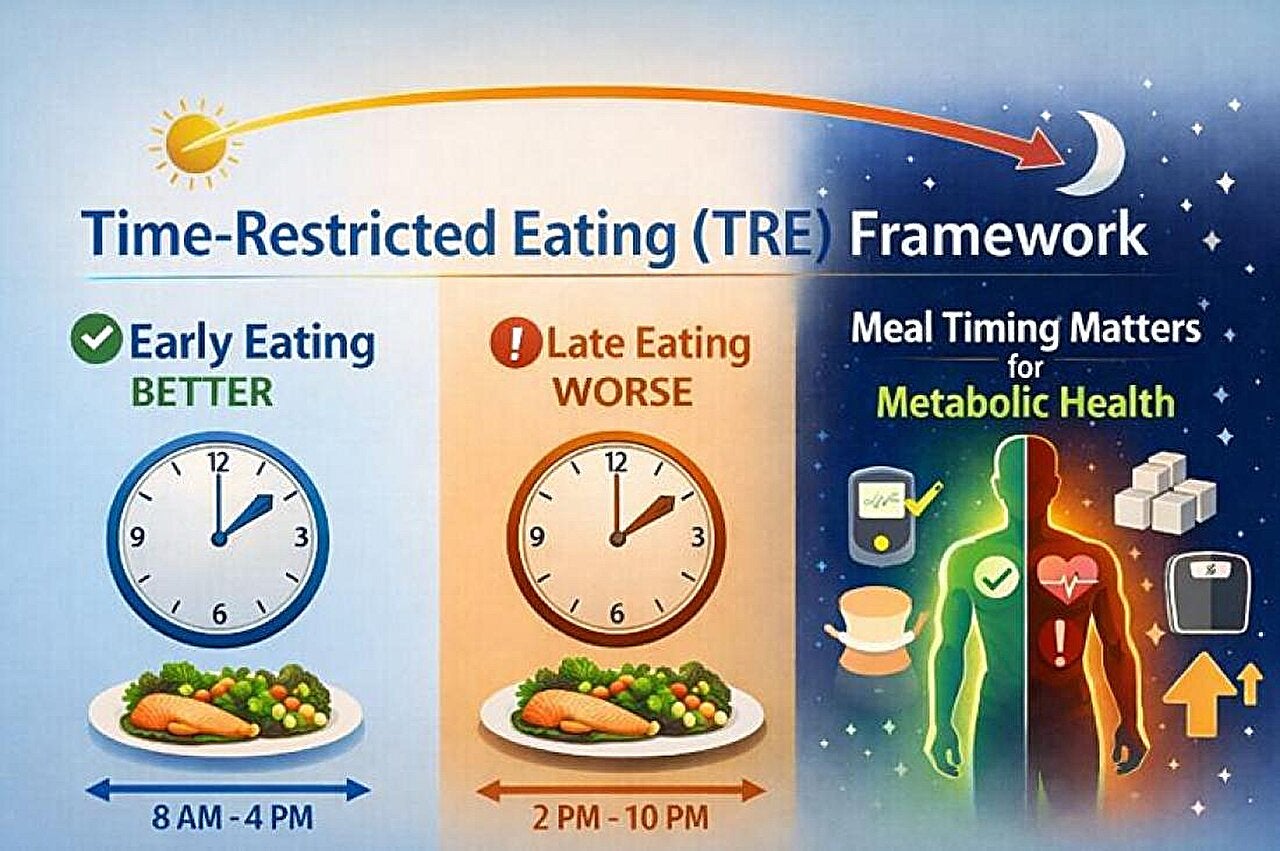
Taking meals earlier or in the middle of the day appeared to consistently lead to more favourable metabolic outcomes than eating late.
Earlier schedules, defined as eating the last meal of the day before 5pm, were consistently associated with improvements in body weight, insulin levels, and other metabolic outcomes compared with the same diet followed later in the day, according to the study published in BMJ Medicine.
Eating the last meal of the day between 5pm and 7pm was seen as still better than a later window that starts after 9am and ends any time after 7pm, researchers say.
“Overall, time-restricted eating was associated with consistent improvements in body weight, body mass index, fat mass, waist circumference, systolic blood pressure, and levels of fasting blood glucose, fasting insulin, and triglycerides compared with usual diets,” scientists wrote in the study.
“Early time-restricted eating was superior to late time-restricted eating,” they wrote.
Blood sugar regulation, body weight, and heart health parameters seemed to improve more when food intake was aligned earlier in the day, researchers found.
Poorer outcomes were mainly caused by eating late in the day, combined with longer eating windows, scientists say.
The findings indicate human metabolism follows daily biological rhythms, with the body better equipped to process food earlier in the day.
Aligning food intake with these rhythms is key, researchers say.
"Time-restricted eating can be effective and achievable for many people, but our findings suggest that timing matters," said Ling-Wei Chen, an author of the study.
"Rather than focusing only on how long people eat, aligning food intake earlier in the day may be important for maximising metabolic benefits,” Dr Chen said.
Join our commenting forum
Join thought-provoking conversations, follow other Independent readers and see their replies
Comments
Bookmark popover
Removed from bookmarks