The best way to prevent crying while chopping onions, according to science
Findings highlight importance of blade sharpening before cutting onions
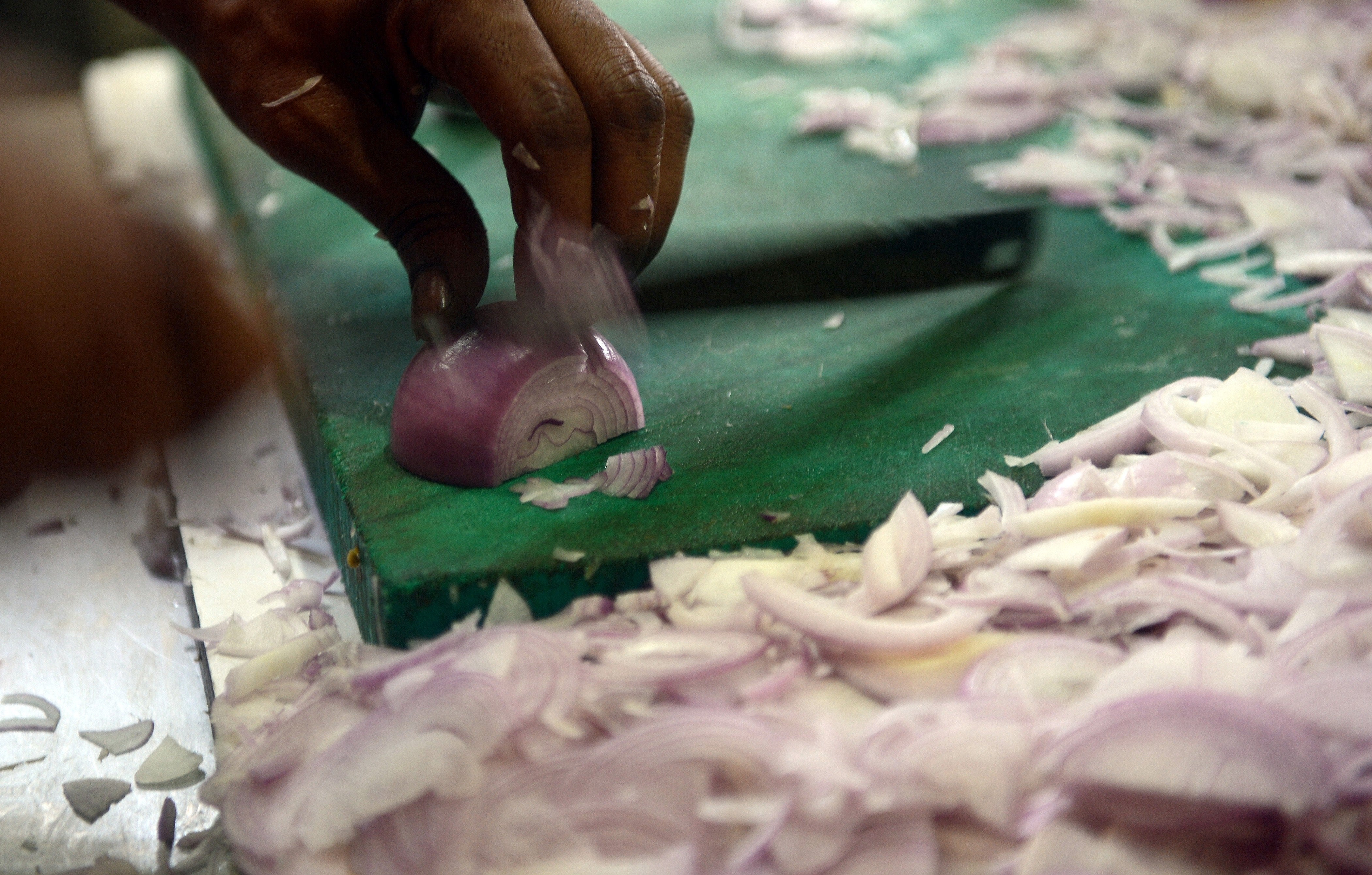
Cutting onions slowly and using the sharpest knives available can reduce eye irritation, physicists have found in a new study.
A familiar and painful experience for home cooks, crying while chopping onions is the result of a chemical reaction in the eye. A volatile liquid compound found in onions – syn-Propanethial-S-oxide – is released into the air when the vegetable is cut, and triggers nerve endings in the cornea.
The new study, published in the journal PNAS, assessed factors that led to different volumes of liquid being released as aerosols during onion slicing.
In the research, scientists cut onions using a special guillotine that could be fitted with different types of blades, as well as coating the pieces of onion with paint so as to better observe the cutting process in action.
In each trial, scientists varied the knife size, sharpness and cutting speed, and used a microscope to closely measure the knives before use.
Videos recorded during the study revealed differences in the amount of onion juicereleased – a measure of the amount of eye irritation each chop was likely to cause.
Researchers found that the sprays were directly linked to the sharpness of the knife and the speed at which each knife stroke cut the onion.
The study revealed that the sharper the knife and the slower the cut, the less the spray.
“By systematically varying blade sharpness and speed, we find that faster or blunter blades significantly increase both the number and energy of ejected droplets,” researchers wrote.
Duller knives seemed to push down on the onion, forcing its layers to bend inward, and as the cut continued, these layers sprang back and forced juice out into the air.
Researchers observed that as the juice droplets were flung into the air, they fragmented into smaller drops, which allowed them to persist longer.
They also found that faster cutting caused more juice generation and thus more mist to irritate the eyes.
“Keep knives sharp and cut gently to spray less,” the study’s authors advised.
During their study the scientists also decided to test a common perception that chilling onions before cutting them would reduce eye irritation.
They refrigerated onions at 1 degree Celcius for 12 hours and compared the results with room-temperature samples.
Researchers found “no significant difference between the two conditions”.
They suggested further experiments to more rigorously evaluate the effects of temperature on onion cutting and droplet generation.
While their work was limited to onions, the scientists noted that their findings could have important implications for reducing other forms of aerosols and droplets in the kitchen, including splashing that can spread food-borne diseases.
“The work highlights the importance of blade sharpening routines to limiting ejected droplets infected with pathogens in the kitchen, which pack additional outburst energy due to vegetables’ outer strong casings,” they wrote in the study.
Join our commenting forum
Join thought-provoking conversations, follow other Independent readers and see their replies
Comments
Bookmark popover
Removed from bookmarks