Massive ‘dinosaur-killer’ crocodile reconstructed in unprecedented detail
Relative of modern alligators is known to have fed on a diet of dinosaurs
Scientists have reconstructed our most complete skeletal model ever of a monstrous 10 metre-long (32ft) crocodile known as a “dinosaur killer” that terrorised prehistoric waters about 76 million years ago.
The species was named Deinosuchus schwimmeri in 2020, in recognition of the decades-long contribution to understanding giant prehistoric crocodilians by palaeontologist David Schwimmer (not to be confused with the actor David Schwimmer, who played palaeontologist Ross Geller in Friends).
D schwimmeri lived in what is now the eastern US during the Late Cretaceous era, reaching roughly the size of a school bus.
The species is a relative of modern alligators and is known to have fed on a diet of dinosaurs.
However, a full skeletal model of the predator had never previously been completed.
“The scale of the dinosaurs and other creatures that lived during [the Late Cretaceous epoch] is hard to capture in words or pictures. We can tell you that Deinosuchus is 30 feet long, but seeing it is far more impactful,” said Rebecca Melsheimer, curatorial coordinator at the Tellus Science Museum.
Researchers have now completed a replica of the crocodile, commissioned by the Tellus Science Museum in Cartersville, Georgia, where it has also been installed.
“The addition of Deinosuchus schwimmeri allows us to provide a more detailed picture of this area’s ecosystem in the Cretaceous Period,” said Hannah Eisla, director of education at the museum.
“Tellus is currently the only museum to have a cast of Deinosuchus schwimmeri, so this is an experience our visitors can’t get anywhere else,” Ms Melsheimer said.
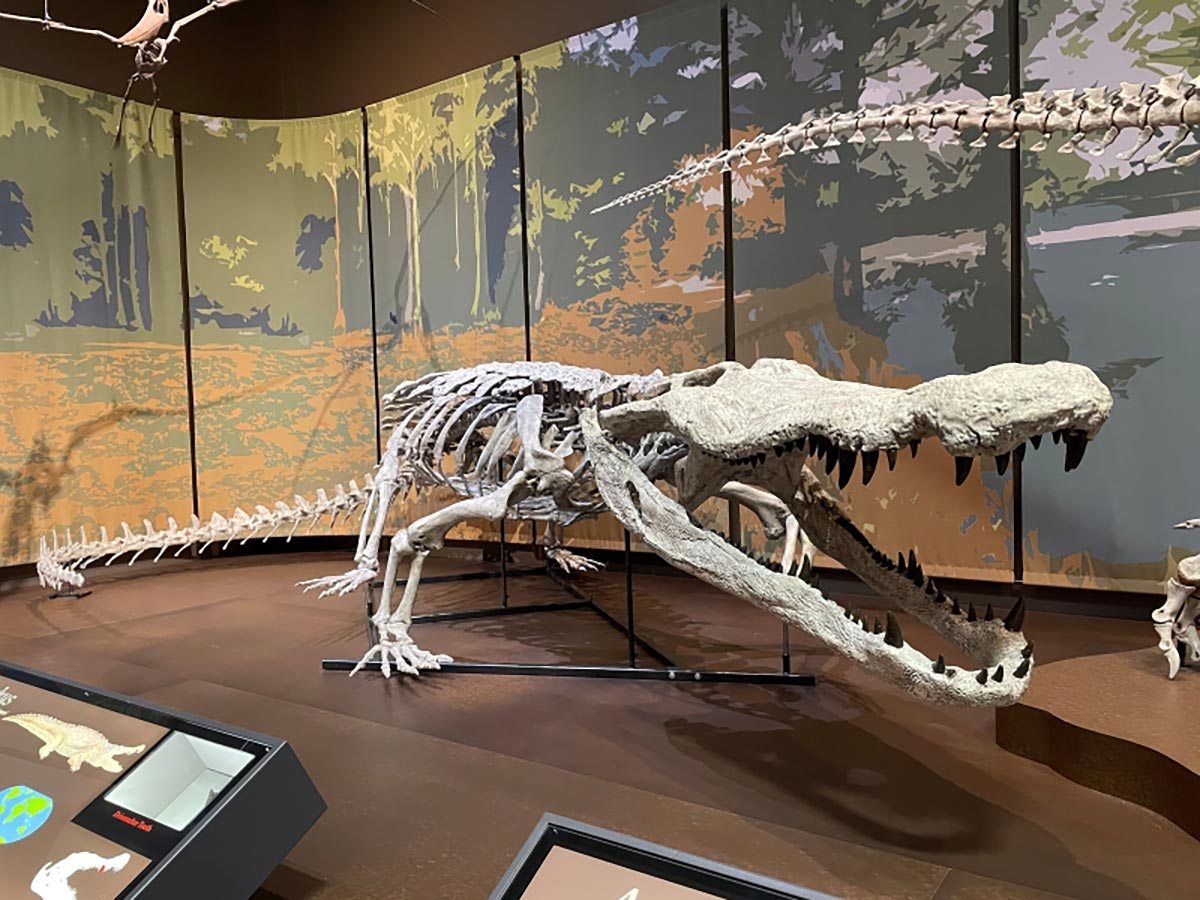
Scientists used several modern techniques to put the fragmentary fossil evidence of the crocodile into a life-sized, scientifically grounded skeletal model.
They used high-resolution 3D scans of fossil material to reconstruct the animal’s skeletal framework and distinctive dermal armour.
The model, according to researchers, represents the most current scientific understanding of Deinosuchus anatomy.
It provides researchers and the public with a clearer picture of one of the largest predators ever to inhabit North America, they say.
“Understanding dinosaurs’ predatory habits helps us decode some of nature’s greatest survival strategies. By studying these ancient apex predators, we are essentially looking back in time to see exactly how life adapted and dominated a changing world,” Dr Schwimmer explained.
“Fully assembled, life-size replicas become a blueprint for better understanding the dynamic animals that creatures like Deinosuchus really were,” he concluded.
Join our commenting forum
Join thought-provoking conversations, follow other Independent readers and see their replies
Comments
Bookmark popover
Removed from bookmarks