Medieval tunnel discovered in Germany were likely used for secret cult rituals
Medieval shaft was found during excavation of a Stone Age burial


Archaeologists have discovered a medieval underground tunnel running beneath a German village, which was the likely site of cult rituals.
Researchers stumbled upon the tunnel during excavations that unravelled a Stone Age burial site near the German village of Dornberg.
A trapezoidal trench dating to the fourth millennium BC was first discovered along with several poorly preserved, late Neolithic remains from the third millennium BC.
Then further excavations revealed a stone slab and a long, oval pit, measuring around 6.5ft long and 2.5ft wide, intersecting the Stone Age burial ditch at a right angle.
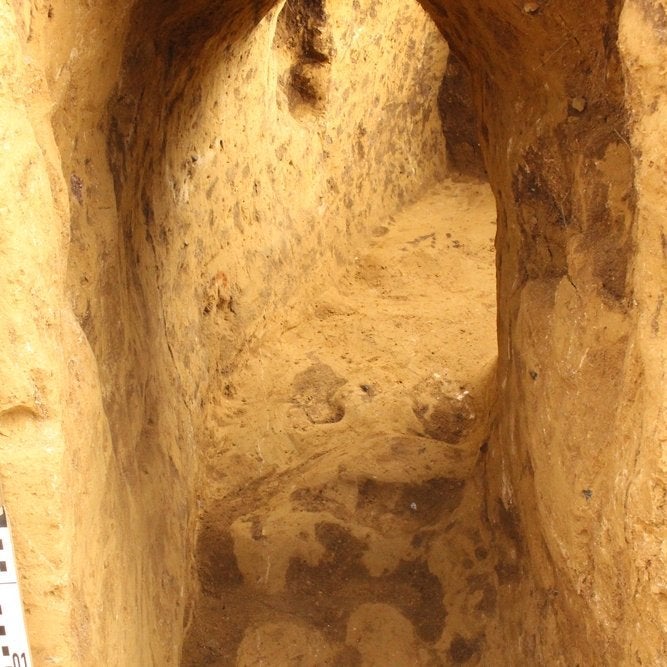
Initially assumed to be another grave, researchers soon found that the pit extended and was actually a tunnel system.
Such shafts containing chamber-like extensions have previously been found in and around Germany, in regions with firm but easily workable soil, made in the Middle Ages.
Researchers suspect these tunnels were likely hiding places or spaces for cultic activity, but are not entirely sure what they were used for.
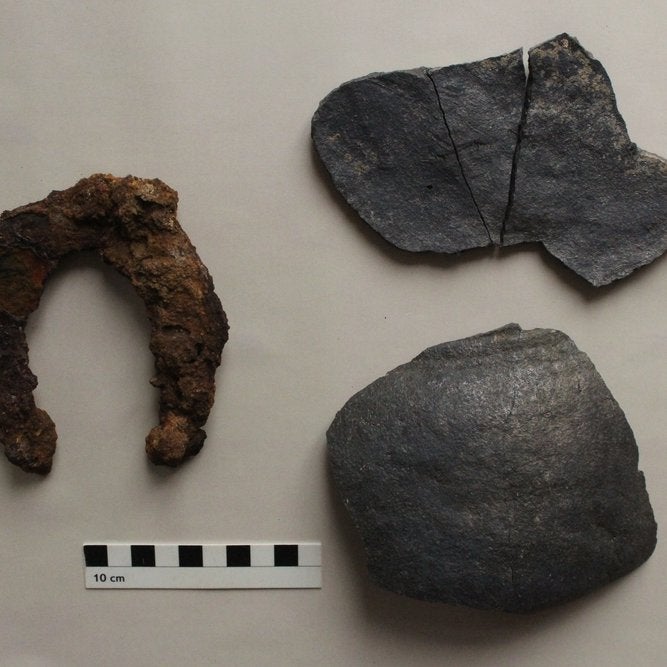
During excavations in the tunnel, they found a metal horseshoe, fragments of a ceramic pot, a charcoal layer, and a fox skeleton in one of the curving passages.
“Since no red colouration of the substrate was found under the charcoal, but only a hardening, it will have been the remains of a fire that only burned briefly,” researchers from the German State Office for Heritage Management and Archaeology (LDA) wrote in a statement.
The tunnel’s entrance also appeared to be purposefully sealed at some point with a cluster of large stones, which researchers suspect was done to hide the secret activity in the shaft.
“At the narrowest point of the entrance, an accumulation of larger stones stacked on top of each other was noticeable, which could indicate an intentional closure of the entrance,” archaeologists wrote.
Researchers aren’t entirely sure what to make of the tunnel.
"However, perhaps the site, due to its significance as a pagan grave, was generally avoided by the local population and therefore particularly well-suited as a hiding place," they wrote.
Join our commenting forum
Join thought-provoking conversations, follow other Independent readers and see their replies
Comments
Bookmark popover
Removed from bookmarks