Death masks ‘removed’ from Colombian mummies for first time to reveal faces
Researchers digitally reconstruct likenesses of four individuals based on anatomical standards
Archaeologists have unmasked Colombian mummies and digitally reconstructed their faces, shedding more light on the cultural practices of South America’s indigenous people.
Many pre-Columbian cultures of South America crafted masks for the dead and fused them to their mummified remains in such a precise manner that the bodies seemed to be alive.
The masks were typically made of waxes and resins but often contained gold or other decorative material.
In a new study, researchers studied four mummy mask samples held in the collection of the Colombian Institute of Anthropology and History.
The masks were made to cover the faces and jaws of a child, a woman in her 60s and two young adult males.
The individuals were from the pre-Hispanic populations that lived in the Colombian Andes between 1216AD and 1797AD.
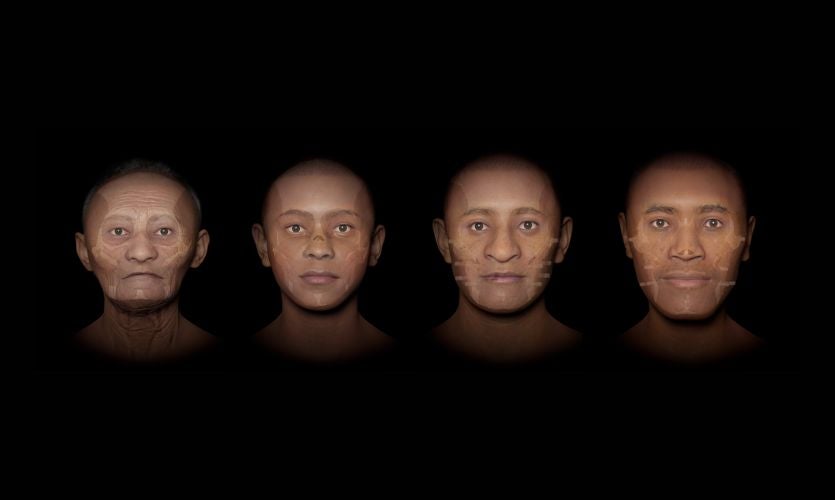
The masks were damaged, with some missing noses and chunks along their bases, but retained some ornamental beads on the eyes.
Researchers removed the masks digitally, using CT X-ray scans to generate virtual 3D images of the faces underneath.
They took 2D image slices of each sample and put them together, which they told Live Science "effectively unmasked the skull digitally".
Then, they conducted facial analysis of the four 3D scans and digitally reconstructed the likenesses of the individuals based on anatomical standards.
Researchers used a special software to add muscles, soft tissue and fat onto each digitally unmasked skull, helping create facial tissue to perfectly fit the individual.
They used data on facial tissue depth from modern adult Colombians to add the soft tissue.
“The masks are of extraordinary workmanship and so far the only ones known to exist in Colombia,” Felipe Cárdenas-Arroyo from Academia Colombiana de Historia said.
Jessica Liu, a researcher from Liverpool John Moores University, said that this project “highlights the fascinating cultural practices of the indigenous peoples of South America” and hoped that revealing the faces for the first time would draw more “interest in these incredible civilisations”.
Join our commenting forum
Join thought-provoking conversations, follow other Independent readers and see their replies
Comments
Bookmark popover
Removed from bookmarks