Rape in the storage room. Groping at the bar. Why is the restaurant industry so terrible for women?
In interviews with dozens of women, a picture of rampant assault and harassment emerges. And not just by powerful chefs
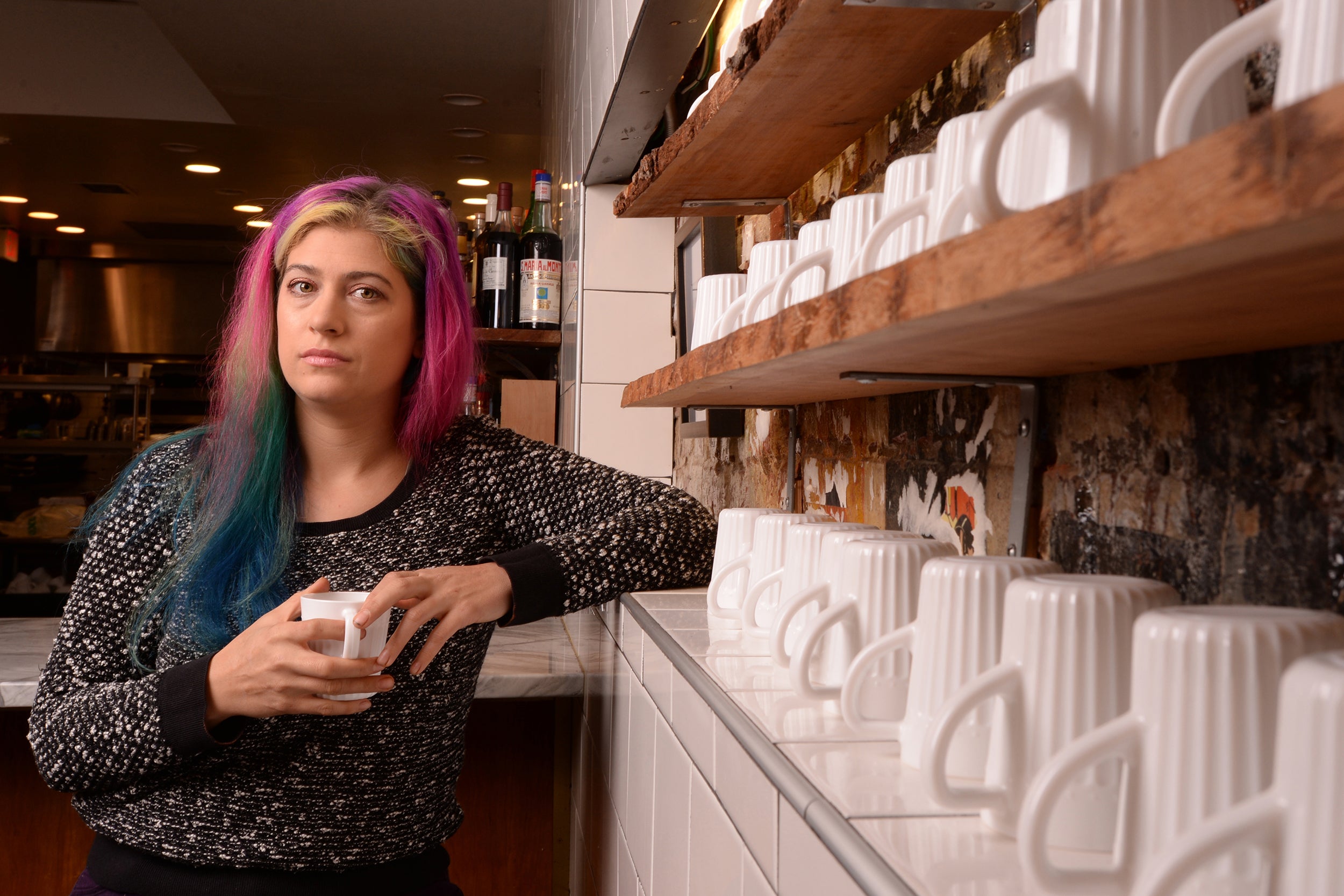
If you’re a woman, what makes a restaurant dangerous isn’t the sharp knives or the hot griddle: It’s an isolated area of the kitchen, like the dry storage pantry.
That’s where Miranda Rosenfelt, 31, then a cook at Jackie’s restaurant in Silver Spring, was headed one day seven years ago to help with inventory, at the request of one of her direct supervisors, who she says had been harassing her for months. When she walked into the narrow basement room, far from the bustle of the kitchen, she turned around to find him “standing there with his pants on the floor, and his penis in his hands,” blocking her exit from the basement, she said.
“I felt cornered, and trapped, and scared, and what ended up happening was that he got me to perform oral sex, and it was horrible. And the whole time he was saying things like, ‘Oh, I’ve always wanted to do this.’ ” Her instinct was “not to do anything, and wait for it to be over. Because that’s what will make me the safest.”
Or maybe the dangerous place is the walk-in cooler. That’s where chef Maya Rotman-Zaid, 36, says she was cornered once about 12 years ago, by a co-worker who tried to grope her. But after years of working in kitchens with handsy, misbehaving men, she had remembered an anecdote from Anthony Bourdain’s Kitchen Confidential, in which the famous chef struck back after being grabbed repeatedly by a colleague.
“The guy tried to feel me up, and I stuck a fork in his leg,” she said. A friend she had confided in confirmed details of this story to The Washington Post. Although she doesn’t think she broke his skin, he “screamed and ran out of there like it never happened. I mean, talk about embarrassing. But he never tried to touch me again.”
Women are vulnerable in just about every inch of a restaurant. Behind the bar. The hostess stands where patrons are greeted. Behind stoves and in front of dishwashers. From lewd comments to rape, sexual misconduct is, for many, simply part of the job.

After the public toppling of Miramax co-founder Harvey Weinstein, it seems every industry is looking to identify its bad actors. In New Orleans, a blockbuster report by the Times-Picayune felled uber-restaurateur John Besh, who resigned after two dozen women said they had been subjected to sexual harassment within his empire – some of it by Besh himself.
But the culture of widespread sexual harassment and abuse in kitchens and dining rooms from Washington, DC, to Portland, Ore., can’t be pinned solely on a few celebrity chefs or the rare, singularly powerful gatekeeper. It takes place in suburban chains and in dazzling three-star Michelin restaurants, and its perpetrators might just as easily be owners as lowly barbacks. The reasons are many, and they’re complicated: Many kitchens are boys’ clubs, dominated by machismo and flashing knives; many women rely on pleasing their male customers and managers for tips or good shifts; human resources departments might be nonexistent or toothless; and restaurant staffs are often hard-partying posses that blur professional lines.
These stories show that how women experience sexual harassment depends on their place in the restaurant ecosystem. Cooks are harassed by other cooks, servers are harassed by everyone. And immigrants and young people – who make up a large percentage of the workforce – are particularly vulnerable.
‘I couldn’t find who to tell’
Maria Vazquez, 52, is a monolingual Spanish-speaking Mexican immigrant mother of six, so her job as a cook and dishwasher at Art’s Wings and Things in South Los Angeles was a lifeline. But one day in 2005, she alleges, restaurant owner Arthur Boone cornered her in the back of the warehouse where she was doing inventory and raped her.
“He came downstairs and attacked me. I remember I was defending myself as much as I could,” Vazquez said through a translator, as she cried. “I couldn’t do anything else.”
Afterward, she said, he took her to a store for supplies, and everyone treated him like a king. Vazquez said she confided in her priest, but he “told me that I was to blame, and that I shouldn’t be talking about that.” Because she couldn’t afford to be out of work, she kept the job – and, she alleges, Boone kept taking her into the warehouse. She alleges that when she transferred to a different location of the restaurant – one that did not have a warehouse – Boone assaulted her in the bathroom there, and that the rapes continued over a period of eight years. Vazquez sued Boone in June 2014 seeking damages based on 10 allegations detailed in her lawsuit. Boone, who denied the allegations in a court-filed response, could not be reached for comment.
“Because of the excess of work that I had, I didn’t have time to talk to anybody. It was only work, watch over my kids, go back to work,” she said. “I didn’t have anyone to give me a hand. I couldn’t find who to tell about what was happening to me.” She left the job, she says, when Boone threatened to cut her pay.

Nearly a quarter of restaurant employees are foreign-born versus 19 per cent for the overall economy, according to the National Restaurant Association. And many are undocumented: Ten per cent of the workforce in “eating and drinking places” in 2014 lacked US work authorisation, according to the Pew Research Center. Fear of deportation may make undocumented immigrant restaurant workers who are abused less likely to report that abuse to authorities.
Vazquez is one of the rare immigrants who were able to sue their employers, and win. In her lawsuit against Boone and his restaurant corporation, a court awarded her a judgment of more than $1m (£760,000). But she hasn’t received a cent from Boone.
His restaurant business has closed, and Vazquez has not been able to collect.
‘This is just our industry’
In 2015, the Equal Employment Opportunity Commission received 5,431 complaints of sexual harassment from women. Of the 2,036 claims that listed an industry, 12.5 per cent came from the hotel and food industry, more than any other category, according to the National Women’s Law Centre. The Restaurant Opportunities Centre United, which advocates for higher wages, found in a 2014 study that two-thirds of female restaurant workers were sexually harassed by restaurant management, 80 per cent by their co-workers and 78 per cent by customers. A third of women reported that unwanted touching was routine, the survey found.
But those numbers may not provide the full picture. Harassment is so routine that many restaurant employees say they do not consider sexual comments or touching to be worth reporting.
“I have spoken in a number of industry settings where people say, ‘Why are you talking about this as if it’s so outrageous? This is just our industry,’” said Saru Jayaraman, co-founder of ROC United. When workers do speak up, it does not always end well.
“This one particular busser ... had asked me out a couple of times, and I had always said no,” said one former server from Seattle, who spoke on the condition of anonymity because she still works in the industry. “He came up behind me, and I had really long hair, and he held a lighter underneath my hair like he was going to set my hair on fire.”
The general manager saw him do it, made him stop and reprimanded him, but afterward, “We were all supposed to go back to work like everything was normal.” The busser was not fired, she said. The incident took place about 15 years ago, and she didn’t tell anyone else at the time.
When employees are punished for their misconduct, it often does end with firing – but no other consequences. Rosenfelt, the cook who says she was coerced into oral sex in the restaurant basement, told a co-worker what happened, and that colleague went to her boss, Jackie Greenbaum, who says she “was brought to my knees” by the allegations. “I cried.” She fired the supervisor swiftly. “We encouraged her to go to the police and report it,” Greenbaum said.
That is where Rosenfelt hit a roadblock. “What I was told was that because there was no physical evidence, I wasn’t bruised or injured in any sort of way, that it would be a ‘he said, she said,’ and that it would be long and drawn out and it could be costly for me and that it could take months, possibly years for anything to happen,” Rosenfelt said. She dropped it.
‘Your breasts had to be out’
In some of Vaiva Labukaite’s early jobs as a Las Vegas cocktail waitress and bartender, “You had to wear something really sexy. The shorts had to be super short, and your breasts had to be out,” she said. “It was more like sex work than the restaurant business.”
When Labukaite, now 38, got a bartending job at celebrity chef Rick Moonen’s restaurant, RM Seafood, seven years ago, she thought it was a step up. But soon enough, she alleged in a lawsuit, her manager, Paul Fisichella, started to harass her verbally. She brushed it off and reminded him that he was married. One time, he grabbed her hand and put it on his crotch to make her feel his penis, she alleged in the lawsuit. She said the incident took place while they were in the restaurant having a glass of wine after her shift. “I was kind of in shock for a little bit. I told him that this cannot happen again.” Fisichella “adamantly disputed the claims,” according to one of his attorneys.
Labukaite said Fisichella kept dangling the possibility of a promotion for her. One night, she alleged, Fisichella told her she needed to go with him and Moonen to dinner to “talk about my advancement in the company”. She got in the car with Fisichella, “and that’s when he started groping me and putting his hands up my skirt. And again I was in shock.”
She later complained about the sexual harassment to the restaurant’s management, and “the next thing you know, my shifts were going down from five days a week to two days a week.” She filed suit against Fisichella and RM Seafood, and eventually the parties settled, with the restaurant settling on Fisichella’s behalf, according to his attorney. Both Moonen and RM Seafood declined to comment.
Servers and bartenders worry about harassment not only from colleagues, but also from their customers. And because of a “customer is always right” mentality and the pressure of working for tips, they often feel compelled to accept it. The “front of the house” is mostly made up of women: According to the Bureau of Labor Statistics’ Current Population Survey, 56 per cent of bartenders, 70 per cent of servers and 80 per cent of hosts are female.
When Sola Pyne, 33, was a waitress at a Washington sports bar from 2006 to 2009, she once served a table of half-drunk off-duty police officers, whom she identified by the T-shirts and hats they sported for the city’s annual National Police Week. “They kept asking what kind of underwear I had on: Was it a thong? A bikini?’ I told my manager, and at first he giggled, but he said if they took it any further to let him know,” she said. “I just let it slide. I didn’t need any drama.”
Stefanie Williams, 31, said that four years ago, when she worked at an upscale New York steakhouse as a cocktail waitress, she was groped by one of her regulars, an investment banker who spent lots of money entertaining clients there. At a Christmas party, he “put his hand up my dress, and he put his hand under my underwear and asked if I was wearing any underwear,” she said. She said she told the story to two colleagues at the time, and they confirmed that account to The Post. Later, he “put his groin against my butt and pushed really hard,” she said. “ I said, ‘Don’t f***ing touch me.’ He was like, ‘Oh, I’m the bad guy now?’ ” She told her manager that either the customer had to leave or she would, and he was escorted out. But before long, he was back.
“One of the managers was very into what the guys with money were into. He knew that I was upset that night, but he let him come back in, and I remember looking at him and thinking, ‘Are you f***ing kidding me?’ ”
A recipe for a toxic culture
Restaurant kitchens are a man’s world. The Brigade de Cuisine, the division of kitchen labor famously developed by chef Auguste Escoffier in the late 19th century, was based on the French military structure he observed while in the army. Home cooking has historically come from women, while high-status restaurant work was until a few decades ago the domain of men.
As French chefs began to rise in stature in the late 1800s, “a lot of work was done to sort of denigrate women’s cooking and uphold and elevate men’s cooking,” said Deborah Harris, co-author of “Taking the Heat: Women Chefs and Gender Inequality in the Professional Kitchen.” “The women were kept out, and over the years that kind of crystallised in these very hypermasculine work cultures.”
Some women view the sexual harassment as an outgrowth of Escoffier’s system. When Liz Vaknin graduated from culinary school and went to work in a fine-dining restaurant in Manhattan in 2012, she came to see the kitchen as a place where higher-ups bullied underlings, no matter their gender, and sexual harassment was an expedient form of abuse. “It’s easier to make a woman feel bad about herself by touching her than just yelling that you’re not cutting your parsley right,” Vaknin, now 28, said.
The rough talk so common in kitchens is a result of those jobs being historically blue-collar. But that does not mean elite restaurants are immune.
Two women who spoke on the condition of anonymity because they still work in the industry said a male manager at the Alinea restaurant group, which includes the Michelin three-star restaurant of the same name in Chicago, harassed them in 2013 and 2016. “He would kiss me on the face, or hold my arm back,” one of the women said. He would frequently touch her when no one was looking, “around the waist, hips, that sort of thing.” The other woman said the manager falsely told other employees that he had sex with her. Two other former female employees of the restaurant group confirmed that the women spoke of harassment at the time.
The first woman says that she complained to management and that “they, over and over, asked if I had anyone that witnessed it, and I didn’t,” she said. “So they wanted me to get other girls to come forward to talk about their experiences with him, which I didn’t feel like should have been my job.”
Nick Kokonas, one of the owners of Alinea, says that accusations of verbal improprieties but not physical contact were brought to him – the female employee disputes this – and that he spoke with the male employee, who denied wrongdoing. He put the man on paid administrative leave while he investigated. Eventually, the man was fired when another employee provided some inappropriate text messages. But the woman who says she reported the abuse had already decided to leave. The investigation had left her with the impression that the company was more concerned with a wrongful-termination lawsuit than with the sexual harassment.
“I can’t fire somebody unless I know it’s real. You can’t fire someone legally with no basis,” said Kokonas, who said he was “really proud of the way that we handled it.”
Learning to ‘just go with it’
Women in the kitchen say they feel pressure to just take harassment in stride.
Ulzii Hoyle, 20, a recent culinary school graduate, says the “masculine ideology” she was taught in school meant not complaining about the way she was treated so that others wouldn’t perceive her as weak. She knew she had to look after herself. So one day two years ago, at her off-campus job at a pizza restaurant in Boulder, “a male colleague came up, and he grabbed my butt” and aggressively poked her in her genitals, “and I elbowed him.”
A manager heard the man cry out in surprise. Later, Hoyle says, the manager pulled her aside and asked her whether she planned to report the incident, and Hoyle said no. At the time, she confided in her sister, who confirmed that Hoyle told her the details of this story.
“And [the manager] was like, ‘I think it would be best for everybody if you just left,’ ” allegedly explaining that Hoyle was fired for being “too big of a liability.”
Rotman-Zaid, the chef who jabbed a groper with a fork, said female chefs have learned to “just go with it” when men harass them, to fit in and gain the trust of male colleagues. If you are a “prude and don’t want to be in that situation, you won’t last very long in the restaurant world in general.”
It quickly hardens women who just want to cook.
“In the beginning, you try to ignore it, or you try to deflect it, to be both funny and defensive, and know how to put them in their place,” said Heather Carlucci, 50, who describes herself as “a kitchen rat” now working as a restaurant consultant. “It’s an enormous amount of energy to do it.”
Harris, the “Taking the Heat” co-author, said that in her book research, she noticed a contradiction among the female chefs she interviewed. They often expressed hope that the industry would change but pushed back at the notion that kitchens needed more oversight, which they told her would interfere with the unique culture of the job.
“I think about women in the military, any sort of hazing or group like that, where if you make it through, you take on the identity of the survivor,” Harris said. “And ‘I’m tough and I was able to do this and other people should too.’ If you take a step back, you realize that you’re also perpetuating this system that’s really unfair.”
The just-deal-with it mentality that female chefs talk about is inculcated at the industry’s earliest levels.

Marisa Licandro, 22, was a student at the Culinary Institute of America, with a full course load and a server job at a campus-run teaching restaurant. At an on-campus party last fall, she alleges, a fellow student who worked with her at the restaurant locked her in a room, pinned her down and tried to rape her. She escaped. The next morning, she filed a report with the campus safety department, and a few days later, she tearfully told her manager at the restaurant that she could not be scheduled to work with the other student, because he had traumatised her. Nevertheless, she showed up to work on a subsequent Saturday and found herself staring down her alleged attacker.
“It made me very nervous, obviously, to be placed in a situation where I unwillingly was face to face with this guy that tried to hurt me,” Licandro said. She said her boss told her, “ ‘We’ll keep you on different sides of the restaurant,’ which is a Band-Aid on an amputated leg.”
When her manager scheduled her with him yet again, Licandro quit. Meanwhile, she was growing disheartened by the school’s response: In emails Licandro provided to The Post, one dean told her that the school had dismissed her complaint because the student about whom she complained did not violate the school’s harassment, sexual misconduct and discrimination policy. Licandro said she asked for an explanation and said the school’s response indicated that because she had escaped, a violation did not take place. The school gave her the opportunity to put a “no contact” rule in place with the student, but she declined out of fear that it would provoke him.
The school confirmed that Licandro filed a campus safety report last September but declined to disclose its contents. Joseph Morano, the school’s Title IX officer, declined to speak about Licandro’s case, citing student privacy. “The [Culinary Institute of America] is committed to providing a safe campus environment for all of its students and prohibits any form of harassment or discrimination based upon sex, including sexual violence,” Morano said in an email. “All reported incidents are thoroughly reviewed.”
Drinking blurs the lines
Unlike traditional offices, with their coffee-pod machines, booze is a part of restaurant life, even for employees. Drinking during shifts is common, if not explicitly condoned by management. There’s often partying after the dining room empties, and hookups among staff members are frequent. And alcohol and drug abuse is a big problem in the industry: According to a survey by the Substance Abuse and Mental Health Services Administration, about 17 per cent of employees in the “accommodations and food services” category, more than any other category of worker, report having a substance-use disorder.
One woman who worked for a restaurant in New Orleans said her boss knew she struggled with alcohol abuse. But three years ago, she said, he befriended her, telling her he would help her move up in the company. He began to offer her rides home and, knowing she had trouble saying no, would persuade her to stop at a bar for one drink, which would turn into several.
“He started taking me home to his apartment when I was blackout drunk, barely conscious,” said the woman, who spoke on the condition of anonymity because she still fears the man. “I would wake up at his apartment on a semiregular basis and have no memory of the previous night whatsoever.”
At work, she said, he would send her inappropriate text messages, including a video of himself masturbating, despite her protestations. Eventually, she told one of her co-workers, who told the owner of the restaurant, who fired the man. The owner of the restaurant independently confirmed the details of the woman’s account to The Post.
“I’ve thought about the fact that he’s a predator,” she said. “He put himself in this position to leverage power over me, and coerce me using his position and alcohol.”
Bosses sometimes foster a boozy atmosphere during work hours. Arielle Mullen, now a 32-year-old marketing consultant in Sacramento, worked in restaurants for 15 years, including at a college-town bar when she was in her early 20s. Her manager, she said, encouraged the young female servers and bartenders to drink shots with customers who wanted to buy them drinks. “I still remember it verbatim. He said, ‘As long as you can still hold a tray, I don’t f---ing care. Just do it.’ ” For her boss, it meant more liquor sales, and for Mullen it meant finding a workaround. She found a friendly bartender who would pour water in place of vodka into her shot glass.
Moment for a culture change?
Since the Weinstein and Besh scandals broke, the restaurant community has been in an unusually introspective mode. Celebrity chef Anthony Bourdain, who personified the swaggering alpha dog of kitchen lore, in recent interviews has publicly copped to perpetuating the “meathead bro culture” that allows sexual harassment to go unchecked. And “Top Chef” host Tom Colicchio posted an open letter to male chefs on Medium noting that Besh was hardly one of a few “bad eggs” and that men needed to “acknowledge the larger culture that hatched all these crummy eggs, and have some hard conversations among ourselves that are long overdue.”
While industry leaders talk about their culpability, some women are taking small steps.
Caroline Richter, a New Orleans waitress who described being assaulted by a customer, founded a group called Medusa – named after the mythical maiden turned into a Gorgon as punishment by Athena for being raped by the god Poseidon in Athena’s temple — with a goal of creating best practices for bars and restaurants regarding sexual harassment.
Many of the women interviewed for this story said they were hopeful the Weinstein and Besh sagas would trigger a change in the industry. But many noted that the roots of the problem run deep and will not be easily dug up.
One factor is the relative dearth of women at the top of the food chain, as chef-owners, award winners – or even as general managers. While the ratio of male to female culinary students is close to even at many schools, only 21 per cent of chefs and head cooks are women, according to the Bureau of Labor Statistics. Many women are discouraged by the constant harassment as well as by the lack of health care and regular hours, which can make it difficult to have a family.
And while some say more women in management could be a solution, the harsh kitchen culture is so pervasive that even high-profile female chefs are among those accused of harassment. Celebrity chef Anne Burrell was sued in 2008 for allegedly harassing several employees at Centro Vinoteca, the restaurant where she worked at the time. According to the complaint, Burrell commented on employees’ cleavages and the shape of their breasts, and called female employees “sluts” and one employee “a whore.” The suit was settled. “The case was resolved,” said Burrell’s publicist, who declined to comment on the substance of the allegations.
Training and strong human resources departments are not a panacea, either: Even big chain restaurants that have both have been the subject of sexual harassment lawsuits.
Advocates including ROC say the tipped minimum wage – which is several dollars lower than the standard minimum wage – is a primary driver of harassment.
But few of the suggested solutions seem that they would have helped Rosenfelt, the woman who alleges she was coerced into performing oral sex in the storage pantry at Jackie’s.
Rosenfelt knew she would never again be able to set foot in the restaurant where it happened. She was offered a new job at a sister restaurant. And for a while, things seemed to be going well – she worked with friends, she let her guard down. She felt safe.
But she said that her colleagues there, too, began to exhibit alarming behavior. One man repeatedly tricked her into looking at pictures of his genitals on his phone, she said, and talked constantly about sex workers. And she said that one day, when staffers were drinking together after hours in a small back hallway, another man – whom Rosenfelt had trusted enough to confide in about her assault – exposed himself to her and told her he wanted to have sex with her. She got away. And she couldn’t believe that the same thing had nearly happened to her twice.
This time, she said nothing.
“I was worried about them thinking that I was being dramatic,” Rosenfelt said. “Because how could these two awful things happen so quickly, back to back?”
Emily Codik contributed to this report
© Washington Post
Bookmark popover
Removed from bookmarks