The Independent's journalism is supported by our readers. When you purchase through links on our site, we may earn commission.
What it’s really like to carry somebody else’s baby, according to the women who do it
Whether it’s a job or a calling, surrogacy numbers are rising in the United States and across the world. Holly Baxter reports on what it’s really like to carry somebody else’s baby, according to the women who do it — as well as the evolving research on what the genetic implications might be


When Sammi Itatani went for her seven-week scan, she assumed she was carrying a routine pregnancy. She’d transferred one embryo during IVF, and had gotten a positive pregnancy test not long afterwards. She went to the appointment alone, casual as ever.
Then the sonographer paused. There were two heartbeats: identical twins.
Sammi left the room and made a phone call. “I remember he kind of laughed,” she says, of the call she then had with the babies’ father. “And he then was like: ‘Oh my gosh, I'm so sorry. I didn’t mean to laugh. Are you OK?’ And I was like, ‘Well, I’m OK. Are you OK? You’re about to have two babies when you assumed you were going to have one.’”
Although she would now have to worry about carrying a slightly riskier twin pregnancy, Sammi didn’t have to raise the children. She wouldn’t be the one doing double shifts of feeding through the night, changing twice as many diapers, and saving up for two kids to go to college. Once she’d updated the first father over the phone, he went to call the other father, who was abroad on a business trip. This was unexpected news, but then nothing about this situation was entirely regular.
Sammi Itatani was a gestational surrogate: a woman who carries a donated embryo to term that has no genetic relation to herself. Gestational surrogacy — different from traditional surrogacy, where the woman carrying the baby also provides the egg — is by far the most popular way to carry a surrogate child in the United States. Because the surrogate has no genetic connection to the child, it’s both legally and, some say, emotionally easier.
Logistically, it’s another story. If the surrogate is carrying for a straight couple, it can be fairly simple: the straight couple does IVF, and the surrogate has their embryo transferred into her uterus. But if the “intended parents” — the term used in surrogacy literature for the parents who plan to raise the baby — are two fathers, they must find a willing egg donor as well as a separate woman willing to carry their child. And it’s rare that one person will want to do both.
“I’d actually had a friend who was an egg donor,” says Sammi, “and so it kind of sparked my brain around that stuff in general. And myself, I wasn’t comfortable with egg donation, having my DNA out there — it had a different effect, thinking about it. But then I was like: Well, I could absolutely be a surrogate. I loved pregnancy.” She talked with her partner about it, who was skeptical at first, but he came around, “then I signed up and went through all the screening, ended up being a good candidate, and we moved forward.”
Although it’s a private arrangement, the public has a lot to say about surrogacy — now more than ever. When Meghan Trainor announced in January that her third child had been born via a gestational surrogate, the reaction was immediate and ferocious: congratulatory posts sat alongside accusations that she had “rented a womb,” avoided pregnancy for cosmetic reasons, or performed motherhood without earning it. Trainor responded that she’d made the decision after “endless conversations” with doctors and said that she’d been told this was “the safest way” to grow her family. The episode was a reminder that, even as surrogacy becomes more common, public tolerance has not necessarily caught up; in fact, it appears to have gone down.
Lily Collins, Paris Hilton, Kim Kardashian and others have all faced scrutiny for using gestational carriers, often framed as a luxury option for the rich. Commentators increasingly question whether commercial surrogacy exploits poorer women or turns babies into bespoke purchases, while defenders argue that such critiques erase the agency of surrogates and the medical realities many intended parents face.The tone of the debate has sharpened in recent years, particularly as surrogacy becomes more visible among ultra-wealthy families and public figures.At the same time, extraordinary cases — including a recent investigation into a Los Angeles couple who arranged more than 20 surrogate births, prompting calls for tighter regulation — have fed concerns about oversight and the potential for abuse in an industry that remains patchily regulated in the United States and globally.
Politicians and policymakers are also circling. In Washington, proposed legislation has framed commercial surrogacy as a national security and trafficking issue, perhaps even a way for predators to have kids without oversight. Countries including Spain and India have moved to restrict or refuse recognition of babies born through international surrogacy arrangements, citing concerns about exploitation and children’s rights. All of this means that carrying someone else’s child — an intensely personal, often private experience — now unfolds against a noisy cultural backdrop.
For the women who become surrogates and the families who rely on them, the reality tends to be more complicated than the headlines: less a tidy ethical debate than a tangle of medical necessity, money, trust and emotion. And their experiences often look very different to what your average keyboard warrior might imagine.
Like almost all surrogates, Sammi Itatani was already a mother when she became pregnant with the twins: she had a two-year-old daughter at home. Most surrogacy agencies in the U.S. — and indeed across the world — ask that any woman signing up for surrogacy has already carried a healthy baby to term, and that they have “completed their families,” i.e. don’t want any more kids themselves. The reasons for this are twofold: firstly, the best signal the agencies have for intended parents, who often pay hundreds of thousands of dollars, that their embryo transfer will lead to a successful pregnancy and healthy child, is the fact that the surrogate has done it in the past. Secondly, a mother who’s raising her own kids isn’t likely to abscond with the surrogate child.
The checklist for each surrogacy agency looks very similar. People who had complications during their other pregnancies — such as gestational diabetes, IUGR, or pre-eclampsia — are generally not accepted. Emergency C-sections, however, are considered fine (Sammi had had one herself with her daughter.) Surrogates should be under 35, and U.S. citizens or permanent residents are preferred.
And then there are the more thorny issues, the ones that are to be worked out between the intended parents and the surrogates themselves: will you do prenatal testing on the embryos to rule out genetic issues? In what situations, if any, would both parties want to terminate? How much does the surrogate get paid if they miscarry, and how many embryo transfers are they willing to try? Indeed, does the surrogate want to get paid at all — taking a salary and entering into a “commercial surrogacy” — or would they rather only be compensated for their medical fees and walk away with nothing, which is known as an “altruistic surrogacy”? Will the intended parents come to every appointment throughout the surrogate’s pregnancy, or will they only turn up for the birth, or something in between? Will the surrogate provide breastmilk, and for how long? Are there any differences in opinion on diet, vaccines or medications taken during pregnancy? And will the families stay in touch after the baby — or babies — are born?
Before they match with intended parents themselves, surrogates are encouraged to think about the kind of family they want to work with. For Sammi, it was clear: “My preferences that I had provided were, I wanted to help a same-sex family — so I wanted to help two dads.” Why, as a straight woman, was she so keen to work with two fathers?
One advantage, she says, was that she wanted to teach her young daughter about how there are many different ways to be a family. If she was going to be pregnant with a toddler around, she was going to use that as a teaching experience. But the main reason two dads appealed was because she wanted to be part of a joyful, optimistic experience rather than one suffused by anxiety and grief.
“Intended mothers and fathers — so, a different-sex couple — who come to surrogacy, unfortunately they usually come to surrogacy from a place of hurt and loss,” she says. “And a [male] same-sex couple is coming to it from a place of hope, and it’s their main way of having, hopefully, a biological child. And so it’s just a different, I think, emotional relationship that I felt more inclined in my life and my personality to have, to be able to fit those emotional needs… A different-sex couple has been through a lot of loss, and surrogacy was most likely never their first choice, whereas for dads, it’s typically one of their first choices.”
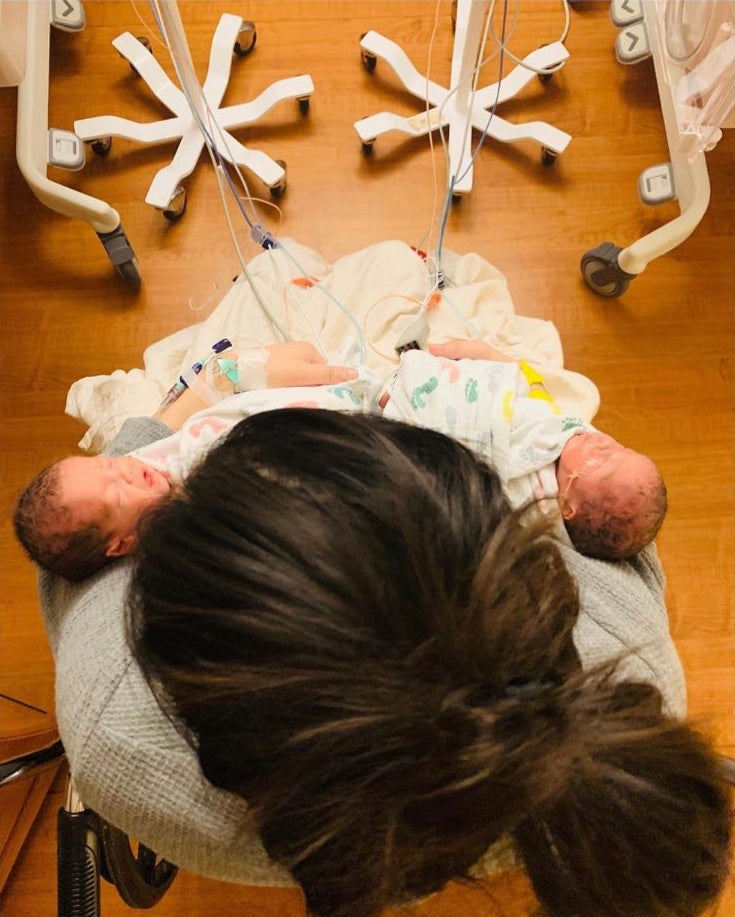
Sammi — who was 32 when she carried the twins, and who went on to carry another child for a separate couple before “retiring” from pregnancy and moving into work at the surrogacy agency Nodal — had a vision for her surrogacy experience.
For Grace Kao, it was more of a mission.
Grace — who is a professor of ethics at Claremont School of Theology and author of My Body, Their Baby — had a deeply unusual experience of surrogacy, statistically speaking. She was 40 years old and working in a highly demanding, high-income academic career when she agreed to carry a child for an evangelical Christian couple she knew who had spent 10 years trying to conceive. Believing that God heals not just through prayer but through technology and human innovation, Kao stepped up. But the fact that the couple were not strangers to her brought its own complications.
The couple declined PGT testing — the initial testing that can be done on embryos before they’re implanted to determine whether they have any genetic issues — “and I actually thought it was the wrong thing for them to decline,” says Grace, “but they did, meaning that if there’s no PGT, now we’re doing prenatal testing [a few weeks into the pregnancy]. And they did not want to say one way or the other if they would ask me to terminate [once the results of the prenatal testing came in].”
“I think they didn’t want to say for a couple of reasons,” she says. One of those is that “the wife is more of a conservative Christian than the husband, and so frankly, I don’t think they themselves were aligned on what they wanted to do.” She believes “they didn’t want to have the hypothetical conversation because that would mean they would have to resolve it as a couple, and then tell me weeks in advance.”
Instead, the couple stayed quiet and equivocated when the subject came up. Grace got the sense they would only discuss it if they were forced by a particular situation; in other words, if the fetus really was found to have a serious health issue.
“It’s kind of like, why go through that stress if we don’t have to, right?” she says. “But that meant I bore the stress.” Sometimes, she’d be walking around with her pregnant belly, discussing the situation with her two young children, and be struck by the thought: “Oh my God, am I going to be having my first ever abortion, on their request?”
When surrogacy doesn’t stop at the birth
Another issue came up when Grace wanted to talk about breastfeeding. She let the couple know that she was willing to pump breastmilk for six months: no mean feat, considering that meant hauling her electrical breast pump into work all week and stripping off to pump in a separate room four or five times throughout the day, every day. She had an oversupply, meaning that she was producing more milk than the baby needed, and after four and a half months she had donated enough milk to tide them over until the baby hit the six-month mark. But every time she tried to broach the subject of stopping, again, the couple equivocated. Nobody wanted to say the word “formula,” which carried a certain stigma in the circles they were in.
But then it got to winter, and Grace was taking her two kids to snowboarding camp in January and February, having given birth to the surrogate baby in September.
“I was trying to figure it out — do I really want to be in my snow parka, pumping in this tiny stall at Mountain High? And I thought: You know what, Grace, this is kind of ridiculous, right?” she says, with a laugh. “So that’s how it happened — I basically forced it.”
Because her surrogacy was based on “love and friendship,” she adds, that made all of those conversations a little more awkward, whereas “if you start off where you’re strangers at first, maybe there’s not so much shyness about saying: This is how I want to proceed.”


Breastfeeding is something most surrogates won’t do, because of the long-term inconvenience. It also throws up all sorts of additional questions. Should the surrogate take supplements if their breastmilk isn’t fatty enough to sustain a baby’s weight gain? Should they avoid medications in the same way they did during pregnancy? Should they restrict their diet?
But there’s one thing almost every surrogate — over 95 percent of carriers — will have to do, and that’s IVF. The fertility treatment has excellent odds at producing a healthy pregnancy, but also carries with it ideological issues for some. The process creates numerous embryos and inevitably leads to their destruction. Even those who choose to “donate” their embryos to banks for infertile couples will have embryos that didn’t survive the freezing or thawing process, that didn’t implant successfully and so were miscarried, or that were considered so low-quality that they shouldn’t be implanted.
The creation and destruction of “life” in that way still creates a shame around surrogacy in some Christian circles, says Grace Kao. The outraged reaction among pro-lifers to Mike Pence publicly stating that he and his wife did multiple cycles of IVF to conceive their three children is enough to underscore how much of a serious issue this remains to Christians experiencing infertility. In the late 1990s, when the British government announced that 3,300 embryos which had been left on ice in fertility clinics were due to be destroyed after the couples stopped paying their fees and went out of contact, a 200-strong group of Catholic women in Italy offered to have them implanted into themselves rather than allow them to be incinerated. (The women sought permission from the Pope, who refused to give it, and the implantations never went ahead.)
Religious approaches toward IVF differ: in Judaism, for instance, surrogacy is accepted and in fact encouraged if it’s the only way a couple can reasonably have a child. Israel offers a fully government-funded surrogacy program, although it does stipulate that the surrogate herself must be Jewish, in order to avoid complications about Judaism being matrilineal. Grace Kao found, during her research, that Israeli surrogates also had the least differences in income and education with the intended parents. In other countries — particularly those where international commercial surrogacy was common, such as India and Ukraine — the discrepancies were huge. Both of these countries, once the main providers of international surrogates, have since experienced huge changes: Ukraine because of the war, which left around 50 gestational carriers and their babies stranded in bomb shelters for months, although agencies are operating again now; and India because it banned commercial surrogacy in 2015.
Danielle Tumminio Hansen, who is a professor in philosophy and practical theology as well as an Episcopal priest, ended up becoming an expert in surrogacy ethics after her lifelong best friend needed an egg donor. Moved by her friend’s plight, Danielle offered to be the donor. But when she and her friend turned up at the clinic to undergo the process together, “there came a moment that was very illuminating for me,” she says.
“We would want to sit together, and the clinic would say: No, you’re not allowed to sit together,” she recalls. “The donors and the surrogates have to be in this back room, this much less glamorous back room. So we would say: ‘We’re really good friends! We know each other.’ And they said: ‘Well, first of all, you’re the oddballs here. Most people don’t know their donors and they don’t want to see their donors. And so the donors go in the back and the surrogates go in the back, and the people who are trying to be parents go in the front together so they don’t have to see each other.’”
That stayed with Danielle. In the end, her egg donation didn’t take: her friend’s case was more complicated than they’d first realised, and it became clear that she would need to use a gestational surrogate. The surrogate her friend used was from India, where it was normal practice for surrogates to have no contact at all with the intended parents, from beginning to end.
‘You’re only doing it for the money’
Despite the clear risk in carrying someone else’s child, Danielle Tumminio Hansen points out that egg donors tend to be compensated better than gestational surrogates.
“I do think for as much as surrogates get paid, they are paid vastly less than egg donors per hour of their time,” she says, “... [T]here’s clearly more of a monetary value placed on DNA.”
That’s one thing that a lot of people ignore about the work of surrogacy, Danielle adds: that it’s work, and like any other job, the salary should be worked out per hour. There’s no clocking off from a pregnancy: a baby will kick you at all hours of the night, give you nausea at any moment of the day, and prevent you from various activities during the entire time you’re carrying. The going rate for a commercial surrogate in the U.S., after medical expenses, is about $100,000 — which sounds fantastic until you work out the per-hour rate and realize you’re effectively making below minimum wage.
Such realities about money-making in surrogacy might feel uncomfortable, says Grace Kao, but they’re important conversations to have. For one thing, they illuminate how many prejudices we all carry about surrogacy — and the gap between our assumptions and the reality of who carries other people’s babies in the U.S.

“The receipt of financial compensation somehow, in the case of surrogacy, gets reduced to: Oh, she only did it for the money,” she says. “And I feel like we only do this with things like surrogacy and sex work, but we don’t do this for other things, like being a social worker or being a public school teacher, or being a nurse or being a doctor.”
There is one group of people in the U.S. for whom surrogacy seems to fit seamlessly into their lives as a career: military wives. These women, who live alone at bases for long stints with their own children while their spouses are deployed, are often eager to take on a job that is compatible with their lifestyle, both for financial reasons and reasons of personal fulfillment. They also have easy access to high-quality, on-site healthcare.
Surrogacy agencies are aware of this, and many run advertising campaigns specifically targeting military wives as potential gestational carriers. One article in the main military-focused online magazine Military.com suggested that over half of all surrogates in the U.S. are military wives. However, this statistic should be approached with caution, as data on surrogacy is hard to find and relies on self-reporting from fertility clinics, with this particular figure using numbers from states where there are a large amount of military bases. Yet, even when being conservative with the estimates, it does seem likely that around 20 percent of American surrogates are military wives. That’s a huge number, considering that as a group they only make up 1 percent of the U.S. population.
Divided by politics
Ariel Taylor is a Canadian social worker and psychotherapist who has been a gestational surrogate five times, and an egg donor six times. She’s seen surrogacy from pretty much every angle: she’s delivered four healthy babies, experienced one painful loss, undergone multiple cycles of IVF, and raised her own daughter through it all.
Taylor, who is 34 and now retired from surrogacy, delivered her last baby two years ago. She had her daughter in her early 20s, and started her work in surrogacy and egg donation when that daughter was a toddler: her oldest surrogate is now eight years old. None of this made her any money. In Canada, only altruistic surrogacy is legal.
“There definitely is a separation,” Ariel says, when recalling surrogate pregnancies versus the pregnancy where she carried her biological daughter. “When I was pregnant with my own daughter, you spend so much of your mental energy planning your life with them, and what will they be when they grow up, and what will their room be like? And you’re very intentional with the bonding that you do towards that child, because you’re going to be bringing them home. Whereas I don't think it's the same mindset when you're pregnant with a surrogate baby... I don't want to take someone else's baby home.”
Despite being a rare surrogate who is happy to also do egg donation, Ariel still has her own rules of separation: “I’ve never donated my eggs and been the surrogate at the same time. I’ve done them separately, but not together. So really, the babies I carry, they are not mine.”
For Ariel — who now works full-time as the founder and CEO of Carried With Love, a company that “specializes in virtual fertility counseling and surrogacy expertise” — carrying for others was a calling. Her first surrogacy was for a couple who had been unsuccessfully trying for a baby for years, including “eight or nine” IVF embryo transfers that had failed to take. “Nothing was working,” she says. “And I remember when I had their son and he was born and just the look on [the mother’s] face. It was just seeing him finally be held, and her whole face just — you could see it. And that’s why, in my mind, I’m like: How could I not?... I've got it and I’m not using it, so why can’t I help somebody else with it?”
Ariel is worried, however, about the divisive politics around women’s reproductive rights across the border in the U.S. She counsels a lot of American surrogates and says the anxiety is palpable; even for Canadians, they worry that far-right attitudes about fertility treatments and abortion could become so widespread that they make surrogacy functionally impossible.
“I am a big believer that women get to make choices about their own bodies, full stop,” she says. “...And if men could carry babies, it would be a full stop.”
A “perfect example” of why recent political developments are so scary for her U.S. clients is the legal work that surrogates and intended parents do around pregnancy termination, she adds: “In surrogacy, no one can force somebody to terminate a pregnancy. With that being said, the contracts are typically worded that in the event of a severe abnormality or no quality of life or something tragic, that the surrogate would agree to terminate if it’s in the best interests. These decisions are not taken lightly… and there are contracts that stipulate exactly what that looks like. But there was a case where a surrogate found out that she had breast cancer in the first trimester, and she couldn’t do treatments because she was pregnant. And this was a healthy baby, but for the good of the surrogate’s health, they decided to terminate the pregnancy so that she could begin chemo.
“These are the topics that people don’t want to talk about, but they’re vitally important because we should be able to make choices that are in our best interests. We shouldn’t have somebody go through a whole pregnancy where hormones are going to exacerbate these types of reproductive cancers, and then now we have somebody potentially a lot worse off by waiting eight months to get treatment.”
Such rare cases make other surrogates wonder, if they’re just a couple weeks into a pregnancy but laws have changed to give a fetus personhood from conception, whether they could reasonably terminate to save their own lives.

In a country as large and as politically divided as the U.S., it can even come down to which state you’re in. One particularly controversial case in 2013 concerned a gestational surrogate who was offered $10,000 to abort by the intended parents after the fetus was found to have multiple health issues and abnormalities. Determined to carry the baby to term, the surrogate ended up moving from her home state of Connecticut — where her legal contract with the intended parents was enforceable — to Michigan, where surrogacy was criminalized, for the birth (surrogacy was decriminalized in the state in 2024.) That allowed the surrogate to give birth as the baby’s legal mother. But she was in no position herself to raise another child, so she intended to give up the baby to foster care in the state as soon as she was born.
The legal battle that played out was phenomenally bruising for all parties. The intended parents detailed how they’d been told their genetic child would have a short and painful life, and that it was against their values to bring such a child into the world. The surrogate maintained that the baby should be “given a chance”. And during proceedings, it was revealed that the couple had used an egg donor for their embryo, meaning that the baby was not genetically related to the intended mother either. Did that mean she could have a legal say in the baby’s future at all? Such cases underlie how complex the surrogate process can become, even when it starts out with everybody on the same page.
And then, of course, there are the truly dystopian examples: A suspected “surrogacy scam” that led to the discovery of 21 babies, all the genetic offspring of one couple, living under the care of various abusive nannies in a large house in California last year is still being investigated. A number of surrogate mothers claimed they had been misled by the couple, who claimed they were loving and involved parents. The fact that there is still very little regulation around surrogacy in the U.S., and crossing state lines can often obscure matters enough to let bad actors evade detection, makes such cases possible.
The unexpected grief
When people talk about grief and loss after surrogacy, says Grace Kao, they too often focus on the surrogate’s “loss” of the child. But the research doesn’t bear this out. Instead, surrogates tend to grieve the close connection they had with the intended parents, who now disappear into the background to tend to their newborn baby. These might have previously felt like very close friends, who checked in every day.
When Sammi Itatani thinks about her experience of birthing the three children she carried as a gestational surrogate, she tends to agree.
“Of course, there’s the hormonal side of it and the physical side of it that is the same, that doesn’t change if it’s delivering your baby or a surrogacy baby,” she says. “So you’re kind of battling that. But then… when we take care of a newborn, we’re exhausted 24/7. But with the surrogacy, you have to almost prepare your mind the whole time with: Oh, I’m not going to have to do any of that postpartum... For the physical sides of it, I think I recovered faster because I wasn’t waking up every two hours. I got to come home and snuggle my daughter and love on her and just take the time I needed.”
The birth for most surrogates, she says, actually feels like “this big sigh of relief”. Because “every stage of surrogacy is so high-stress, from the medical screening to the embryo transfer to the first pregnancy test, and the goal is to deliver a healthy baby... I feel like almost the whole journey, a surrogate is holding their breath, just hoping nothing goes wrong.”
When she gave birth to the twins, it happened so fast that the intended parents weren’t able to make the delivery. As soon as Sammi called them to say she was in labor, they got onto the first flight they could across the country. Despite being slightly premature and spending a couple days in the NICU, the twins were healthy, remembers Sammi, “but I still was so high-anxiety until [the parents] got there.” Once they arrived, she went down with them to the NICU in a wheelchair and “I let out an audible sigh. I was just like: OK, they’re here. I’m done. Take me back to my room and let them love their babies, and I’m going to go to sleep now.”
As the dads and their babies set off home and Sammi went back to her husband and daughter, a little residual sadness remained, however. She grieved “the really close friendship I had built with the intended parents throughout,” she says. “We obviously talked more often or texted more often, but now they had their babies and then eventually they go home, and now we don’t talk as much... It was, of course, how it was always going to be, but it was kind of like: Oh, wow. We were talking every day… I never expected the babies to be mine, so I was never sad that the baby was going with their family.” The birth was the beginning for one family, but for her, “it was the end of an era.”
Join our commenting forum
Join thought-provoking conversations, follow other Independent readers and see their replies
Comments
Bookmark popover
Removed from bookmarks